




When using right angle triangle trigonometry , the ratio of adjacent side/hypotenuse is named what?
Answer
 Verified
521.7k+ views
Hint: In this question, we need to find what the ratio of adjacent sides to the hypotenuse is named as . Trigonometric function is nothing but dividing the length of a side of the triangle by the length of another side of the triangle .First, let us know about Pythagoras theorem. For that let us consider a right angle ABC. Then by using Pythagoras theorem, we can find what the ratio of the adjacent side to the hypotenuse is named .
Complete step-by-step answer:
Here we need to know what the ratio of the adjacent side to the hypotenuse is named as.
Pythagoras theorem :
Pythagoras theorem is nothing but it deals with the relationship between the sides of the right angle triangle. It states that in a right angled triangle, the square of the hypotenuse is equal to the sum of the squares of the other two sides.
Let us consider a right angle triangle ABC,
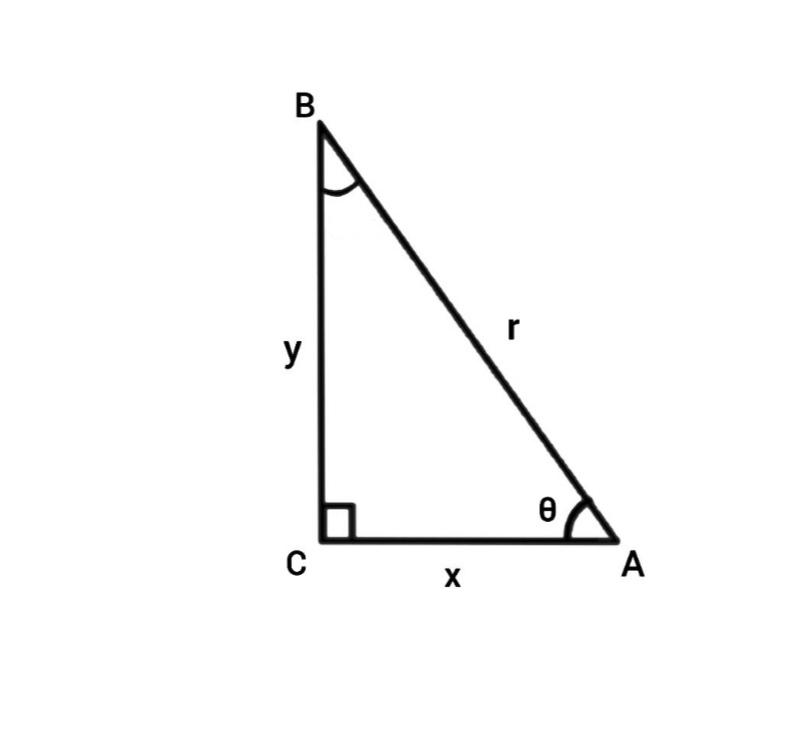
Where \[C\] is the hypotenuse, \[B\] is the base and \[A\] is the perpendicular.
According to Pythagoras theorem,
\[\left({Hypotenuse} \right)^{2} = \left({perpendicular} \right)^{2} + \left({base} \right)^{2}\]
⇒ \[r^{2} = y^{2} + x^{2}\]
Here in the right angle triangle ABC, the longest side of the triangle is the hypotenuse which is \[r\] , the side next to the angle is known as the adjacent which is \[y\] and the side opposite to it is known as the opposite which is \[x\] .
Now, the ratio of the adjacent side of the right angle to the hypotenuse is known as the cosine function.
\[\cos\theta = \dfrac{{adjacent\ side}}{{hypotenuse}}\]
Thus we can conclude that the ratio of adjacent side/hypotenuse is named as cosine function.
Final answer :
The ratio of adjacent side/hypotenuse is named as cosine function.
Note: The concept used to solve the given problem is trigonometric ratios. In order to solve these types of questions, we should have a strong grip over the Pythagoras theorem. Trigonometric identities are nothing but they involve trigonometric functions including variables and constants. Trigonometrically, sine , cosine and tangent are known as the basic functions which we will find on most calculators. The other three functions are secant, cosecant and cotangent which of these are not in usual calculators.
Complete step-by-step answer:
Here we need to know what the ratio of the adjacent side to the hypotenuse is named as.
Pythagoras theorem :
Pythagoras theorem is nothing but it deals with the relationship between the sides of the right angle triangle. It states that in a right angled triangle, the square of the hypotenuse is equal to the sum of the squares of the other two sides.
Let us consider a right angle triangle ABC,
Where \[C\] is the hypotenuse, \[B\] is the base and \[A\] is the perpendicular.
According to Pythagoras theorem,
\[\left({Hypotenuse} \right)^{2} = \left({perpendicular} \right)^{2} + \left({base} \right)^{2}\]
⇒ \[r^{2} = y^{2} + x^{2}\]
Here in the right angle triangle ABC, the longest side of the triangle is the hypotenuse which is \[r\] , the side next to the angle is known as the adjacent which is \[y\] and the side opposite to it is known as the opposite which is \[x\] .
Now, the ratio of the adjacent side of the right angle to the hypotenuse is known as the cosine function.
\[\cos\theta = \dfrac{{adjacent\ side}}{{hypotenuse}}\]
Thus we can conclude that the ratio of adjacent side/hypotenuse is named as cosine function.
Final answer :
The ratio of adjacent side/hypotenuse is named as cosine function.
Note: The concept used to solve the given problem is trigonometric ratios. In order to solve these types of questions, we should have a strong grip over the Pythagoras theorem. Trigonometric identities are nothing but they involve trigonometric functions including variables and constants. Trigonometrically, sine , cosine and tangent are known as the basic functions which we will find on most calculators. The other three functions are secant, cosecant and cotangent which of these are not in usual calculators.
Recently Updated Pages
Master Class 11 English: Engaging Questions & Answers for Success

Master Class 11 Social Science: Engaging Questions & Answers for Success
Master Class 11 Maths: Engaging Questions & Answers for Success
Master Class 11 Biology: Engaging Questions & Answers for Success
Master Class 11 Physics: Engaging Questions & Answers for Success
Master Class 11 Chemistry: Engaging Questions & Answers for Success
Trending doubts
One Metric ton is equal to kg A 10000 B 1000 C 100 class 11 physics CBSE
Difference Between Prokaryotic Cells and Eukaryotic Cells
Find the value of the expression given below sin 30circ class 11 maths CBSE
Difference between physical and chemical change class 11 chemistry CBSE
Two of the body parts which do not appear in MRI are class 11 biology CBSE
Draw a diagram of a plant cell and label at least eight class 11 biology CBSE