




Using integration, find the area of the triangular region bounded by-
$y = 2x + 1, y = 3x + 1 and x = 4.$
Answer
 Verified
638.4k+ views
Hint: Geometrically, definite integration can be used to find the area under the given curve up to the x-axis. We will first find the coordinates of the vertices of the triangle and then find the enclosing area using the formula-
$\mathop \smallint \nolimits_{{\text{x}} = {\text{a}}}^{{\text{x}} = {\text{b}}} {\text{f}}\left( {\text{x}} \right)d{\text{x}} = area$
Complete step-by-step answer:
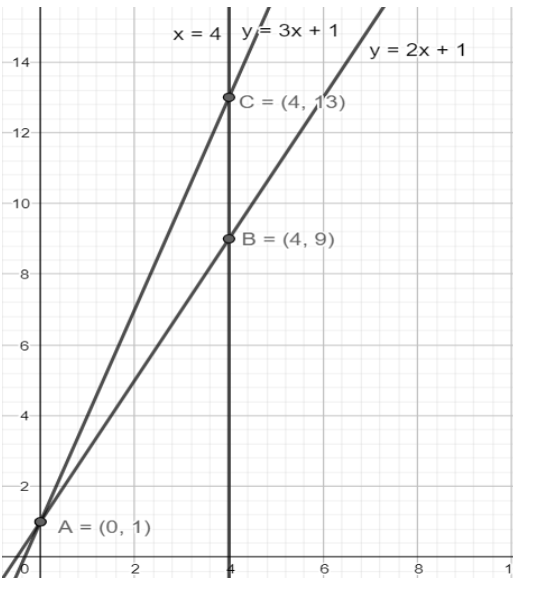
To find the area enclosed by these lines, we will first find the point of intersection of these lines. Let the points be A, B and C respectively.
For point A,
$y = 2x + 1$
$y = 3x + 1$
Subtracting the two equations we get,
$x = 0 $
$y = 2(0) + 1$
$y = 1$
So, the coordinates of A are A(0, 1)
For point B,
$y = 2x + 1$
$x = 4$
Substituting the value of x in the first equation,
$y = 2(4) + 1 = 9$
So, the coordinates of B are B(4, 9)
For point C,
$y = 3x + 1$
$x = 4$
Substituting the value of x in the first equation,
$y = 3(4) + 1 = 13$
So, the coordinates of C are C(4, 13)
Now we have to find the area of the triangle ABC formed by the given lines. By observing the figure, the area of triangle can be calculated as-
Area = area under the line AC - area under the line AB under the limits $x = 0 and x = 4$.
$ = \mathop \smallint \nolimits_0^4 \left( {3x + 1} \right)dx - \mathop \smallint \nolimits_0^4 \left( {2x + 1} \right)dx$
$ = \left( {\dfrac{{3{x^2}}}{2} + x} \right)_0^4 - \left( {\dfrac{{2{x^2}}}{2} + x} \right)_0^4$
$ = \left( {\dfrac{{48}}{2} + 4 - 0} \right) - \left( {\dfrac{{32}}{2} + 4 - 0} \right)$
$ = 24 + 4 - 16 - 4 = 8\;$
Area of the triangular region is 8 sq units. This is the required area.
Note: In such types of questions, we may need to divide the figure into two or more regions as shown in the figure. Also, a diagram is necessary to solve the problem correctly. Alternatively, we can use y-axis as the reference and then find the area of the triangle.
$\mathop \smallint \nolimits_{{\text{x}} = {\text{a}}}^{{\text{x}} = {\text{b}}} {\text{f}}\left( {\text{x}} \right)d{\text{x}} = area$
Complete step-by-step answer:
To find the area enclosed by these lines, we will first find the point of intersection of these lines. Let the points be A, B and C respectively.
For point A,
$y = 2x + 1$
$y = 3x + 1$
Subtracting the two equations we get,
$x = 0 $
$y = 2(0) + 1$
$y = 1$
So, the coordinates of A are A(0, 1)
For point B,
$y = 2x + 1$
$x = 4$
Substituting the value of x in the first equation,
$y = 2(4) + 1 = 9$
So, the coordinates of B are B(4, 9)
For point C,
$y = 3x + 1$
$x = 4$
Substituting the value of x in the first equation,
$y = 3(4) + 1 = 13$
So, the coordinates of C are C(4, 13)
Now we have to find the area of the triangle ABC formed by the given lines. By observing the figure, the area of triangle can be calculated as-
Area = area under the line AC - area under the line AB under the limits $x = 0 and x = 4$.
$ = \mathop \smallint \nolimits_0^4 \left( {3x + 1} \right)dx - \mathop \smallint \nolimits_0^4 \left( {2x + 1} \right)dx$
$ = \left( {\dfrac{{3{x^2}}}{2} + x} \right)_0^4 - \left( {\dfrac{{2{x^2}}}{2} + x} \right)_0^4$
$ = \left( {\dfrac{{48}}{2} + 4 - 0} \right) - \left( {\dfrac{{32}}{2} + 4 - 0} \right)$
$ = 24 + 4 - 16 - 4 = 8\;$
Area of the triangular region is 8 sq units. This is the required area.
Note: In such types of questions, we may need to divide the figure into two or more regions as shown in the figure. Also, a diagram is necessary to solve the problem correctly. Alternatively, we can use y-axis as the reference and then find the area of the triangle.
Recently Updated Pages
Master Class 12 Economics: Engaging Questions & Answers for Success

Master Class 12 English: Engaging Questions & Answers for Success
Master Class 12 Social Science: Engaging Questions & Answers for Success
Master Class 12 Maths: Engaging Questions & Answers for Success
Master Class 12 Physics: Engaging Questions & Answers for Success
Master Class 12 Business Studies: Engaging Questions & Answers for Success
Trending doubts
Draw ray diagrams each showing i myopic eye and ii class 12 physics CBSE
The ratio of E to B in electromagnetic waves is equal class 12 physics CBSE
Sulphuric acid is known as the king of acids State class 12 chemistry CBSE
The atomic mass of potassium is 391 What is the mass class 12 chemistry CBSE
Drive an expression for the electric field due to an class 12 physics CBSE
Short note Soil Erosion class 12 biology CBSE