




Using Heron’s formula, find the area of an isosceles triangle, the measure of one of its equal sides being $a$ units and the third $2b$ units.
(A) $b\sqrt {{a^2} - {b^2}} $ sq.units.
(B) $a\sqrt {{a^2} + {b^2}} $ sq.units.
(C) $a\sqrt {{a^2} - {b^2}} $ sq.units.
(D) $b\sqrt {{a^2} + {b^2}} $ sq.units.
Answer
 Verified
584.7k+ views
Hint: Heron’s formula to determine the area of a triangle is $A = \sqrt {s\left( {s - a} \right)\left( {s - b} \right)\left( {s - c} \right)} $, where $a,{\text{ }}b{\text{ and }}c$ are the sides of the triangle and $s$ is its semi-perimeter. Use this formula for the given isosceles triangle to determine the answer.
Complete step-by-step solution:
According to the question, an isosceles triangle is given such that the length of its equal sides is $a$ units and the length of the third side is $2b$ units. This is shown in the below figure:
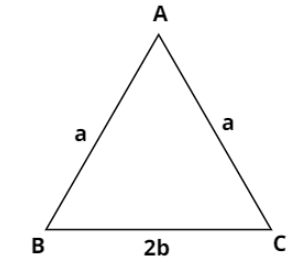
We know that Heron’s formula to determine the area of a triangle is $A = \sqrt {s\left( {s - a} \right)\left( {s - b} \right)\left( {s - c} \right)} $, where $a,{\text{ }}b{\text{ and }}c$ are the sides of the triangle and $s$ is its semi-perimeter. The value of the semi-perimeter of the above triangle is:
$
\Rightarrow s = \dfrac{{a + a + 2b}}{2} \\
\Rightarrow s = \dfrac{{2\left( {a + b} \right)}}{2} \\
\Rightarrow s = a + b
$
Putting the values of semi-perimeter and the lengths of sides of the triangle in Heron’s formula, we’ll get:
$
\Rightarrow A = \sqrt {\left( {a + b} \right)\left( {a + b - 2b} \right)\left( {a + b - a} \right)\left( {a + b - a} \right)} \\
\Rightarrow A = \sqrt {\left( {a + b} \right)\left( {a - b} \right) \cdot b \cdot b}
$
We know that $\left( {a + b} \right)\left( {a - b} \right) = {a^2} - {b^2}$. Using this formula, we’ll get:
$
\Rightarrow A = \sqrt {{b^2}\left( {{a^2} - {b^2}} \right)} \\
\Rightarrow A = b\sqrt {\left( {{a^2} - {b^2}} \right)}
$
Thus the area of the given isosceles triangle is $b\sqrt {\left( {{a^2} - {b^2}} \right)} $ sq.units.
(A) is the correct option.
Note: The general formula for finding the area of a triangle is given as:
$ \Rightarrow A = \dfrac{1}{2} \times {\text{base}} \times {\text{height}}$
If $a$ and $b$ are the lengths of two sides of a triangle and $\theta $ is the angle between them as shown in the below figure, the area of the triangle is:
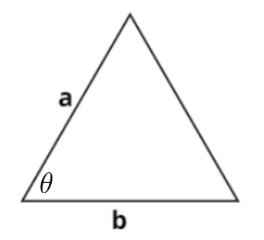
$ \Rightarrow A = \dfrac{1}{2} \times a \times b\sin \theta $
Complete step-by-step solution:
According to the question, an isosceles triangle is given such that the length of its equal sides is $a$ units and the length of the third side is $2b$ units. This is shown in the below figure:
We know that Heron’s formula to determine the area of a triangle is $A = \sqrt {s\left( {s - a} \right)\left( {s - b} \right)\left( {s - c} \right)} $, where $a,{\text{ }}b{\text{ and }}c$ are the sides of the triangle and $s$ is its semi-perimeter. The value of the semi-perimeter of the above triangle is:
$
\Rightarrow s = \dfrac{{a + a + 2b}}{2} \\
\Rightarrow s = \dfrac{{2\left( {a + b} \right)}}{2} \\
\Rightarrow s = a + b
$
Putting the values of semi-perimeter and the lengths of sides of the triangle in Heron’s formula, we’ll get:
$
\Rightarrow A = \sqrt {\left( {a + b} \right)\left( {a + b - 2b} \right)\left( {a + b - a} \right)\left( {a + b - a} \right)} \\
\Rightarrow A = \sqrt {\left( {a + b} \right)\left( {a - b} \right) \cdot b \cdot b}
$
We know that $\left( {a + b} \right)\left( {a - b} \right) = {a^2} - {b^2}$. Using this formula, we’ll get:
$
\Rightarrow A = \sqrt {{b^2}\left( {{a^2} - {b^2}} \right)} \\
\Rightarrow A = b\sqrt {\left( {{a^2} - {b^2}} \right)}
$
Thus the area of the given isosceles triangle is $b\sqrt {\left( {{a^2} - {b^2}} \right)} $ sq.units.
(A) is the correct option.
Note: The general formula for finding the area of a triangle is given as:
$ \Rightarrow A = \dfrac{1}{2} \times {\text{base}} \times {\text{height}}$
If $a$ and $b$ are the lengths of two sides of a triangle and $\theta $ is the angle between them as shown in the below figure, the area of the triangle is:
$ \Rightarrow A = \dfrac{1}{2} \times a \times b\sin \theta $
Recently Updated Pages
Master Class 9 Social Science: Engaging Questions & Answers for Success

Master Class 9 Science: Engaging Questions & Answers for Success
Master Class 9 Maths: Engaging Questions & Answers for Success
Master Class 9 General Knowledge: Engaging Questions & Answers for Success
Class 9 Question and Answer - Your Ultimate Solutions Guide
Master Class 8 Social Science: Engaging Questions & Answers for Success
Trending doubts
Find the sum of series 1 + 2 + 3 + 4 + 5 + + 100 class 9 maths CBSE
What is the Full Form of ISI and RAW
Fill the blanks with the suitable prepositions 1 The class 9 english CBSE
Difference Between Plant Cell and Animal Cell
Who is eligible for RTE class 9 social science CBSE
What is pollution? How many types of pollution? Define it