



Using a protractor, draw an angle of measure \[72^\circ \]. With this angle as given, draw angles of measure \[36^\circ \] and \[54^\circ \].
Answer
 Verified
594.6k+ views
Hint: Here, we will draw an angle ABC of \[72^\circ \] with the help of a protractor. Then with a center B and any radius, we will draw an arc, which intersect AB at D and BC at E and center D and E and radius more than \[\dfrac{{{\text{DE}}}}{2}\] and then draw two arcs which intersect each other at F. Then we will Join FB, which intersect the arc at G. So with centers D and G and radius more than \[\dfrac{{{\text{DE}}}}{2}\] and we will draw two arcs which intersect each other at F. Now with centers D and G and radius more than \[\dfrac{{{\text{DG}}}}{2}\] draw two arcs, which intersect each other at H and we will join HB to find the required angles.
Complete step-by-step answer:
First, we will draw an angle ABC of \[72^\circ \] with the help of a protractor.

Then with a center B and any radius, we will draw an arc, which intersects AB at D and BC at E.
With center D and E and radius more than \[\dfrac{{{\text{DE}}}}{2}\] and then draw two arcs which intersect each other at F.
Then we will Join FB, which intersects the arc at G.
So with centers D and G and radius more than \[\dfrac{{{\text{DE}}}}{2}\] and we will draw two arcs which intersect each other at F.
Now with centers D and G and radius more than \[\dfrac{{{\text{DG}}}}{2}\] draw two arcs which intersect each other at H.
Joining HB, we get
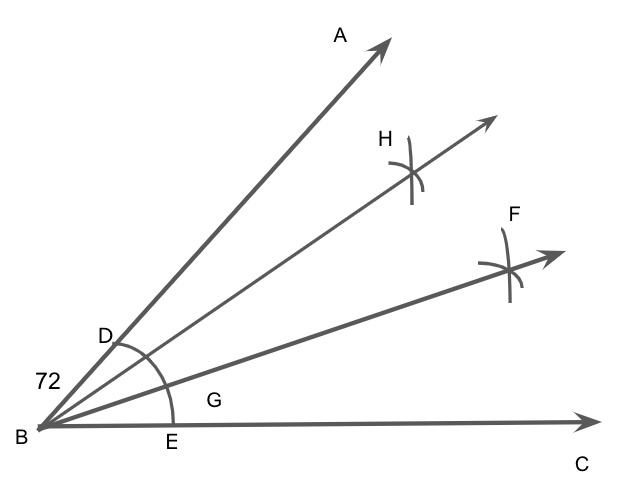
Therefore this implies that \[\angle HBC = 54^\circ \] and \[\angle FBC = 36^\circ \].
Note: The crucial part of this problem is to use the compass properly. One needs to know the basic rules and way of using a compass. We will verify our angle by using the protractor and putting it on the line BC with B as a center. This is a simple problem, we have to be careful with the labeling of the arcs as well.
Complete step-by-step answer:
First, we will draw an angle ABC of \[72^\circ \] with the help of a protractor.
Then with a center B and any radius, we will draw an arc, which intersects AB at D and BC at E.
With center D and E and radius more than \[\dfrac{{{\text{DE}}}}{2}\] and then draw two arcs which intersect each other at F.
Then we will Join FB, which intersects the arc at G.
So with centers D and G and radius more than \[\dfrac{{{\text{DE}}}}{2}\] and we will draw two arcs which intersect each other at F.
Now with centers D and G and radius more than \[\dfrac{{{\text{DG}}}}{2}\] draw two arcs which intersect each other at H.
Joining HB, we get
Therefore this implies that \[\angle HBC = 54^\circ \] and \[\angle FBC = 36^\circ \].
Note: The crucial part of this problem is to use the compass properly. One needs to know the basic rules and way of using a compass. We will verify our angle by using the protractor and putting it on the line BC with B as a center. This is a simple problem, we have to be careful with the labeling of the arcs as well.

Recently Updated Pages
The branch of science which deals with nature and natural class 10 physics CBSE

Understanding the Sun's Density: Exploring the Mass Density of a Hot Plasma - FAQs and Data Analysis
Where is the Centre for Environmental Education Located?
How is Abiogenesis Theory Disproved Experimentally?
Which country won UEFA Euro 2020 tournament (played in 2021)?
In a plane electromagnetic wave the electric field class 12 physics CBSE
Trending doubts
What were the major teachings of Baba Guru Nanak class 7 social science CBSE
Aeroplanes fly in which of the following layers of class 7 social science CBSE
Write a letter to the editor of the national daily class 7 english CBSE
The plural of Chief is Chieves A True B False class 7 english CBSE
What are the controls affecting the climate of Ind class 7 social science CBSE
What do you mean by Voters list What is its signif class 7 social science CBSE