



What is used by chlorophyll containing cells of leaves to synthesize carbohydrates during photosynthesis?
A. Carbon dioxide
B. Water
C. Carbon dioxide and water
D. None of the above
Answer
 Verified
504.9k+ views
Hint: Chloroplasts are small organelles present inside the plant cell, which store the energy of sunlight. In chloroplast, within the thylakoid membrane, there is a light-absorbing pigment called chlorophyll. During the process of photosynthesis, chlorophyll absorbs energy from blue-light waves, and red-light waves, and reflects green-light waves. Thus, it is responsible for providing a green color to the plant.
Complete answer:
Photosynthesis is a process, through which green plants prepare carbohydrates from water and carbon dioxide in the presence of sunlight.
The balanced equation can be written as follows:
\[6CO_2 + 6H_2O \to C_6H_{12}O_6 + 6O_2\]
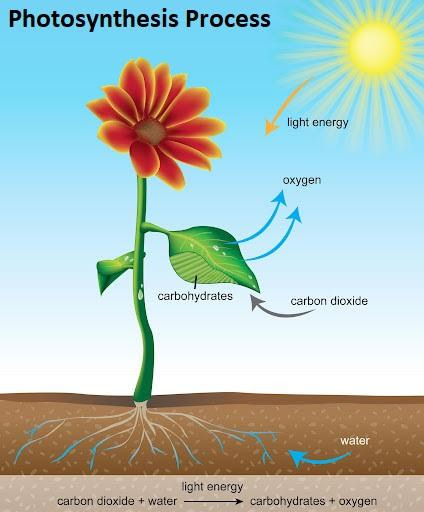
Fig: Components involved in Photosynthesis
Carbon dioxide and water are the reactants and glucose and oxygen are the products in the process. Water is transformed into oxygen and carbohydrate is stored as glucose in the process. Glucose is a main product and oxygen byproduct and both are needed for respiration.
As evident from the equation, both carbon dioxide and water are involved in the process.
Therefore, Option (C) is correct.
Additional Information
Option (A) Carbon dioxide: Carbon dioxide is not the only reactant involved in the process.
So, Option (A) is not correct
Option (B) Water: In this case also, water is not the only reactant involved in the process.
Hence, Option (B) is not correct
Option (D) None of the above: As water and carbon dioxide are involved, this option looks improbable.
Option D is not correct
Note:
During the light reaction, chlorophyll absorbs light energy, which splits water, yielding hydrogen ions and oxygen gas. Chloroplast utilizes the hydrogen ions, producing ATP molecules. During the dark reaction or Calvin cycle, chloroplast exploits the carbon from carbon dioxide, producing three-carbon molecules, which are assembled into glucose.
Complete answer:
Photosynthesis is a process, through which green plants prepare carbohydrates from water and carbon dioxide in the presence of sunlight.
The balanced equation can be written as follows:
\[6CO_2 + 6H_2O \to C_6H_{12}O_6 + 6O_2\]
Fig: Components involved in Photosynthesis
Carbon dioxide and water are the reactants and glucose and oxygen are the products in the process. Water is transformed into oxygen and carbohydrate is stored as glucose in the process. Glucose is a main product and oxygen byproduct and both are needed for respiration.
As evident from the equation, both carbon dioxide and water are involved in the process.
Therefore, Option (C) is correct.
Additional Information
Option (A) Carbon dioxide: Carbon dioxide is not the only reactant involved in the process.
So, Option (A) is not correct
Option (B) Water: In this case also, water is not the only reactant involved in the process.
Hence, Option (B) is not correct
Option (D) None of the above: As water and carbon dioxide are involved, this option looks improbable.
Option D is not correct
Note:
During the light reaction, chlorophyll absorbs light energy, which splits water, yielding hydrogen ions and oxygen gas. Chloroplast utilizes the hydrogen ions, producing ATP molecules. During the dark reaction or Calvin cycle, chloroplast exploits the carbon from carbon dioxide, producing three-carbon molecules, which are assembled into glucose.
Recently Updated Pages
Master Class 12 Business Studies: Engaging Questions & Answers for Success

Master Class 12 Biology: Engaging Questions & Answers for Success
Master Class 12 Chemistry: Engaging Questions & Answers for Success
Class 12 Question and Answer - Your Ultimate Solutions Guide
Master Class 11 Social Science: Engaging Questions & Answers for Success
Master Class 11 English: Engaging Questions & Answers for Success
Trending doubts
Find the sum of series 1 + 2 + 3 + 4 + 5 + + 100 class 9 maths CBSE
Fill the blanks with the suitable prepositions 1 The class 9 english CBSE
Difference Between Plant Cell and Animal Cell
How many hours before the closure of election must class 9 social science CBSE
What is pollution? How many types of pollution? Define it
Name 10 Living and Non living things class 9 biology CBSE