




How do you use transformation to graph the cosine function and determine the amplitude and period of \[y = - \cos \left( {x - \dfrac{\pi }{4}} \right)\] ?
Answer
 Verified
551.4k+ views
Hint: Here in this question, we have to find the period, amplitude and graph of given sine function. Use the form \[a\cos \left( {bx - c} \right) + d\] to Find the amplitude = \[\left| a \right|\] , then Find the period using the formula \[\dfrac{{2\pi }}{{\left| b \right|}}\] and draw a sketch or graph for the co-ordinates \[\left( {x,y} \right)\] by the giving the \[x\] value as 0, 1, 2, 3… we can easily find the value of y by using the given expression.
Complete step-by-step answer:
Let's use the form of the equation i.e., \[a\cos \left( {bx - c} \right) + d\] to find the variables used to find the amplitude, and period.
Now consider the given expression \[y = - \cos \left( {x - \dfrac{\pi }{4}} \right)\]
Where,
\[a = - 1\]
\[b = 1\]
\[c = \dfrac{\pi }{4}\]
\[d = 0\]
The Amplitude is the height from the centre line to the peak (or to the trough). Or we can measure the height from highest to lowest points and divide that by 2.
To Find the amplitude = \[\left| a \right|\] .
\[ \Rightarrow \,\,\] Amplitude \[ = \left| a \right| = \left| { - 1} \right| = 1\]
Period is the complete revolution of a wave completing crest and followed by trough.
Otherwise
The Period goes from one peak to the next (or from any point to the next matching point):
Find the period using the formula \[\dfrac{{2\pi }}{{\left| b \right|}}\]
\[ \Rightarrow \,\,\] Period \[ = \dfrac{{2\pi }}{{\left| b \right|}} = \dfrac{{2\pi }}{{\left| 1 \right|}}\, = 2\pi \]
Sketch or graph we can draw by using the coordinates
For coordinates, giving the x values 0, 1, 2, 3… simultaneously to the given equation to get the values of y
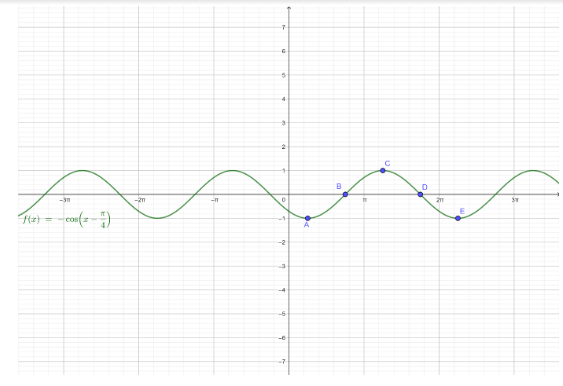
The sketch of the given function \[y = - \cos \left( {x - \dfrac{\pi }{4}} \right)\] is:
Note: The period is the length of the smallest interval that contains exactly one copy of the repeating pattern. The Amplitude is the height from the centre line to the peak. We use the form of equation i.e., \[a\sin \left( {bx - c} \right) + d\] and we have formula for the period and amplitude and hence we determine the values.
Complete step-by-step answer:
Let's use the form of the equation i.e., \[a\cos \left( {bx - c} \right) + d\] to find the variables used to find the amplitude, and period.
Now consider the given expression \[y = - \cos \left( {x - \dfrac{\pi }{4}} \right)\]
Where,
\[a = - 1\]
\[b = 1\]
\[c = \dfrac{\pi }{4}\]
\[d = 0\]
The Amplitude is the height from the centre line to the peak (or to the trough). Or we can measure the height from highest to lowest points and divide that by 2.
To Find the amplitude = \[\left| a \right|\] .
\[ \Rightarrow \,\,\] Amplitude \[ = \left| a \right| = \left| { - 1} \right| = 1\]
Period is the complete revolution of a wave completing crest and followed by trough.
Otherwise
The Period goes from one peak to the next (or from any point to the next matching point):
Find the period using the formula \[\dfrac{{2\pi }}{{\left| b \right|}}\]
\[ \Rightarrow \,\,\] Period \[ = \dfrac{{2\pi }}{{\left| b \right|}} = \dfrac{{2\pi }}{{\left| 1 \right|}}\, = 2\pi \]
Sketch or graph we can draw by using the coordinates
For coordinates, giving the x values 0, 1, 2, 3… simultaneously to the given equation to get the values of y
| \[x\] | \[\dfrac{\pi }{4}\] | \[\dfrac{{3\pi }}{4}\] | \[\dfrac{{5\pi }}{4}\] | \[\dfrac{{7\pi }}{4}\] | \[\dfrac{{9\pi }}{4}\] |
| \[y = - \cos \left( {x - \dfrac{\pi }{4}} \right)\] | \[ - 1\] | \[0\] | \[1\] | \[0\] | \[ - 1\] |
| \[\left( {x,y} \right)\] | \[\left( {\dfrac{\pi }{4}, - 1} \right)\] | \[\left( {\dfrac{{3\pi }}{4},0} \right)\] | \[\left( {\dfrac{{5\pi }}{4},1} \right)\] | \[\left( {\dfrac{{7\pi }}{4},0} \right)\] | \[\left( {\dfrac{{9\pi }}{4}, - 1} \right)\] |
The sketch of the given function \[y = - \cos \left( {x - \dfrac{\pi }{4}} \right)\] is:
Note: The period is the length of the smallest interval that contains exactly one copy of the repeating pattern. The Amplitude is the height from the centre line to the peak. We use the form of equation i.e., \[a\sin \left( {bx - c} \right) + d\] and we have formula for the period and amplitude and hence we determine the values.
Recently Updated Pages
Understanding the Sun's Density: Exploring the Mass Density of a Hot Plasma - FAQs and Data Analysis

The magnetic field in a plane electromagnetic wave class 11 physics CBSE
The branch of science which deals with nature and natural class 10 physics CBSE
Where is the Centre for Environmental Education Located?
How is Abiogenesis Theory Disproved Experimentally?
Which country won UEFA Euro 2020 tournament (played in 2021)?
Trending doubts
One Metric ton is equal to kg A 10000 B 1000 C 100 class 11 physics CBSE
What are the examples of C3 and C4 plants class 11 biology CBSE
What is charge mass and charge to mass ratio of an class 11 chemistry CBSE
State and prove Bernoullis theorem class 11 physics CBSE
Difference Between Prokaryotic Cells and Eukaryotic Cells
1 ton equals to A 100 kg B 1000 kg C 10 kg D 10000 class 11 physics CBSE