




Use the unit circle to derive \[\sin \left( {2\pi - \theta } \right)\].
Answer
 Verified
597.3k+ views
Hint: An unit circle is a circle of radius \[1\] unit whose various arc lengths determine the values of trigonometric functions.
Complete step by step solution:
A unit circle is a circle of radius \[1\] unit. For every real number \[x\] represented by a point \[P\] on the real axis, there exists a point \[P'\] on the unit circle with the center at the origin of the coordinate system such that the radian measure of \[\angle AOP\] is \[x\] so the arc length \[AP\] \[ = \] \[x\].
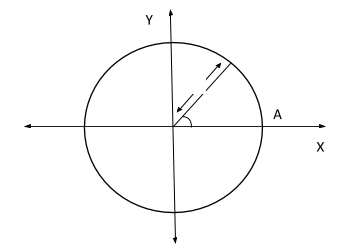
Then on the unit circle we define cosine and sine functions of radian measure (for any real number \[x\]) as:
\[\cos x = a\], \[\sin x = b\]
Now you have to find the value of \[\sin \left( {2\pi - \theta } \right)\]:
Using the formula:
\[\sin \left( {a - b} \right)\] \[ = \] \[\sin a\cos b - \cos a\sin b\]
Find \[\sin (2\pi - \theta )\]:
\[\sin (2\pi - \theta )\] \[ = \] \[\sin 2\pi \cos \theta - \cos 2\pi \sin \theta \]
\[ \Rightarrow \] \[\sin (2\pi - \theta )\] \[ = \] \[0 - \sin \theta \]
\[ \Rightarrow \] \[\sin (2\pi - \theta )\] \[ = \] \[ - \sin \theta \]
In the first step it is already shown how to find the value of \[\sin \theta \] for any real \[\theta \] from the unit circle then the negative of that will be equal to the value of \[\sin \left( {2\pi - \theta } \right)\].
Note: Students must remember the following conversions:
\[\sin \left( {2\pi - \theta } \right)\] \[ = \] \[ - \sin \theta \]
\[\sin \left( {2\pi + \theta } \right)\] \[ = \] \[\sin \theta \]
\[\sin \left( {\pi - \theta } \right)\] \[ = \] \[\sin \theta \]
\[\sin \left( {\pi + \theta } \right)\] \[ = \] \[ - \sin \theta \]
The same conversations must also be remembered for other trigonometric functions. The derivations as shown in the solution must be done for understanding but memorising the conversions are useful for quick application.
Complete step by step solution:
A unit circle is a circle of radius \[1\] unit. For every real number \[x\] represented by a point \[P\] on the real axis, there exists a point \[P'\] on the unit circle with the center at the origin of the coordinate system such that the radian measure of \[\angle AOP\] is \[x\] so the arc length \[AP\] \[ = \] \[x\].
Then on the unit circle we define cosine and sine functions of radian measure (for any real number \[x\]) as:
\[\cos x = a\], \[\sin x = b\]
Now you have to find the value of \[\sin \left( {2\pi - \theta } \right)\]:
Using the formula:
\[\sin \left( {a - b} \right)\] \[ = \] \[\sin a\cos b - \cos a\sin b\]
Find \[\sin (2\pi - \theta )\]:
\[\sin (2\pi - \theta )\] \[ = \] \[\sin 2\pi \cos \theta - \cos 2\pi \sin \theta \]
\[ \Rightarrow \] \[\sin (2\pi - \theta )\] \[ = \] \[0 - \sin \theta \]
\[ \Rightarrow \] \[\sin (2\pi - \theta )\] \[ = \] \[ - \sin \theta \]
In the first step it is already shown how to find the value of \[\sin \theta \] for any real \[\theta \] from the unit circle then the negative of that will be equal to the value of \[\sin \left( {2\pi - \theta } \right)\].
Note: Students must remember the following conversions:
\[\sin \left( {2\pi - \theta } \right)\] \[ = \] \[ - \sin \theta \]
\[\sin \left( {2\pi + \theta } \right)\] \[ = \] \[\sin \theta \]
\[\sin \left( {\pi - \theta } \right)\] \[ = \] \[\sin \theta \]
\[\sin \left( {\pi + \theta } \right)\] \[ = \] \[ - \sin \theta \]
The same conversations must also be remembered for other trigonometric functions. The derivations as shown in the solution must be done for understanding but memorising the conversions are useful for quick application.
Recently Updated Pages
Master Class 11 English: Engaging Questions & Answers for Success

Master Class 11 Social Science: Engaging Questions & Answers for Success
Master Class 11 Maths: Engaging Questions & Answers for Success
Master Class 11 Biology: Engaging Questions & Answers for Success
Master Class 11 Physics: Engaging Questions & Answers for Success
Master Class 11 Chemistry: Engaging Questions & Answers for Success
Trending doubts
One Metric ton is equal to kg A 10000 B 1000 C 100 class 11 physics CBSE
Difference Between Prokaryotic Cells and Eukaryotic Cells
Two of the body parts which do not appear in MRI are class 11 biology CBSE
Find the value of the expression given below sin 30circ class 11 maths CBSE
Draw a diagram of a plant cell and label at least eight class 11 biology CBSE
10 examples of friction in our daily life