




How do you use the Law of Cosines and Sines in various ambiguous cases?
Answer
 Verified
570.6k+ views
Hint: Here in this question we have been asked to explain how we use the Law of Cosines and Sines in various ambiguous cases. The Law of Cosines and Sines is generally used if at least any three elements of the triangle elements (except the case the three elements are the three angles, in that case the triangle is not unique) are known to us.
Complete step by step solution:
Now considering from the question we have been asked to explain how we use the Law of Cosines and Sines in various ambiguous cases.
From the basic concepts of triangles we know that the Law of Cosines and Sines is generally used if at least any three elements of the triangle elements (except the case the three elements are the three angles, in that case the triangle is not unique) are known to us.
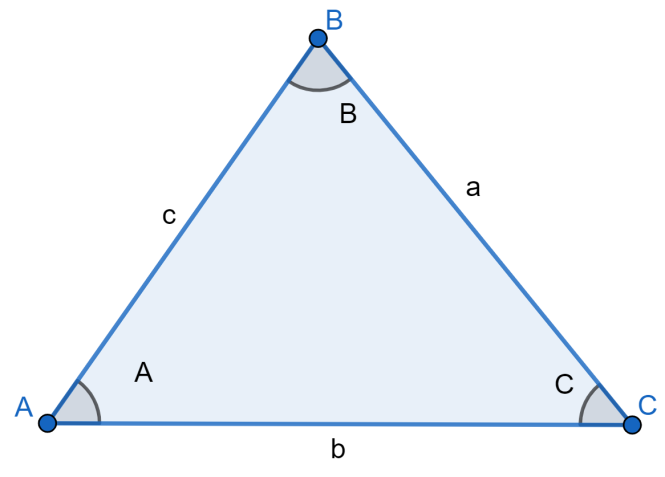
The Law of Cosines is used when we are aware of two sides and their enclosed angle. In all other cases we use the Law of Sines.
The Law of Sines establishes a relationship between the angles and the side lengths of $\Delta ABC$ given as \[\dfrac{a}{\sin A}=\dfrac{b}{\sin B}=\dfrac{c}{\sin C}\] .
The Law of Cosines establishes a relationship between the angles and the side lengths of $\Delta ABC$ given as
$\begin{align}
& {{c}^{2}}={{a}^{2}}+{{b}^{2}}-2ab\cos C \\
& {{a}^{2}}={{b}^{2}}+{{c}^{2}}-2bc\cos A \\
& {{b}^{2}}={{a}^{2}}+{{c}^{2}}-2ac\cos B \\
\end{align}$ .
Note: While answering questions of this type we should be sure with the concepts that we are going to apply. This is a very simple and easy question and can be answered accurately in a short span of time. This is a completely theoretical based question and it can be answered if we have a basic concept. Very few mistakes are possible in questions of this type. If someone has confused and written Law of Cosines for Law of Sines and vice-versa then they will end up having a wrong conclusion.
Complete step by step solution:
Now considering from the question we have been asked to explain how we use the Law of Cosines and Sines in various ambiguous cases.
From the basic concepts of triangles we know that the Law of Cosines and Sines is generally used if at least any three elements of the triangle elements (except the case the three elements are the three angles, in that case the triangle is not unique) are known to us.
The Law of Cosines is used when we are aware of two sides and their enclosed angle. In all other cases we use the Law of Sines.
The Law of Sines establishes a relationship between the angles and the side lengths of $\Delta ABC$ given as \[\dfrac{a}{\sin A}=\dfrac{b}{\sin B}=\dfrac{c}{\sin C}\] .
The Law of Cosines establishes a relationship between the angles and the side lengths of $\Delta ABC$ given as
$\begin{align}
& {{c}^{2}}={{a}^{2}}+{{b}^{2}}-2ab\cos C \\
& {{a}^{2}}={{b}^{2}}+{{c}^{2}}-2bc\cos A \\
& {{b}^{2}}={{a}^{2}}+{{c}^{2}}-2ac\cos B \\
\end{align}$ .
Note: While answering questions of this type we should be sure with the concepts that we are going to apply. This is a very simple and easy question and can be answered accurately in a short span of time. This is a completely theoretical based question and it can be answered if we have a basic concept. Very few mistakes are possible in questions of this type. If someone has confused and written Law of Cosines for Law of Sines and vice-versa then they will end up having a wrong conclusion.
Recently Updated Pages
Master Class 12 Economics: Engaging Questions & Answers for Success

Master Class 12 English: Engaging Questions & Answers for Success
Master Class 12 Social Science: Engaging Questions & Answers for Success
Master Class 12 Maths: Engaging Questions & Answers for Success
Master Class 12 Physics: Engaging Questions & Answers for Success
Master Class 10 English: Engaging Questions & Answers for Success
Trending doubts
Explain the Treaty of Vienna of 1815 class 10 social science CBSE
Why is it 530 pm in india when it is 1200 afternoon class 10 social science CBSE
What is the full form of POSCO class 10 social science CBSE
Define Potential, Developed, Stock and Reserved resources
The speaker of the Lok Sabha is elected by the APresident class 10 social science CBSE
Complete the sentence with the most appropriate word class 10 english CBSE