




How do you use Pascal’s triangle to expand${(2x - y)^3}$?
Answer
 Verified
550.8k+ views
Hint: Pascal’s triangle is an infinite equilateral triangle which consists of a sequence of numbers. It starts with 1. That means the first row is one. Then, the second row consist of the sum of two numbers above it. Similarly, we will find out the values of next rows. This creates a pattern of numbers as shown below.
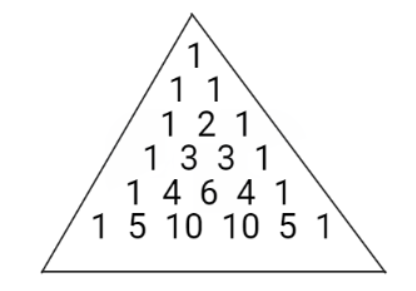
The main application of this triangle is to solve a binomial function. The triangle represents the coefficients of the binomial expansion. If the binomial equation is ${\left( {a + b} \right)^n}$. Then the expansion is ${C_1}{a^n}{b^0} + {C_2}{a^{n - 1}}{b^1} + ..... + {C_n}{a^0}{b^n}$, where ${C_1},{C_2},....,{C_n}$are the coefficients derived from the triangle .
Complete step by step answer:
We first derive the coefficients from the triangle where $n = 3$, which is depicted below:
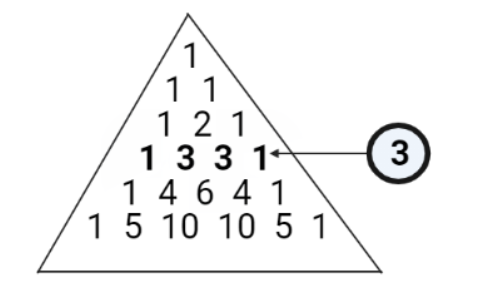
Hence we get, ${(a + b)^3} = 1{a^3}{b^0} + 3{a^2}{b^1} + 3{a^1}{b^2} + 1{a^0}{b^3}$
After substituting the value we get,
$
{(2x - 3y)^3} = 1{(2x)^3}{( - 3y)^0} + 3{(2x)^2}{( - 3y)^1} + 3{(2x)^1}{( - 3y)^2} + 1{(2x)^0}{( - 3y)^3} \\
{(2x - 3y)^3} = 8{x^3}.1 + 3(4{x^2})( - 3y) + 3(2x)(9{y^2}) + 1.1( - 27{y^3}) \\
{(2x - 3y)^3} = 8{x^3} - 36{x^2}y + 54x{y^2} - 27{y^3} \\
$
Hence, the expansion of ${(2x - y)^3}$ is $8{x^3} - 36{x^2}y + 54x{y^2} - 27{y^3}$.
Note: The Pascal’s triangle is helpful only when the value of $n$is small in the equation ${\left( {a + b} \right)^n}$. If the value of $n$is large , then it's tedious to draw the triangle until we reach n. Then, we should use combinations to expand the binomial expression.
The main application of this triangle is to solve a binomial function. The triangle represents the coefficients of the binomial expansion. If the binomial equation is ${\left( {a + b} \right)^n}$. Then the expansion is ${C_1}{a^n}{b^0} + {C_2}{a^{n - 1}}{b^1} + ..... + {C_n}{a^0}{b^n}$, where ${C_1},{C_2},....,{C_n}$are the coefficients derived from the triangle .
Complete step by step answer:
We first derive the coefficients from the triangle where $n = 3$, which is depicted below:
Hence we get, ${(a + b)^3} = 1{a^3}{b^0} + 3{a^2}{b^1} + 3{a^1}{b^2} + 1{a^0}{b^3}$
After substituting the value we get,
$
{(2x - 3y)^3} = 1{(2x)^3}{( - 3y)^0} + 3{(2x)^2}{( - 3y)^1} + 3{(2x)^1}{( - 3y)^2} + 1{(2x)^0}{( - 3y)^3} \\
{(2x - 3y)^3} = 8{x^3}.1 + 3(4{x^2})( - 3y) + 3(2x)(9{y^2}) + 1.1( - 27{y^3}) \\
{(2x - 3y)^3} = 8{x^3} - 36{x^2}y + 54x{y^2} - 27{y^3} \\
$
Hence, the expansion of ${(2x - y)^3}$ is $8{x^3} - 36{x^2}y + 54x{y^2} - 27{y^3}$.
Note: The Pascal’s triangle is helpful only when the value of $n$is small in the equation ${\left( {a + b} \right)^n}$. If the value of $n$is large , then it's tedious to draw the triangle until we reach n. Then, we should use combinations to expand the binomial expression.
Recently Updated Pages
Master Class 11 Social Science: Engaging Questions & Answers for Success

Master Class 11 Physics: Engaging Questions & Answers for Success
Master Class 11 Maths: Engaging Questions & Answers for Success
Master Class 11 Economics: Engaging Questions & Answers for Success
Master Class 11 Computer Science: Engaging Questions & Answers for Success
Master Class 11 Chemistry: Engaging Questions & Answers for Success
Trending doubts
One Metric ton is equal to kg A 10000 B 1000 C 100 class 11 physics CBSE
There are 720 permutations of the digits 1 2 3 4 5 class 11 maths CBSE
1 Quintal is equal to a 110 kg b 10 kg c 100kg d 1000 class 11 physics CBSE
State and prove Bernoullis theorem class 11 physics CBSE
Difference Between Prokaryotic Cells and Eukaryotic Cells
Which among the following are examples of coming together class 11 social science CBSE