




How do I use Pascal's triangle to expand ${{\left( x+2 \right)}^{5}}$ ?
Answer
 Verified
571.8k+ views
Hint: To solve these types of questions which are given above ${{\left( x+2 \right)}^{5}}$ we will use a binomial expansion formula. In elementary algebra, the binomial expansion describes the algebraic expansion of powers of binomials.
Complete step by step solution:
The formula of binomial expansion is: ${{\left( a+b \right)}^{n}}{{=}^{n}}{{c}_{0}}{{a}^{n}}{{b}^{0}}{{+}^{n}}{{c}_{1}}{{a}^{n-1}}{{b}^{1}}+...............{{+}^{n}}{{c}_{n}}{{a}^{0}}{{b}^{n}}$ where $a$ and \[b\] are integers and the $^{n}{{c}_{k}}=\dfrac{n!}{k!\left( n-k \right)!}$, where $n$ is equal to power of the expansion and $k$ is equal to picks and this is the combinations general formula. So we can also write binomial expansion by putting the values of combinations. Therefore the formula becomes: ${{\left( a+b \right)}^{n}}={{a}^{n}}+n{{a}^{n-1}}b+\dfrac{n\left( n-1 \right)}{2!}{{b}^{2}}{{a}^{n-2}}+..........+{{b}^{n}}$. So by using this above expression we will solve our given expression${{\left( x+2 \right)}^{5}}$. Now we will expand this expression by using this ${{\left( a+b \right)}^{n}}={{a}^{n}}+n{{a}^{n-1}}b+\dfrac{n\left( n-1 \right)}{2!}{{b}^{2}}{{a}^{n-2}}+..........+{{b}^{n}}$ we get,
$\Rightarrow {{\left( x+2 \right)}^{5}}={{x}^{5}}+5{{x}^{4}}\cdot 2+\dfrac{5\left( 5-1 \right)}{2!}{{x}^{3}}{{\left( 2 \right)}^{2}}+\dfrac{5\left( 5-1 \right)}{2!}{{x}^{2}}{{\left( 2 \right)}^{3}}+5x{{\left( 2 \right)}^{4}}+\left( {{2}^{5}} \right)$ $\Rightarrow {{\left( x+2 \right)}^{5}}={{x}^{5}}+10{{x}^{4}}+10\cdot 4{{x}^{3}}+10\cdot 8{{x}^{2}}+5\cdot 16x+32$ $ {{\left( x+2 \right)}^{5}}={{x}^{5}}+10{{x}^{4}}+40{{x}^{3}}+80{{x}^{2}}+80x+32$
Hence we get the expanded form of given expression ${{\left( x+2 \right)}^{5}}$ which is, ${{\left( x+2 \right)}^{5}}={{x}^{5}}+10{{x}^{4}}+40{{x}^{3}}+80{{x}^{2}}+80x+32$
We can also solve the above expression by using direct Pascal's triangle formula. Pascal's triangle is a never ending equilateral triangle of numbers that follows a rule of adding the two numbers above to get the number below. Here two of the sides are “all $1\grave{\ }s''$ and because the triangle is infinite, there is no “bottom side”.
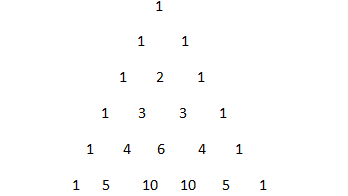
The 5th row of Pascal's triangle is: $1,5,10,10,5,1$. These values are the coefficients in a binomial expansion to the 5th power:
$\Rightarrow {{\left( a+b \right)}^{5}}={{a}^{5}}+5{{a}^{4}}b+10{{a}^{3}}{{b}^{2}}+10{{a}^{2}}{{b}^{3}}+5a{{b}^{4}}+{{b}^{5}}$
Notice this pattern of the exponents: the exponents of $a$ starts at $5$ and goes to $0$ and $b$ starts at $0$ and goes to $5$.
We will apply this in rule ${{\left( a+b \right)}^{5}}={{a}^{5}}+5{{a}^{4}}b+10{{a}^{3}}{{b}^{2}}+10{{a}^{2}}{{b}^{3}}+5a{{b}^{4}}+{{b}^{5}}$ to solve ${{\left( x+2 \right)}^{5}}$:
$\begin{align}
& \Rightarrow {{\left( x+2 \right)}^{5}}={{x}^{5}}+5{{x}^{4}}\left( 2 \right)+10{{x}^{^{3}}}{{\left( 2 \right)}^{2}}+10{{x}^{2}}{{\left( 2 \right)}^{3}}+5x{{\left( 2 \right)}^{4}}+{{2}^{5}} \\
& \Rightarrow {{x}^{5}}+10{{x}^{4}}+40{{x}^{3}}+80{{x}^{2}}+80x+32 \\
\end{align}$
Hence by using the binomial expansion formula ${{\left( a+b \right)}^{n}}{{=}^{n}}{{c}_{0}}{{a}^{n}}{{b}^{0}}{{+}^{n}}{{c}_{1}}{{a}^{n-1}}{{b}^{1}}+...............{{+}^{n}}{{c}_{n}}{{a}^{0}}{{b}^{n}}$ we get the expansion of ${{\left( x+2 \right)}^{5}}$is ${{x}^{5}}+10{{x}^{4}}+40{{x}^{3}}+80{{x}^{2}}+80x+32$
Note:
Here we can go wrong by writing the wrong binomial expansion formula, sometimes students make mistakes in the powers of $a$and b. Therefore by using the above two methods binomial expansion and Pascal's triangle formula we can easily expand any expression.
Complete step by step solution:
The formula of binomial expansion is: ${{\left( a+b \right)}^{n}}{{=}^{n}}{{c}_{0}}{{a}^{n}}{{b}^{0}}{{+}^{n}}{{c}_{1}}{{a}^{n-1}}{{b}^{1}}+...............{{+}^{n}}{{c}_{n}}{{a}^{0}}{{b}^{n}}$ where $a$ and \[b\] are integers and the $^{n}{{c}_{k}}=\dfrac{n!}{k!\left( n-k \right)!}$, where $n$ is equal to power of the expansion and $k$ is equal to picks and this is the combinations general formula. So we can also write binomial expansion by putting the values of combinations. Therefore the formula becomes: ${{\left( a+b \right)}^{n}}={{a}^{n}}+n{{a}^{n-1}}b+\dfrac{n\left( n-1 \right)}{2!}{{b}^{2}}{{a}^{n-2}}+..........+{{b}^{n}}$. So by using this above expression we will solve our given expression${{\left( x+2 \right)}^{5}}$. Now we will expand this expression by using this ${{\left( a+b \right)}^{n}}={{a}^{n}}+n{{a}^{n-1}}b+\dfrac{n\left( n-1 \right)}{2!}{{b}^{2}}{{a}^{n-2}}+..........+{{b}^{n}}$ we get,
$\Rightarrow {{\left( x+2 \right)}^{5}}={{x}^{5}}+5{{x}^{4}}\cdot 2+\dfrac{5\left( 5-1 \right)}{2!}{{x}^{3}}{{\left( 2 \right)}^{2}}+\dfrac{5\left( 5-1 \right)}{2!}{{x}^{2}}{{\left( 2 \right)}^{3}}+5x{{\left( 2 \right)}^{4}}+\left( {{2}^{5}} \right)$ $\Rightarrow {{\left( x+2 \right)}^{5}}={{x}^{5}}+10{{x}^{4}}+10\cdot 4{{x}^{3}}+10\cdot 8{{x}^{2}}+5\cdot 16x+32$ $ {{\left( x+2 \right)}^{5}}={{x}^{5}}+10{{x}^{4}}+40{{x}^{3}}+80{{x}^{2}}+80x+32$
Hence we get the expanded form of given expression ${{\left( x+2 \right)}^{5}}$ which is, ${{\left( x+2 \right)}^{5}}={{x}^{5}}+10{{x}^{4}}+40{{x}^{3}}+80{{x}^{2}}+80x+32$
We can also solve the above expression by using direct Pascal's triangle formula. Pascal's triangle is a never ending equilateral triangle of numbers that follows a rule of adding the two numbers above to get the number below. Here two of the sides are “all $1\grave{\ }s''$ and because the triangle is infinite, there is no “bottom side”.
The 5th row of Pascal's triangle is: $1,5,10,10,5,1$. These values are the coefficients in a binomial expansion to the 5th power:
$\Rightarrow {{\left( a+b \right)}^{5}}={{a}^{5}}+5{{a}^{4}}b+10{{a}^{3}}{{b}^{2}}+10{{a}^{2}}{{b}^{3}}+5a{{b}^{4}}+{{b}^{5}}$
Notice this pattern of the exponents: the exponents of $a$ starts at $5$ and goes to $0$ and $b$ starts at $0$ and goes to $5$.
We will apply this in rule ${{\left( a+b \right)}^{5}}={{a}^{5}}+5{{a}^{4}}b+10{{a}^{3}}{{b}^{2}}+10{{a}^{2}}{{b}^{3}}+5a{{b}^{4}}+{{b}^{5}}$ to solve ${{\left( x+2 \right)}^{5}}$:
$\begin{align}
& \Rightarrow {{\left( x+2 \right)}^{5}}={{x}^{5}}+5{{x}^{4}}\left( 2 \right)+10{{x}^{^{3}}}{{\left( 2 \right)}^{2}}+10{{x}^{2}}{{\left( 2 \right)}^{3}}+5x{{\left( 2 \right)}^{4}}+{{2}^{5}} \\
& \Rightarrow {{x}^{5}}+10{{x}^{4}}+40{{x}^{3}}+80{{x}^{2}}+80x+32 \\
\end{align}$
Hence by using the binomial expansion formula ${{\left( a+b \right)}^{n}}{{=}^{n}}{{c}_{0}}{{a}^{n}}{{b}^{0}}{{+}^{n}}{{c}_{1}}{{a}^{n-1}}{{b}^{1}}+...............{{+}^{n}}{{c}_{n}}{{a}^{0}}{{b}^{n}}$ we get the expansion of ${{\left( x+2 \right)}^{5}}$is ${{x}^{5}}+10{{x}^{4}}+40{{x}^{3}}+80{{x}^{2}}+80x+32$
Note:
Here we can go wrong by writing the wrong binomial expansion formula, sometimes students make mistakes in the powers of $a$and b. Therefore by using the above two methods binomial expansion and Pascal's triangle formula we can easily expand any expression.
Recently Updated Pages
Master Class 11 Social Science: Engaging Questions & Answers for Success

Master Class 11 English: Engaging Questions & Answers for Success
Master Class 11 Maths: Engaging Questions & Answers for Success
Master Class 11 Chemistry: Engaging Questions & Answers for Success
Master Class 11 Biology: Engaging Questions & Answers for Success
Master Class 11 Physics: Engaging Questions & Answers for Success
Trending doubts
One Metric ton is equal to kg A 10000 B 1000 C 100 class 11 physics CBSE
Difference Between Prokaryotic Cells and Eukaryotic Cells
There are 720 permutations of the digits 1 2 3 4 5 class 11 maths CBSE
Draw a diagram of a plant cell and label at least eight class 11 biology CBSE
Two of the body parts which do not appear in MRI are class 11 biology CBSE
Which gas is abundant in air class 11 chemistry CBSE