




How do you use a graphing calculator to find the sum of the geometric series \[\sum{5{{(0.2)}^{n-1}}}\] from n=1 to 10?
Answer
 Verified
579.6k+ views
Hint: In order to find the solution to this question, we will start by expressing the given expression as a function in terms of n. Then we will write the steps to get the required answer.
Complete step by step answer:
According to the question, we have been asked to find the sum of the geometric series \[\sum{5{{(0.2)}^{n-1}}}\] where the values of n range between 1 to 10.
Now, to solve this, we will first start this question by expressing the equation as a function in terms of n.
Let us consider the function as f(n). Hence, we get the function as
\[f\left( n \right)=\sum{5{{(0.2)}^{n-1}}}\]
Now, to find its final value, we will start by opening the graphing calculator in our device.
As soon as we open our graphing calculator, we follow a few steps to get our answer.
Step 1- We first write the given expression as a function that \[f\left( n \right)=\sum{5{{(0.2)}^{n-1}}}\] in the appropriate place.
Step 2- To write the expression, we will represent ∑ by sum.
Step 3- As we will type sum, a list will appear with 5 options, that are
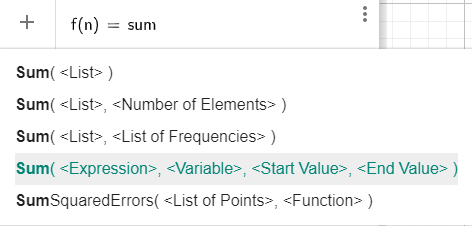
From these 5 options, we will check for the most suitable option according to our given situation.
Step 4- According to our question, we can see the choice 4 will be the more appropriate option to choose, that is Sum(, , , ).
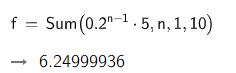
Step 5- Now, we will put the asked value in the chosen option and press the enter key. As soon as we press, we will get our answer.
Note:
If we do not want to use a graphing calculator, then we can solve this question, using the formula of the sum of geometric series, that is \[{{S}_{n}}=a\dfrac{({{r}^{n}}-1)}{(r-1)}\]. And then by calculating values of a and r, we will get our answer. And then we can verify our answer using the graphing calculator.
Complete step by step answer:
According to the question, we have been asked to find the sum of the geometric series \[\sum{5{{(0.2)}^{n-1}}}\] where the values of n range between 1 to 10.
Now, to solve this, we will first start this question by expressing the equation as a function in terms of n.
Let us consider the function as f(n). Hence, we get the function as
\[f\left( n \right)=\sum{5{{(0.2)}^{n-1}}}\]
Now, to find its final value, we will start by opening the graphing calculator in our device.
As soon as we open our graphing calculator, we follow a few steps to get our answer.
Step 1- We first write the given expression as a function that \[f\left( n \right)=\sum{5{{(0.2)}^{n-1}}}\] in the appropriate place.
Step 2- To write the expression, we will represent ∑ by sum.
Step 3- As we will type sum, a list will appear with 5 options, that are
From these 5 options, we will check for the most suitable option according to our given situation.
Step 4- According to our question, we can see the choice 4 will be the more appropriate option to choose, that is Sum(
Step 5- Now, we will put the asked value in the chosen option and press the enter key. As soon as we press, we will get our answer.
Note:
If we do not want to use a graphing calculator, then we can solve this question, using the formula of the sum of geometric series, that is \[{{S}_{n}}=a\dfrac{({{r}^{n}}-1)}{(r-1)}\]. And then by calculating values of a and r, we will get our answer. And then we can verify our answer using the graphing calculator.
Recently Updated Pages
Master Class 11 Economics: Engaging Questions & Answers for Success

Master Class 11 English: Engaging Questions & Answers for Success
Master Class 11 Maths: Engaging Questions & Answers for Success
Class 11 Question and Answer - Your Ultimate Solutions Guide
Master Class 11 Social Science: Engaging Questions & Answers for Success
Master Class 11 Business Studies: Engaging Questions & Answers for Success
Trending doubts
One Metric ton is equal to kg A 10000 B 1000 C 100 class 11 physics CBSE
There are 720 permutations of the digits 1 2 3 4 5 class 11 maths CBSE
Differentiate between an exothermic and an endothermic class 11 chemistry CBSE
In what year Guru Nanak Dev ji was born A15 April 1469 class 11 social science CBSE
Difference Between Prokaryotic Cells and Eukaryotic Cells
State and prove Bernoullis theorem class 11 physics CBSE