




What do you understand by hierarchical classification?
Answer
 Verified
585.3k+ views
Hint: As per the historical backdrop of natural classification, Aristotle, a Greek rationalist classified various creatures dependent on the living space, attributes, and so forth. Afterward, a Swedish botanist Carolus Linnaeus presented Taxonomic Hierarchy Categories during the eighteenth century, and this arrangement of classification is followed worldwide to date.
Complete answer: "Taxonomy" is from a Greek word – "taxis", which means a course of action or division, and "nomos", which means technique.
Scientific categorization is a part of Biology that alludes to the way toward classifying diverse living species. A taxon is alluded to as a gathering of living beings classified as a unit.
"Taxonomic hierarchy is the way toward organizing different creatures into progressive degrees of the natural classification either in a diminishing or an expanding order from realm to species and the other way around." Every one of these degrees of the hierarchy is known as the taxonomic class or rank.
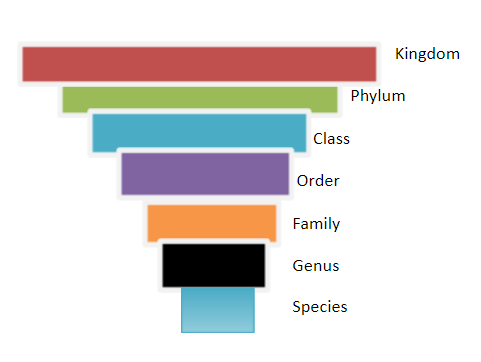
Additional information: Kingdom: The kingdom is the most elevated level of classification,
For Example –
Phylum: Porifera, Arthropoda, and so on.
Class: Mammalia, reptilia, aves, and so on.
Order: Primates, Carnivora, and so on.
Family: The families in the order Carnivora incorporate Canidae, Felidae, Ursidae, and so on.
Genus: Lion and tiger under the genus Panthera.
Species: It is the most reduced degree of the taxonomic hierarchy.
There are about 8.7 million distinct species on earth.
Species can be additionally partitioned into sub-species.
Note: Progressive classification is additionally called as taxonomical classification where creatures are classified into progressive levels as per their intricacy.
Each level is called a taxonomic level.
In this classification, the Kingdom is most elevated positioned followed by division, class, order, family, genus, and species is the least classification.
So, there are 7 taxonomic ranks.
Complete answer: "Taxonomy" is from a Greek word – "taxis", which means a course of action or division, and "nomos", which means technique.
Scientific categorization is a part of Biology that alludes to the way toward classifying diverse living species. A taxon is alluded to as a gathering of living beings classified as a unit.
"Taxonomic hierarchy is the way toward organizing different creatures into progressive degrees of the natural classification either in a diminishing or an expanding order from realm to species and the other way around." Every one of these degrees of the hierarchy is known as the taxonomic class or rank.
Additional information: Kingdom: The kingdom is the most elevated level of classification,
For Example –
Phylum: Porifera, Arthropoda, and so on.
Class: Mammalia, reptilia, aves, and so on.
Order: Primates, Carnivora, and so on.
Family: The families in the order Carnivora incorporate Canidae, Felidae, Ursidae, and so on.
Genus: Lion and tiger under the genus Panthera.
Species: It is the most reduced degree of the taxonomic hierarchy.
There are about 8.7 million distinct species on earth.
Species can be additionally partitioned into sub-species.
Note: Progressive classification is additionally called as taxonomical classification where creatures are classified into progressive levels as per their intricacy.
Each level is called a taxonomic level.
In this classification, the Kingdom is most elevated positioned followed by division, class, order, family, genus, and species is the least classification.
So, there are 7 taxonomic ranks.
Recently Updated Pages
Master Class 11 Computer Science: Engaging Questions & Answers for Success

Master Class 11 Business Studies: Engaging Questions & Answers for Success
Master Class 11 Economics: Engaging Questions & Answers for Success
Master Class 11 English: Engaging Questions & Answers for Success
Master Class 11 Maths: Engaging Questions & Answers for Success
Master Class 11 Biology: Engaging Questions & Answers for Success
Trending doubts
One Metric ton is equal to kg A 10000 B 1000 C 100 class 11 physics CBSE
There are 720 permutations of the digits 1 2 3 4 5 class 11 maths CBSE
Discuss the various forms of bacteria class 11 biology CBSE
Draw a diagram of a plant cell and label at least eight class 11 biology CBSE
State the laws of reflection of light
Explain zero factorial class 11 maths CBSE