




Ulothrix is
(a)Attached unbranched filament
(b)Attached branched filament
(c)Colonial algae
(d)Free-floating
Answer
 Verified
610.8k+ views
Hint: It is an alga that grows on a freshwater. It fixes itself on a substratum such as soil, rocks, particles, etc for its growth.
Ulothrix is an attached unbranched filament. It is a filamentous green algae genus that is commonly observed in marine water and freshwater. Individual cells have a distinct nucleus, a vacuole situated in the center, and a thin chloroplast with a minimum of one pyrenoid. It possesses a specialized cell for attachment known as holdfast and these filaments are unbranched.
Complete step-by-step answer:
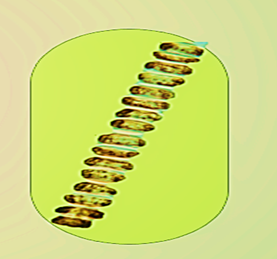
figure: Ulothrix
The above image represents the image of the algae Ulothrix.
Ulothrix can reproduce by vegetative propagation, asexual, and sexual reproduction.
-Vegetative reproduction: In vegetative reproduction, the ulothrix will undergo fragmentation. After vegetative reproduction, the fragments will undergo several divisions, and later it will form into a new filament. Each fragment will develop into a new filament.
-Asexual reproduction: It is observed that ulothrix will form zoospores, akinetes, aplanospores.
-Zoospore is a spore that can swim.
-The shrinkage of protoplasts and will form a wall all over it. This will form an aplanospores.
-Akinetes are also produced similarly as that of aplanospores but, it differs in having a thicker cell wall made of cellulose and pectin.
-Sexual reproduction: The male and female gametes are of the same size. They will undergo fusion. This is otherwise called as isogamous.
So, the correct answer is ‘Attached unbranched filament’
Note: The gametes formed during sexual reproduction may not fuse at times. These gametes will lose its flagella, form a thickly layered wall surrounding it called parthenospores and finally these parthenospores will directly form into a new plant.
Ulothrix is an attached unbranched filament. It is a filamentous green algae genus that is commonly observed in marine water and freshwater. Individual cells have a distinct nucleus, a vacuole situated in the center, and a thin chloroplast with a minimum of one pyrenoid. It possesses a specialized cell for attachment known as holdfast and these filaments are unbranched.
Complete step-by-step answer:
figure: Ulothrix
The above image represents the image of the algae Ulothrix.
Ulothrix can reproduce by vegetative propagation, asexual, and sexual reproduction.
-Vegetative reproduction: In vegetative reproduction, the ulothrix will undergo fragmentation. After vegetative reproduction, the fragments will undergo several divisions, and later it will form into a new filament. Each fragment will develop into a new filament.
-Asexual reproduction: It is observed that ulothrix will form zoospores, akinetes, aplanospores.
-Zoospore is a spore that can swim.
-The shrinkage of protoplasts and will form a wall all over it. This will form an aplanospores.
-Akinetes are also produced similarly as that of aplanospores but, it differs in having a thicker cell wall made of cellulose and pectin.
-Sexual reproduction: The male and female gametes are of the same size. They will undergo fusion. This is otherwise called as isogamous.
So, the correct answer is ‘Attached unbranched filament’
Note: The gametes formed during sexual reproduction may not fuse at times. These gametes will lose its flagella, form a thickly layered wall surrounding it called parthenospores and finally these parthenospores will directly form into a new plant.
Recently Updated Pages
Master Class 11 Social Science: Engaging Questions & Answers for Success

Master Class 11 English: Engaging Questions & Answers for Success
Master Class 11 Maths: Engaging Questions & Answers for Success
Master Class 11 Chemistry: Engaging Questions & Answers for Success
Master Class 11 Biology: Engaging Questions & Answers for Success
Master Class 11 Physics: Engaging Questions & Answers for Success
Trending doubts
One Metric ton is equal to kg A 10000 B 1000 C 100 class 11 physics CBSE
Difference Between Prokaryotic Cells and Eukaryotic Cells
How many of the following diseases can be studied with class 11 biology CBSE
Draw a diagram of a plant cell and label at least eight class 11 biology CBSE
Two of the body parts which do not appear in MRI are class 11 biology CBSE
Which gas is abundant in air class 11 chemistry CBSE