




Ulna is a
(a) Long and curved bone
(b) Small slender bone
(c) Very small bone
(d) Very long bone
Answer
 Verified
629.7k+ views
Hint: An arm is constructed by three large bones among which a single thick bone lays the foundation of the upper arm while the lower arm is made up of two bones of different curvatures and thickness. They both are joined to each other proximally as well as distally.
Complete answer:
The ulna is one of the 30 bones that make up the framework of our arms. Each arm is composed of one humerus, one radius, one ulna, eight carpels, five metacarpals, and fourteen phalanges. The upper arm is composed of the only humorous. The lower arm or the forearm is made up of two bones namely the radius and ulna. The radius is the forearm bone which extends from the elbow to the thumb side of the wrist while the ulna is the bone of the forearm which extends from the elbow to the smallest or little finger of the wrists. Though the radius is thicker ulna is longer and slightly curved than the radius.
Additional Information: -The upper end of the ulna has characteristic extensions known as the olecranon process which articulates with humerus and result in the prominence of the elbow.
-The upper rounded end of the humerus is called the head which articulates well into the glenoid cavity of the pectoral girdle. The pectoral girdle forms the shoulder and consists of two bones -clavicle and scapula.
-Each finger is composed of three series of bones which are proximal phalanges, intermediate phalanges, and distal phalanges. The proximal phalanges are the largest of the three and extend directly from the palm. These are the areas where a person wears rings. The intermediate phalanges are located between the joints of proximal and distal phalanges. The distal phalanges represent the areas of our fingertips.
So, the correct answer is ‘Long and curved bone.’
Note: -The arm is the most common area of short-term injuries or fractures. High impact collisions like any sports injuries, falls or automobile crashes lead to fractures or breaks in any of these bones.
-Single fracture may be healed with casts but multiple breaks or compound fractures require various surgical interventions.
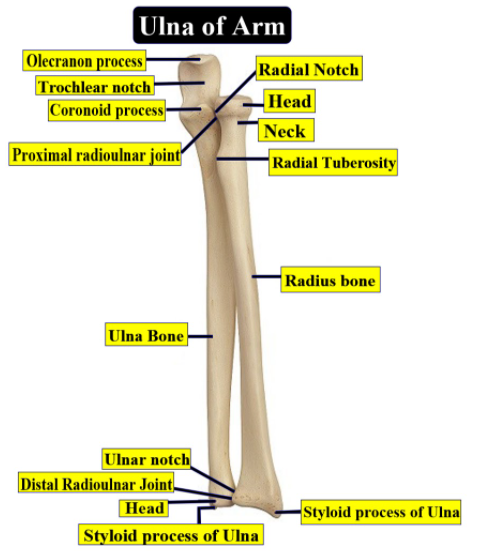
Complete answer:
The ulna is one of the 30 bones that make up the framework of our arms. Each arm is composed of one humerus, one radius, one ulna, eight carpels, five metacarpals, and fourteen phalanges. The upper arm is composed of the only humorous. The lower arm or the forearm is made up of two bones namely the radius and ulna. The radius is the forearm bone which extends from the elbow to the thumb side of the wrist while the ulna is the bone of the forearm which extends from the elbow to the smallest or little finger of the wrists. Though the radius is thicker ulna is longer and slightly curved than the radius.
Additional Information: -The upper end of the ulna has characteristic extensions known as the olecranon process which articulates with humerus and result in the prominence of the elbow.
-The upper rounded end of the humerus is called the head which articulates well into the glenoid cavity of the pectoral girdle. The pectoral girdle forms the shoulder and consists of two bones -clavicle and scapula.
-Each finger is composed of three series of bones which are proximal phalanges, intermediate phalanges, and distal phalanges. The proximal phalanges are the largest of the three and extend directly from the palm. These are the areas where a person wears rings. The intermediate phalanges are located between the joints of proximal and distal phalanges. The distal phalanges represent the areas of our fingertips.
So, the correct answer is ‘Long and curved bone.’
Note: -The arm is the most common area of short-term injuries or fractures. High impact collisions like any sports injuries, falls or automobile crashes lead to fractures or breaks in any of these bones.
-Single fracture may be healed with casts but multiple breaks or compound fractures require various surgical interventions.
Recently Updated Pages
Basicity of sulphurous acid and sulphuric acid are

Master Class 12 Economics: Engaging Questions & Answers for Success
Master Class 12 Biology: Engaging Questions & Answers for Success
Master Class 11 English: Engaging Questions & Answers for Success
Master Class 11 Physics: Engaging Questions & Answers for Success
Master Class 11 Computer Science: Engaging Questions & Answers for Success
Trending doubts
Draw a labelled sketch of the human eye class 12 physics CBSE
The chemical formula of tear gas is A CO Cl 2 B C 10 class 12 chemistry CBSE
Draw ray diagrams each showing i myopic eye and ii class 12 physics CBSE
Which are the Top 10 Largest Countries of the World?
Differentiate between homogeneous and heterogeneous class 12 chemistry CBSE
Which is the correct genotypic ratio of mendel dihybrid class 12 biology CBSE