




What type of carbon-carbon bonds present in vanaspati ghee?
Answer
 Verified
609k+ views
Hint: Vanaspati ghee is made from palm oil. It is prepared by hydrogenation of vegetable oils in the presence of nickel as a catalyst. Vanaspati ghee is a saturated hydrocarbon. The bonds present in saturated carbons are the type of bonds present in vanaspati ghee.
Complete step by step answer:
In India, vanaspati ghee is made from palm oil. Hydrogenation of vegetable oils in the presence of nickel which acts as a catalyst, at 473K temperature, and at low-medium pressure produces Vanaspati ghee. Hydrogenation is nothing but treating the compound with hydrogen.
The chemical formula of vanaspati is ${\left( {{C_{17}}{H_{33}}COO} \right)_3}{C_3}{H_5}$
$
Vegetable\, oil + {H_2}\xrightarrow{{Ni,473K}}Vanaspati \\
{\left( {{C_{17}}{H_{31}}COO} \right)_3}{C_3}{H_5} + 3{H_2}\xrightarrow{{Ni}}{\left( {{C_{17}}{H_{33}}COO} \right)_3}{C_3}{H_5} \\
$
Vanaspati ghee is a saturated hydrocarbon.
The bonds between carbon atoms are called covalent bonds. Saturated hydrocarbons only have carbon-carbon single bonds (C-C).
Unsaturated hydrocarbons are converted into saturated hydrocarbons by hydrogenation. For example, alkenes are converted into alkanes.
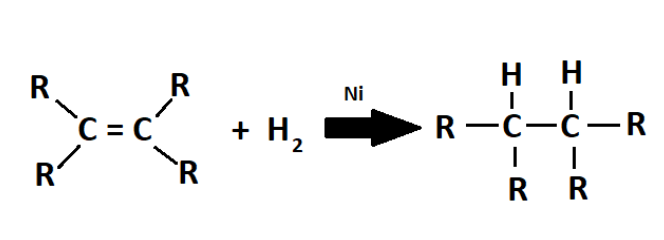
where R is any alkyl group
In the same way, vegetable oils which are unsaturated hydrocarbons are hydrogenated to form vanaspati ghee which is a saturated hydrocarbon.
Therefore, the type of carbon-carbon bonds present in Vanaspati ghee is a Single bond.
Additional Information: The catalyst used in the hydrogenation, nickel, does not react with the oil and hydrogen; it just increases the rate of the reaction.
Note:
In unsaturated carbons, carbon-carbon double bonds (C=C) and carbon-carbon triple bonds (C≡C) whereas saturated hydrocarbons carbon-carbon single bonds (C-C) are present. Do not confuse saturated hydrocarbons with unsaturated hydrocarbons. The IUPAC names of saturated compounds mostly end with “ane” and IUPAC names of unsaturated compounds end with “ene” and “yne”, for example, ethane is saturated and ethene, ethyne is unsaturated.
Complete step by step answer:
In India, vanaspati ghee is made from palm oil. Hydrogenation of vegetable oils in the presence of nickel which acts as a catalyst, at 473K temperature, and at low-medium pressure produces Vanaspati ghee. Hydrogenation is nothing but treating the compound with hydrogen.
The chemical formula of vanaspati is ${\left( {{C_{17}}{H_{33}}COO} \right)_3}{C_3}{H_5}$
$
Vegetable\, oil + {H_2}\xrightarrow{{Ni,473K}}Vanaspati \\
{\left( {{C_{17}}{H_{31}}COO} \right)_3}{C_3}{H_5} + 3{H_2}\xrightarrow{{Ni}}{\left( {{C_{17}}{H_{33}}COO} \right)_3}{C_3}{H_5} \\
$
Vanaspati ghee is a saturated hydrocarbon.
The bonds between carbon atoms are called covalent bonds. Saturated hydrocarbons only have carbon-carbon single bonds (C-C).
Unsaturated hydrocarbons are converted into saturated hydrocarbons by hydrogenation. For example, alkenes are converted into alkanes.
where R is any alkyl group
In the same way, vegetable oils which are unsaturated hydrocarbons are hydrogenated to form vanaspati ghee which is a saturated hydrocarbon.
Therefore, the type of carbon-carbon bonds present in Vanaspati ghee is a Single bond.
Additional Information: The catalyst used in the hydrogenation, nickel, does not react with the oil and hydrogen; it just increases the rate of the reaction.
Note:
In unsaturated carbons, carbon-carbon double bonds (C=C) and carbon-carbon triple bonds (C≡C) whereas saturated hydrocarbons carbon-carbon single bonds (C-C) are present. Do not confuse saturated hydrocarbons with unsaturated hydrocarbons. The IUPAC names of saturated compounds mostly end with “ane” and IUPAC names of unsaturated compounds end with “ene” and “yne”, for example, ethane is saturated and ethene, ethyne is unsaturated.
Recently Updated Pages
Master Class 10 English: Engaging Questions & Answers for Success

Master Class 10 Social Science: Engaging Questions & Answers for Success
Master Class 10 Computer Science: Engaging Questions & Answers for Success
Class 10 Question and Answer - Your Ultimate Solutions Guide
Master Class 10 General Knowledge: Engaging Questions & Answers for Success
Master Class 10 Maths: Engaging Questions & Answers for Success
Trending doubts
Explain the Treaty of Vienna of 1815 class 10 social science CBSE
Who Won 36 Oscar Awards? Record Holder Revealed
What is the median of the first 10 natural numbers class 10 maths CBSE
Why is it 530 pm in india when it is 1200 afternoon class 10 social science CBSE
Make a sketch of the human nerve cell What function class 10 biology CBSE
Define Potential, Developed, Stock and Reserved resources