




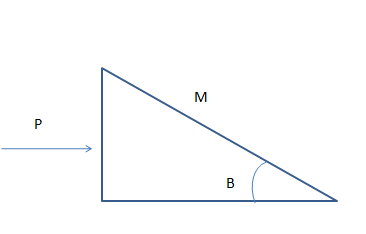
Two wooden blocks are moving on a smooth horizontal surface such that the mass remains stationary with respect to the block on mass M as shown in the figure, the magnitude of force P is.
(A) $ \left( {M + m} \right)g\tan \beta $
(B) $ g\tan \beta $
(C) $ mg\cos \beta $
(D) $ \left( {M + m} \right)g\cos ec\beta $
Answer
 Verified
513.9k+ views
Hint: Acceleration is defined as the rate of change of velocity or Acceleration depends upon the velocity when the velocity continuously increases or decreases then the acceleration will be produced.
Positive Acceleration is If the velocity continuously increases then the acceleration will be positive.
Negative acceleration is If the velocity continuously decreases then the acceleration will be negative.
Complete answer:
The speed is a function of time, and it is a scalar quantity and it is defined as the rate of change of position
Based on Newton's Second Law of motion, acceleration is produced in a body when a force is applied to it. a body can have a constant velocity, but not acceleration when without force.
In the above figure, all the surfaces are smooth in the figure to find the F that block of mass m resting on a wedge of mass m remains stationary concerning wedge.
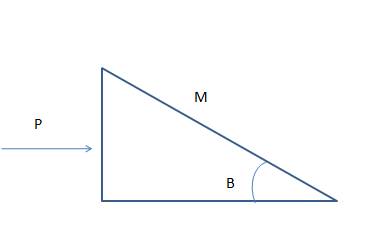
The blocks move with acceleration concerning the ground
The acceleration can be written as,
$ a = \dfrac{P}{{M + m}} $ …..(1)
Then the mass is shown,
$ Rsin\beta = ma.....\left( 2 \right) $
$ Rcos\beta = mg.....\;\left( 3 \right) $
Then,
$ A \Rightarrow an\beta $
Now put the values in equation (1) it becomes,
$ P = \left( {M + m} \right) > an\beta $
Finally, the answer is an option (A).
Note:
Velocity is known as a vector quantity, meaning it defines the speed and direction.
For circular motion such as orbiting planets, the object can be accelerating constantly without increasing speed.
Let us consider the earth as an example. Although Earth's orbit speed stays relatively the same, it's constantly accelerating because the direction in which it's traveling is constantly changing.
Positive Acceleration is If the velocity continuously increases then the acceleration will be positive.
Negative acceleration is If the velocity continuously decreases then the acceleration will be negative.
Complete answer:
The speed is a function of time, and it is a scalar quantity and it is defined as the rate of change of position
Based on Newton's Second Law of motion, acceleration is produced in a body when a force is applied to it. a body can have a constant velocity, but not acceleration when without force.
In the above figure, all the surfaces are smooth in the figure to find the F that block of mass m resting on a wedge of mass m remains stationary concerning wedge.
The blocks move with acceleration concerning the ground
The acceleration can be written as,
$ a = \dfrac{P}{{M + m}} $ …..(1)
Then the mass is shown,
$ Rsin\beta = ma.....\left( 2 \right) $
$ Rcos\beta = mg.....\;\left( 3 \right) $
Then,
$ A \Rightarrow an\beta $
Now put the values in equation (1) it becomes,
$ P = \left( {M + m} \right) > an\beta $
Finally, the answer is an option (A).
Note:
Velocity is known as a vector quantity, meaning it defines the speed and direction.
For circular motion such as orbiting planets, the object can be accelerating constantly without increasing speed.
Let us consider the earth as an example. Although Earth's orbit speed stays relatively the same, it's constantly accelerating because the direction in which it's traveling is constantly changing.
Recently Updated Pages
Master Class 11 Social Science: Engaging Questions & Answers for Success

Master Class 11 English: Engaging Questions & Answers for Success
Master Class 11 Maths: Engaging Questions & Answers for Success
Master Class 11 Chemistry: Engaging Questions & Answers for Success
Master Class 11 Biology: Engaging Questions & Answers for Success
Master Class 11 Physics: Engaging Questions & Answers for Success
Trending doubts
One Metric ton is equal to kg A 10000 B 1000 C 100 class 11 physics CBSE
Difference Between Prokaryotic Cells and Eukaryotic Cells
How many of the following diseases can be studied with class 11 biology CBSE
Draw a diagram of a plant cell and label at least eight class 11 biology CBSE
Two of the body parts which do not appear in MRI are class 11 biology CBSE
Which gas is abundant in air class 11 chemistry CBSE