




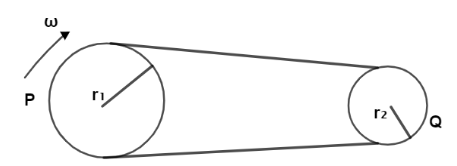
Two wheels $1$ and $2$ of radii ${r_1}$ and ${r_2}$ are connected by a belt. If the belt does not slip on the wheels and angular speed of wheel $1$ is $\omega $ then acceleration of P relative to Q is
A. ${r_1}{\omega ^2}(1 + \dfrac{{{r_2}}}{{{r_1}}})$
B. ${r_1}{\omega ^2}(1 + \dfrac{{{r_1}}}{{{r_2}}})$
C. ${r_1}{\omega ^2}$
D. ${r_1}{\omega ^2}(1 + \dfrac{{{r_2}}}{{{r_2}^2}})$
Answer
 Verified
508.8k+ views
Hint: In order to solve this problem we need to understand angular acceleration which states that angular acceleration is the time derivative of angular velocity whereas angular velocity is the time derivation of angle which body rotates in some period.On a moving body around the axis each particle has its velocity along the tangent and it is equal to the product of angular velocity and radius in which it is moving.
Complete step by step answer:
Here we use formulas of angular velocity and angular acceleration.
Let $\omega $ be angular velocity and “v” be its speed.
Then from relation $v = r\omega $ for the first wheel is $v = {r_1}\omega $.
And for second let it rotates with angular velocity ${\omega _2}$ so using relation of speed we get
$v = {r_2}{\omega _2}$
Equating both speed we get ${r_1}\omega = {r_2}{\omega _2}$
\[ \Rightarrow {\omega _2} = \dfrac{{{r_1}\omega }}{{{r_2}}}\]
We know from relativity that ${\vec \alpha _{PQ}} = {\vec \alpha _P} - {\vec \alpha _Q}$
Where $\alpha $ is angular acceleration
Also using $\alpha = r{\omega ^2}$
We get ${\vec \alpha _p} = {r_1}{\omega ^2}\hat i$ and ${\vec \alpha _Q} = - {r_2}{\omega _2}^2\hat i$
Using value of ${\omega _2}$ we get ${\vec \alpha _Q} = {r_2}(\dfrac{{{r_1}^2{\omega ^2}}}{{{r_2}^2}})\hat i$
$ \Rightarrow {\vec \alpha _Q} = - \dfrac{{{r_1}^2{\omega ^2}}}{{{r_2}}}\hat i$
$\Rightarrow {\vec \alpha _{PQ}} = {r_1}{\omega ^2}\hat i + \dfrac{{{r_1}^2{\omega ^2}}}{{{r_2}}}\hat i$
$\therefore {\vec \alpha _{PQ}} = {r_1}{\omega ^2}\left[ {1 + \dfrac{{{r_1}}}{{{r_2}}}} \right]\hat i$
So the correct option is B.
Note: It should be remembered that the direction of angular acceleration of Q is opposite to that of P because due to belt wrapping Q the wheel moves in the opposite direction so that belt is stationary. If both moves in the same direction then the belt starts moving due to the same directional force applied on it and hence our calculation goes wrong. Also when second wheel motion is analyzed with respect to first the second wheel is assumed to be at rest.
Complete step by step answer:
Here we use formulas of angular velocity and angular acceleration.
Let $\omega $ be angular velocity and “v” be its speed.
Then from relation $v = r\omega $ for the first wheel is $v = {r_1}\omega $.
And for second let it rotates with angular velocity ${\omega _2}$ so using relation of speed we get
$v = {r_2}{\omega _2}$
Equating both speed we get ${r_1}\omega = {r_2}{\omega _2}$
\[ \Rightarrow {\omega _2} = \dfrac{{{r_1}\omega }}{{{r_2}}}\]
We know from relativity that ${\vec \alpha _{PQ}} = {\vec \alpha _P} - {\vec \alpha _Q}$
Where $\alpha $ is angular acceleration
Also using $\alpha = r{\omega ^2}$
We get ${\vec \alpha _p} = {r_1}{\omega ^2}\hat i$ and ${\vec \alpha _Q} = - {r_2}{\omega _2}^2\hat i$
Using value of ${\omega _2}$ we get ${\vec \alpha _Q} = {r_2}(\dfrac{{{r_1}^2{\omega ^2}}}{{{r_2}^2}})\hat i$
$ \Rightarrow {\vec \alpha _Q} = - \dfrac{{{r_1}^2{\omega ^2}}}{{{r_2}}}\hat i$
$\Rightarrow {\vec \alpha _{PQ}} = {r_1}{\omega ^2}\hat i + \dfrac{{{r_1}^2{\omega ^2}}}{{{r_2}}}\hat i$
$\therefore {\vec \alpha _{PQ}} = {r_1}{\omega ^2}\left[ {1 + \dfrac{{{r_1}}}{{{r_2}}}} \right]\hat i$
So the correct option is B.
Note: It should be remembered that the direction of angular acceleration of Q is opposite to that of P because due to belt wrapping Q the wheel moves in the opposite direction so that belt is stationary. If both moves in the same direction then the belt starts moving due to the same directional force applied on it and hence our calculation goes wrong. Also when second wheel motion is analyzed with respect to first the second wheel is assumed to be at rest.
Recently Updated Pages
Master Class 11 Computer Science: Engaging Questions & Answers for Success

Master Class 11 Business Studies: Engaging Questions & Answers for Success
Master Class 11 Economics: Engaging Questions & Answers for Success
Master Class 11 English: Engaging Questions & Answers for Success
Master Class 11 Maths: Engaging Questions & Answers for Success
Master Class 11 Biology: Engaging Questions & Answers for Success
Trending doubts
One Metric ton is equal to kg A 10000 B 1000 C 100 class 11 physics CBSE
There are 720 permutations of the digits 1 2 3 4 5 class 11 maths CBSE
Discuss the various forms of bacteria class 11 biology CBSE
Draw a diagram of a plant cell and label at least eight class 11 biology CBSE
State the laws of reflection of light
10 examples of friction in our daily life