




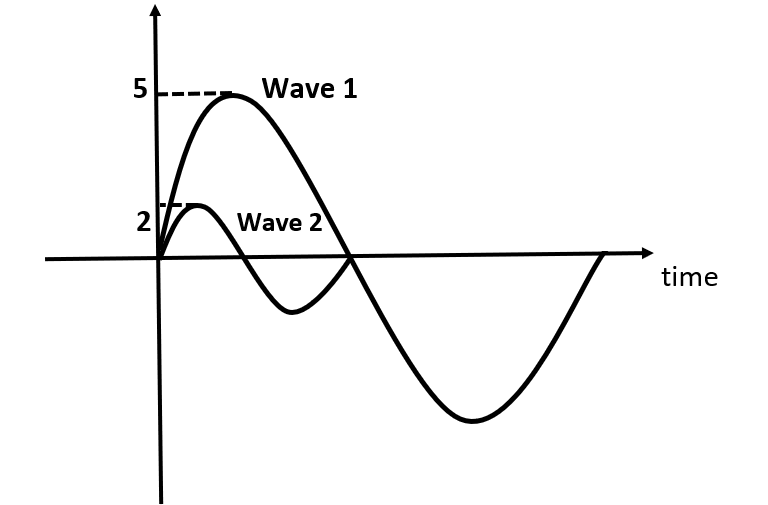
Two waves in the same medium are represented by $y-t$ curves in the figure shown. Find the ratio of their average intensities.
$\begin{align}
& (A)\dfrac{25}{16} \\
& (B)\dfrac{23}{16} \\
& (C)\dfrac{21}{16} \\
& (D)\dfrac{27}{16} \\
\end{align}$
Answer
 Verified
559.5k+ views
Hint: We have the graphical representation of two waves. From the graph, we can determine the Amplitude of the two sinusoidal waves. Once the amplitude of these waves are known, we can calculate the ratio of intensities of the two waves. This can be calculated using the fact that the intensity of any wave is proportional to the square of its amplitude. We will proceed in the above aforesaid manner.
Complete answer:
Let the amplitude of the larger wave be ${{A}_{1}}$ and the amplitude of the smaller wave be ${{A}_{2}}$. Then, from the given graphical diagram, we can say that:
$\Rightarrow {{A}_{1}}=5$ And,
$\Rightarrow {{A}_{2}}=2$
Now, the relation between intensity and amplitude of a wave is given by:
$\begin{align}
& \Rightarrow I\propto {{(A\omega )}^{2}} \\
& \Rightarrow I\propto {{(Af)}^{2}} \\
\end{align}$
Where f is the frequency of the wave.
This could be written as:
$\Rightarrow \dfrac{I}{{{(Af)}^{2}}}=k$
Where, k is an arbitrary constant called the constant of proportionality.
Therefore, for two waves in comparison. We can write as follows:
$\Rightarrow \dfrac{{{I}_{1}}}{{{A}_{1}}^{2}{{f}_{1}}^{2}}=\dfrac{{{I}_{2}}}{{{A}_{2}}^{2}{{f}_{2}}^{2}}$
On rearranging terms, we get:
$\Rightarrow \dfrac{{{I}_{1}}}{{{I}_{2}}}=\dfrac{{{A}_{1}}^{2}{{f}_{1}}^{2}}{{{A}_{2}}^{2}{{f}_{2}}^{2}}$
Putting the values of both the amplitudes in the above equation and simplifying the equation, we get:
$\begin{align}
& \Rightarrow \dfrac{{{I}_{1}}}{{{I}_{2}}}=\dfrac{{{\left( 5 \right)}^{2}}{{\left( 1 \right)}^{2}}}{{{\left( 2 \right)}^{2}}{{\left( 2 \right)}^{2}}} \\
& \therefore \dfrac{{{I}_{1}}}{{{I}_{2}}}=\dfrac{25}{16} \\
\end{align}$
Hence, the ratio of their average intensities of the two waves, comes out to be $\dfrac{25}{16}$.
Hence, option (A) is the correct option.
Note:
Here, the ratio of intensity would have been equal to the ratio of amplitude squared only, if the frequency of both the waves would have been the same. But that wasn’t the case, so we included an extra term, the angular frequency which is directly proportional to frequency into our equation to avoid mistakes. One should also be careful in writing the correct ratio in answer.
Complete answer:
Let the amplitude of the larger wave be ${{A}_{1}}$ and the amplitude of the smaller wave be ${{A}_{2}}$. Then, from the given graphical diagram, we can say that:
$\Rightarrow {{A}_{1}}=5$ And,
$\Rightarrow {{A}_{2}}=2$
Now, the relation between intensity and amplitude of a wave is given by:
$\begin{align}
& \Rightarrow I\propto {{(A\omega )}^{2}} \\
& \Rightarrow I\propto {{(Af)}^{2}} \\
\end{align}$
Where f is the frequency of the wave.
This could be written as:
$\Rightarrow \dfrac{I}{{{(Af)}^{2}}}=k$
Where, k is an arbitrary constant called the constant of proportionality.
Therefore, for two waves in comparison. We can write as follows:
$\Rightarrow \dfrac{{{I}_{1}}}{{{A}_{1}}^{2}{{f}_{1}}^{2}}=\dfrac{{{I}_{2}}}{{{A}_{2}}^{2}{{f}_{2}}^{2}}$
On rearranging terms, we get:
$\Rightarrow \dfrac{{{I}_{1}}}{{{I}_{2}}}=\dfrac{{{A}_{1}}^{2}{{f}_{1}}^{2}}{{{A}_{2}}^{2}{{f}_{2}}^{2}}$
Putting the values of both the amplitudes in the above equation and simplifying the equation, we get:
$\begin{align}
& \Rightarrow \dfrac{{{I}_{1}}}{{{I}_{2}}}=\dfrac{{{\left( 5 \right)}^{2}}{{\left( 1 \right)}^{2}}}{{{\left( 2 \right)}^{2}}{{\left( 2 \right)}^{2}}} \\
& \therefore \dfrac{{{I}_{1}}}{{{I}_{2}}}=\dfrac{25}{16} \\
\end{align}$
Hence, the ratio of their average intensities of the two waves, comes out to be $\dfrac{25}{16}$.
Hence, option (A) is the correct option.
Note:
Here, the ratio of intensity would have been equal to the ratio of amplitude squared only, if the frequency of both the waves would have been the same. But that wasn’t the case, so we included an extra term, the angular frequency which is directly proportional to frequency into our equation to avoid mistakes. One should also be careful in writing the correct ratio in answer.
Recently Updated Pages
Master Class 11 Social Science: Engaging Questions & Answers for Success

Master Class 11 English: Engaging Questions & Answers for Success
Master Class 11 Maths: Engaging Questions & Answers for Success
Master Class 11 Chemistry: Engaging Questions & Answers for Success
Master Class 11 Biology: Engaging Questions & Answers for Success
Master Class 11 Physics: Engaging Questions & Answers for Success
Trending doubts
Differentiate between an exothermic and an endothermic class 11 chemistry CBSE
One Metric ton is equal to kg A 10000 B 1000 C 100 class 11 physics CBSE
Difference Between Prokaryotic Cells and Eukaryotic Cells
There are 720 permutations of the digits 1 2 3 4 5 class 11 maths CBSE
Two of the body parts which do not appear in MRI are class 11 biology CBSE
Which gas is abundant in air class 11 chemistry CBSE