




Two vertical poles of heights 20m and 80m stand 50m apart on a horizontal plane. The height (in m) of the point of intersection of the lines joining the top of each pole to the foot of the other, from this horizontal plane is
A. 15m
B. 16m
C. 18m
D. 50m
Answer
 Verified
609.6k+ views
Hint: Use basic proportionality theorem, if two triangles are similar then the ratio of their alternate sides will be equal. In order to solve this first we have considered the figure as shown below then we have equated their alternate side ratio of the triangles formed in order to find the value of a as represented in the figure.
Complete step-by-step answer:
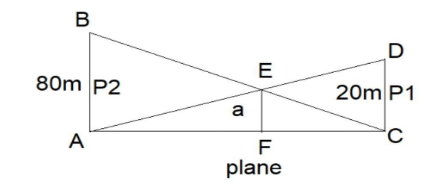
Let us consider a triangle ABC and ADC intersecting at a point E as shown in the figure
Let the height of the point of intersection of the lines joining the top of each pole to the foot of the other, from this horizontal plane be represented by EF.
According to initial data we have
AB=80m
CD=20m
AC=50m
It is clear that AB, EF AND CD are perpendiculars on the line AC from figure
Since all are perpendicular to AC, therefore AB||CD||EF
Now let us consider the triangle ABC & triangle EFC,
Using basic proportionality theorem we have
\[\dfrac{{AC}}{{AB}} = \dfrac{{FC}}{{FE}}\]
On substituting the values we have
\[\dfrac{{AC}}{{80}} = \dfrac{{FC}}{a}\]
$FC = a \times \dfrac{{AC}}{{80}}...........(1)$
Similarly in triangle DCA & triangle EFA
Using basic proportionality theorem we have
\[\dfrac{{AC}}{{DC}} = \dfrac{{AF}}{{EF}}\]
On substituting the values we have
\[\dfrac{{AC}}{{20}} = \dfrac{{AF}}{a}........(2)\]
From figure we know that
\[AF = AC - FC........(3)\]$
\\
\\
$
From (1), (2) and (3) we have
$\dfrac{{AC}}{{20}} = \dfrac{{AC - (\dfrac{{aAC}}{{80}})}}{a}$
Eliminating AC from above equation we get
$\dfrac{1}{{20}} = \dfrac{{1 - (\dfrac{a}{{80}})}}{a}$
On simplifying we have
$
\dfrac{a}{{20}} = \dfrac{{80 - a}}{{80}} \\
a = 20 - \dfrac{a}{4} \\
$
On taking $\dfrac{a}{4}$ on left side we get
$
a + \dfrac{a}{4} = 20 \\
\dfrac{{4a + a}}{4} = 20 \\
$
On further solving we get
$5a = 80$
Finally we get
$a = 16$
Therefore the height (in m) of the point of intersection of the lines joining the top of each pole to the foot of the other, from this horizontal plane is 16 m.
Hence option (B) is the correct answer.
Note: For the height and distance questions just stick with the basic trigonometric formulas and similar triangle properties. Make sure you make a correct diagram and try to find the solution in the diagram itself. Always consider the right triangle in order to get the value easily, try to make less equations in order to solve the problem.
Complete step-by-step answer:
Let us consider a triangle ABC and ADC intersecting at a point E as shown in the figure
Let the height of the point of intersection of the lines joining the top of each pole to the foot of the other, from this horizontal plane be represented by EF.
According to initial data we have
AB=80m
CD=20m
AC=50m
It is clear that AB, EF AND CD are perpendiculars on the line AC from figure
Since all are perpendicular to AC, therefore AB||CD||EF
Now let us consider the triangle ABC & triangle EFC,
Using basic proportionality theorem we have
\[\dfrac{{AC}}{{AB}} = \dfrac{{FC}}{{FE}}\]
On substituting the values we have
\[\dfrac{{AC}}{{80}} = \dfrac{{FC}}{a}\]
$FC = a \times \dfrac{{AC}}{{80}}...........(1)$
Similarly in triangle DCA & triangle EFA
Using basic proportionality theorem we have
\[\dfrac{{AC}}{{DC}} = \dfrac{{AF}}{{EF}}\]
On substituting the values we have
\[\dfrac{{AC}}{{20}} = \dfrac{{AF}}{a}........(2)\]
From figure we know that
\[AF = AC - FC........(3)\]$
\\
\\
$
From (1), (2) and (3) we have
$\dfrac{{AC}}{{20}} = \dfrac{{AC - (\dfrac{{aAC}}{{80}})}}{a}$
Eliminating AC from above equation we get
$\dfrac{1}{{20}} = \dfrac{{1 - (\dfrac{a}{{80}})}}{a}$
On simplifying we have
$
\dfrac{a}{{20}} = \dfrac{{80 - a}}{{80}} \\
a = 20 - \dfrac{a}{4} \\
$
On taking $\dfrac{a}{4}$ on left side we get
$
a + \dfrac{a}{4} = 20 \\
\dfrac{{4a + a}}{4} = 20 \\
$
On further solving we get
$5a = 80$
Finally we get
$a = 16$
Therefore the height (in m) of the point of intersection of the lines joining the top of each pole to the foot of the other, from this horizontal plane is 16 m.
Hence option (B) is the correct answer.
Note: For the height and distance questions just stick with the basic trigonometric formulas and similar triangle properties. Make sure you make a correct diagram and try to find the solution in the diagram itself. Always consider the right triangle in order to get the value easily, try to make less equations in order to solve the problem.
Recently Updated Pages
Master Class 12 Business Studies: Engaging Questions & Answers for Success

Master Class 12 Biology: Engaging Questions & Answers for Success
Master Class 12 Chemistry: Engaging Questions & Answers for Success
Class 12 Question and Answer - Your Ultimate Solutions Guide
Master Class 11 Social Science: Engaging Questions & Answers for Success
Master Class 11 English: Engaging Questions & Answers for Success
Trending doubts
Explain the Treaty of Vienna of 1815 class 10 social science CBSE
Who Won 36 Oscar Awards? Record Holder Revealed
What is the median of the first 10 natural numbers class 10 maths CBSE
Why is it 530 pm in india when it is 1200 afternoon class 10 social science CBSE
Why is there a time difference of about 5 hours between class 10 social science CBSE
What is the full form of POSCO class 10 social science CBSE