




When two vectors of magnitudes $P$ and $Q$ are inclined at an angle $\theta $, the magnitude of their resultant is $2P$. When the inclination is changed to ${{180}^{0}}-\theta $, the magnitude of the resultant is halved. Find the ratio of $P$ to $Q$.
Answer
 Verified
599.1k+ views
Hint: This problem can be solved by using the cosine law for the magnitude of the resultant of two vectors. By plugging in the information given in the question in the form of two equations and comparing them, we can get the required ratio.
Formula used:
The magnitude $\left| \overrightarrow{R} \right|$ of the resultant $\overrightarrow{R}$ of two vectors $\overrightarrow{A}$ and $\overrightarrow{B}$ is given by
$\overrightarrow{\left| R \right|}=\sqrt{{{\overrightarrow{\left| A \right|}}^{2}}+{{\overrightarrow{\left| B \right|}}^{2}}+2\overrightarrow{\left| A \right|}\overrightarrow{\left| B \right|}\cos \theta }$
where $\overrightarrow{\left| A \right|},\overrightarrow{\left| B \right|}$ are the magnitudes of the vectors $\overrightarrow{A},\overrightarrow{B}$ respectively and $\theta $ is the angle between $\overrightarrow{A}$ and $\overrightarrow{B}$.
Complete step by step answer:
As explained in the hint, we will solve this problem by using the information given in the question to form two equations using the cosine law for the magnitude of the resultant of two vectors.
The magnitude $\left| \overrightarrow{R} \right|$ of the resultant $\overrightarrow{R}$ of two vectors $\overrightarrow{A}$ and $\overrightarrow{B}$ is given by
$\overrightarrow{\left| R \right|}=\sqrt{{{\overrightarrow{\left| A \right|}}^{2}}+{{\overrightarrow{\left| B \right|}}^{2}}+2\overrightarrow{\left| A \right|}\overrightarrow{\left| B \right|}\cos \theta }$ --(1)
where $\overrightarrow{\left| A \right|},\overrightarrow{\left| B \right|}$ are the magnitudes of the vectors $\overrightarrow{A},\overrightarrow{B}$ respectively and $\theta $ is the angle between $\overrightarrow{A}$ and $\overrightarrow{B}$.
Hence, let us analyze the question.
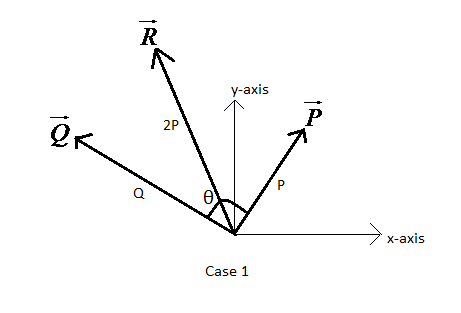
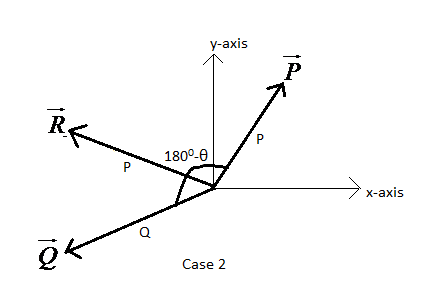
Let the two vectors with magnitudes $P$ and $Q$ be $\overrightarrow{P}$ and $\overrightarrow{Q}$ respectively and the magnitude of the resultant $\overrightarrow{R}$ be $R$. Let the angle between $\overrightarrow{P}$ and $\overrightarrow{Q}$ be $\phi $.
Case 1) $\phi =\theta $, $R=2P$
For this case, using (1), we get,
$2P=\sqrt{{{P}^{2}}+{{Q}^{2}}+2PQ\cos \theta }$
Squaring both sides we get,
${{\left( 2P \right)}^{2}}={{\left( \sqrt{{{P}^{2}}+{{Q}^{2}}+2PQ\cos \theta } \right)}^{2}}$
$\therefore 4{{P}^{2}}={{P}^{2}}+{{Q}^{2}}+2PQ\cos \theta $
$\therefore 4{{P}^{2}}-{{P}^{2}}={{Q}^{2}}+2PQ\cos \theta $
$\therefore 3{{P}^{2}}={{Q}^{2}}+2PQ\cos \theta $ --(2)
Now, Case 2) $\phi ={{180}^{0}}-\theta ,R=P$
For this case, using (2), we get,
$P=\sqrt{{{P}^{2}}+{{Q}^{2}}+2PQ\cos \left( {{180}^{0}}-\theta \right)}$
Squaring both sides we get,
${{\left( P \right)}^{2}}={{\left( \sqrt{{{P}^{2}}+{{Q}^{2}}+2PQ\cos \left( {{180}^{0}}-\theta \right)} \right)}^{2}}$
$\therefore {{P}^{2}}={{P}^{2}}+{{Q}^{2}}+2PQ\cos \left( {{180}^{0}}-\theta \right)$
$\therefore {{P}^{2}}-{{P}^{2}}={{Q}^{2}}+2PQ\left( -\cos \theta \right)$ $\left( \because \cos \left( {{180}^{0}}-\theta \right)=-\cos \theta \right)$
$\therefore 0={{Q}^{2}}-2PQ\cos \theta $
$\therefore {{Q}^{2}}=2PQ\cos \theta $ ---(3)
Putting (3) in (2), we get
$3{{P}^{2}}={{Q}^{2}}+{{Q}^{2}}=2{{Q}^{2}}$
$\therefore \dfrac{{{P}^{2}}}{{{Q}^{2}}}=\dfrac{2}{3}$
$\therefore {{\left( \dfrac{P}{Q} \right)}^{2}}=\dfrac{2}{3}$
Square rooting both sides, we get,
$\sqrt{{{\left( \dfrac{P}{Q} \right)}^{2}}}=\pm \sqrt{\dfrac{2}{3}}$
$\therefore \dfrac{P}{Q}=\pm \dfrac{2}{3}$
However, $\dfrac{P}{Q}=\dfrac{2}{3}$ . (Since $P$ and $Q$ are magnitudes of vectors and magnitudes are always positive, $P>0,Q>0$. Hence, $\dfrac{P}{Q}>0$)
$\therefore \dfrac{P}{Q}=\dfrac{2}{3}$
Hence, the required ratio is $\dfrac{2}{3}=2:3$.
Note: This problem could also have been solved by drawing diagrams for the two cases with proper orthogonal axes and solving for the components of the vectors along these axes if the angle made by each vector with either one of the axes would have been given in the question. However, this would have been a more indirect method and would result in a lengthier process with a lot of calculations and unnecessary variables. The best method to solving these types of problems would be to use the direct formula for the resultant magnitude, that is, the cosine law for the magnitude of the resultant of two vectors.
Formula used:
The magnitude $\left| \overrightarrow{R} \right|$ of the resultant $\overrightarrow{R}$ of two vectors $\overrightarrow{A}$ and $\overrightarrow{B}$ is given by
$\overrightarrow{\left| R \right|}=\sqrt{{{\overrightarrow{\left| A \right|}}^{2}}+{{\overrightarrow{\left| B \right|}}^{2}}+2\overrightarrow{\left| A \right|}\overrightarrow{\left| B \right|}\cos \theta }$
where $\overrightarrow{\left| A \right|},\overrightarrow{\left| B \right|}$ are the magnitudes of the vectors $\overrightarrow{A},\overrightarrow{B}$ respectively and $\theta $ is the angle between $\overrightarrow{A}$ and $\overrightarrow{B}$.
Complete step by step answer:
As explained in the hint, we will solve this problem by using the information given in the question to form two equations using the cosine law for the magnitude of the resultant of two vectors.
The magnitude $\left| \overrightarrow{R} \right|$ of the resultant $\overrightarrow{R}$ of two vectors $\overrightarrow{A}$ and $\overrightarrow{B}$ is given by
$\overrightarrow{\left| R \right|}=\sqrt{{{\overrightarrow{\left| A \right|}}^{2}}+{{\overrightarrow{\left| B \right|}}^{2}}+2\overrightarrow{\left| A \right|}\overrightarrow{\left| B \right|}\cos \theta }$ --(1)
where $\overrightarrow{\left| A \right|},\overrightarrow{\left| B \right|}$ are the magnitudes of the vectors $\overrightarrow{A},\overrightarrow{B}$ respectively and $\theta $ is the angle between $\overrightarrow{A}$ and $\overrightarrow{B}$.
Hence, let us analyze the question.
Let the two vectors with magnitudes $P$ and $Q$ be $\overrightarrow{P}$ and $\overrightarrow{Q}$ respectively and the magnitude of the resultant $\overrightarrow{R}$ be $R$. Let the angle between $\overrightarrow{P}$ and $\overrightarrow{Q}$ be $\phi $.
Case 1) $\phi =\theta $, $R=2P$
For this case, using (1), we get,
$2P=\sqrt{{{P}^{2}}+{{Q}^{2}}+2PQ\cos \theta }$
Squaring both sides we get,
${{\left( 2P \right)}^{2}}={{\left( \sqrt{{{P}^{2}}+{{Q}^{2}}+2PQ\cos \theta } \right)}^{2}}$
$\therefore 4{{P}^{2}}={{P}^{2}}+{{Q}^{2}}+2PQ\cos \theta $
$\therefore 4{{P}^{2}}-{{P}^{2}}={{Q}^{2}}+2PQ\cos \theta $
$\therefore 3{{P}^{2}}={{Q}^{2}}+2PQ\cos \theta $ --(2)
Now, Case 2) $\phi ={{180}^{0}}-\theta ,R=P$
For this case, using (2), we get,
$P=\sqrt{{{P}^{2}}+{{Q}^{2}}+2PQ\cos \left( {{180}^{0}}-\theta \right)}$
Squaring both sides we get,
${{\left( P \right)}^{2}}={{\left( \sqrt{{{P}^{2}}+{{Q}^{2}}+2PQ\cos \left( {{180}^{0}}-\theta \right)} \right)}^{2}}$
$\therefore {{P}^{2}}={{P}^{2}}+{{Q}^{2}}+2PQ\cos \left( {{180}^{0}}-\theta \right)$
$\therefore {{P}^{2}}-{{P}^{2}}={{Q}^{2}}+2PQ\left( -\cos \theta \right)$ $\left( \because \cos \left( {{180}^{0}}-\theta \right)=-\cos \theta \right)$
$\therefore 0={{Q}^{2}}-2PQ\cos \theta $
$\therefore {{Q}^{2}}=2PQ\cos \theta $ ---(3)
Putting (3) in (2), we get
$3{{P}^{2}}={{Q}^{2}}+{{Q}^{2}}=2{{Q}^{2}}$
$\therefore \dfrac{{{P}^{2}}}{{{Q}^{2}}}=\dfrac{2}{3}$
$\therefore {{\left( \dfrac{P}{Q} \right)}^{2}}=\dfrac{2}{3}$
Square rooting both sides, we get,
$\sqrt{{{\left( \dfrac{P}{Q} \right)}^{2}}}=\pm \sqrt{\dfrac{2}{3}}$
$\therefore \dfrac{P}{Q}=\pm \dfrac{2}{3}$
However, $\dfrac{P}{Q}=\dfrac{2}{3}$ . (Since $P$ and $Q$ are magnitudes of vectors and magnitudes are always positive, $P>0,Q>0$. Hence, $\dfrac{P}{Q}>0$)
$\therefore \dfrac{P}{Q}=\dfrac{2}{3}$
Hence, the required ratio is $\dfrac{2}{3}=2:3$.
Note: This problem could also have been solved by drawing diagrams for the two cases with proper orthogonal axes and solving for the components of the vectors along these axes if the angle made by each vector with either one of the axes would have been given in the question. However, this would have been a more indirect method and would result in a lengthier process with a lot of calculations and unnecessary variables. The best method to solving these types of problems would be to use the direct formula for the resultant magnitude, that is, the cosine law for the magnitude of the resultant of two vectors.
Recently Updated Pages
Master Class 11 Computer Science: Engaging Questions & Answers for Success

Master Class 11 Business Studies: Engaging Questions & Answers for Success
Master Class 11 Economics: Engaging Questions & Answers for Success
Master Class 11 English: Engaging Questions & Answers for Success
Master Class 11 Maths: Engaging Questions & Answers for Success
Master Class 11 Biology: Engaging Questions & Answers for Success
Trending doubts
One Metric ton is equal to kg A 10000 B 1000 C 100 class 11 physics CBSE
There are 720 permutations of the digits 1 2 3 4 5 class 11 maths CBSE
Discuss the various forms of bacteria class 11 biology CBSE
Draw a diagram of a plant cell and label at least eight class 11 biology CBSE
State the laws of reflection of light
Explain zero factorial class 11 maths CBSE