




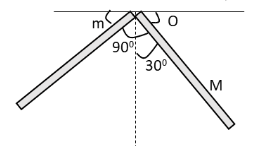
Two Uniform rods of equal length but different masses are rigidly joined to form an L-shaped body, which is then pivoted about O as shown in the figure. If the system is in equilibrium in the shown configuration. Then the ratio \[M/m\] will be:
A. \[2\]
B. \[3\]
C. \[\sqrt 2 \]
D. \[\sqrt 3 \]
Answer
 Verified
592.5k+ views
Hint:Use the formula for torque acting on an object. This formula gives the relation between the torque, force acting on the object and the perpendicular distance between the point of action of force and centre of the torque. The net torque acting on a system is zero if the system is in equilibrium. Determine the value of torques acting on both the rods and equate the sum of these torques to zero.
Formula used:
The torque \[\tau \] acting on an object is
\[\tau = Fr\] …… (1)
Here, \[F\] is the force acting on the object, \[r\] is a perpendicular distance between the point of action of force and centre of the torque.
Complete step by step answer:
We have given that the mass of the left hand side rod is \[m\], the mass of the right hand side rod is \[M\] and the length of both of the rods is \[L\]. The force acting on both the rods are their weights acting in the downward direction at the centre of their lengths. The torque \[{\tau _m}\] acting on the left hand side rod due to its weight \[mg\] according to equation (1) is,
\[{\tau _m} = mg\dfrac{L}{2}\sin 60^\circ \]
The torque \[{\tau _M}\] acting on the left hand side rod due to its weight \[Mg\] according to equation (1) is
\[{\tau _M} = - Mg\dfrac{L}{2}\sin 30^\circ \]
For the system of two rods to be in equilibrium, the net torque acting on both the rods must be zero.Hence, the sum of the torques acting on the given system is zero.
\[{\tau _m} + {\tau _M} = 0\]
Substitute \[mg\dfrac{L}{2}\sin 60^\circ \] for \[{\tau _m}\] and \[ - Mg\dfrac{L}{2}\sin 30^\circ \] for \[{\tau _M}\] in the above equation.
\[mg\dfrac{L}{2}\sin 60^\circ - Mg\dfrac{L}{2}\sin 30^\circ = 0\]
\[ \Rightarrow m\sin 60^\circ = M\sin 30^\circ \]
\[ \Rightarrow \dfrac{M}{m} = \dfrac{{\sin 60^\circ }}{{\sin 30^\circ }}\]
\[ \Rightarrow \dfrac{M}{m} = \dfrac{{\dfrac{{\sqrt 3 }}{2}}}{{\dfrac{1}{2}}}\]
\[ \therefore \dfrac{M}{m} = \sqrt 3 \]
Therefore, the value of the ratio of masses is \[\sqrt 3 \].
Hence, the correct option is D.
Note: The students may think that the torque acting on the right hand side rod is taken negative and on the left hand side rod is positive. The torque acting on the right hand side is in the clockwise direction. Hence, it is negative. The torque acting on the right hand side is in the anti-clockwise direction. Hence, it is positive.
Formula used:
The torque \[\tau \] acting on an object is
\[\tau = Fr\] …… (1)
Here, \[F\] is the force acting on the object, \[r\] is a perpendicular distance between the point of action of force and centre of the torque.
Complete step by step answer:
We have given that the mass of the left hand side rod is \[m\], the mass of the right hand side rod is \[M\] and the length of both of the rods is \[L\]. The force acting on both the rods are their weights acting in the downward direction at the centre of their lengths. The torque \[{\tau _m}\] acting on the left hand side rod due to its weight \[mg\] according to equation (1) is,
\[{\tau _m} = mg\dfrac{L}{2}\sin 60^\circ \]
The torque \[{\tau _M}\] acting on the left hand side rod due to its weight \[Mg\] according to equation (1) is
\[{\tau _M} = - Mg\dfrac{L}{2}\sin 30^\circ \]
For the system of two rods to be in equilibrium, the net torque acting on both the rods must be zero.Hence, the sum of the torques acting on the given system is zero.
\[{\tau _m} + {\tau _M} = 0\]
Substitute \[mg\dfrac{L}{2}\sin 60^\circ \] for \[{\tau _m}\] and \[ - Mg\dfrac{L}{2}\sin 30^\circ \] for \[{\tau _M}\] in the above equation.
\[mg\dfrac{L}{2}\sin 60^\circ - Mg\dfrac{L}{2}\sin 30^\circ = 0\]
\[ \Rightarrow m\sin 60^\circ = M\sin 30^\circ \]
\[ \Rightarrow \dfrac{M}{m} = \dfrac{{\sin 60^\circ }}{{\sin 30^\circ }}\]
\[ \Rightarrow \dfrac{M}{m} = \dfrac{{\dfrac{{\sqrt 3 }}{2}}}{{\dfrac{1}{2}}}\]
\[ \therefore \dfrac{M}{m} = \sqrt 3 \]
Therefore, the value of the ratio of masses is \[\sqrt 3 \].
Hence, the correct option is D.
Note: The students may think that the torque acting on the right hand side rod is taken negative and on the left hand side rod is positive. The torque acting on the right hand side is in the clockwise direction. Hence, it is negative. The torque acting on the right hand side is in the anti-clockwise direction. Hence, it is positive.
Recently Updated Pages
Master Class 11 Social Science: Engaging Questions & Answers for Success

Master Class 11 English: Engaging Questions & Answers for Success
Master Class 11 Maths: Engaging Questions & Answers for Success
Master Class 11 Chemistry: Engaging Questions & Answers for Success
Master Class 11 Biology: Engaging Questions & Answers for Success
Master Class 11 Physics: Engaging Questions & Answers for Success
Trending doubts
Differentiate between an exothermic and an endothermic class 11 chemistry CBSE
One Metric ton is equal to kg A 10000 B 1000 C 100 class 11 physics CBSE
Difference Between Prokaryotic Cells and Eukaryotic Cells
There are 720 permutations of the digits 1 2 3 4 5 class 11 maths CBSE
Two of the body parts which do not appear in MRI are class 11 biology CBSE
Which gas is abundant in air class 11 chemistry CBSE