




Two triangles ABC and PQR are similar, if $BC:CA:AB = 1:2:3$, then $\dfrac{{QR}}{{PR}}$ is …
A) $\dfrac{1}{3}$
B) $\dfrac{1}{2}$
C) $\dfrac{1}{{\sqrt 2 }}$
D) $\dfrac{2}{3}$
Answer
 Verified
611.4k+ views
Hint: Triangles are said to be similar if they have the same shape, but same sizes may not be necessary. Similar triangles are represented as $\Delta ABC \sim \Delta PQR$. For similar triangles corresponding angles will be the same and corresponding sides will be in the same proportions.
So, $\angle A = \angle P$, $\angle B = \angle Q$, $\angle C = \angle R$ and $\dfrac{{AB}}{{PQ}} = \dfrac{{BC}}{{QR}} = \dfrac{{AC}}{{PR}}$. Here given that $BC:CA:AB = 1:2:3$, so assume $BC = k$, then $CA = 2k$ and $AB = 3k$. After that use $\dfrac{{AB}}{{PQ}} = \dfrac{{BC}}{{QR}} = \dfrac{{AC}}{{PR}}$ and put $BC = k$ and $CA = 2k$ to obtain $\dfrac{{QR}}{{PR}}$.
Complete step-by-step answer:
Triangles are said to be similar if they have the same shape, but same sizes may not be necessary. If one triangle is rotated, reflected or zoomed in/out to obtain another triangle, then both triangles will be similar triangles.
Here the given two triangles ABC and PQR are similar. Similar triangles are represented as $\Delta ABC \sim \Delta PQR$.
Properties of similar triangles are like corresponding angles will be the same and corresponding sides will be in the same proportions.
They are represented as $\angle A = \angle P$, $\angle B = \angle Q$, $\angle C = \angle R$ and $\dfrac{{AB}}{{PQ}} = \dfrac{{BC}}{{QR}} = \dfrac{{AC}}{{PR}}$.
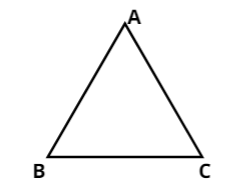
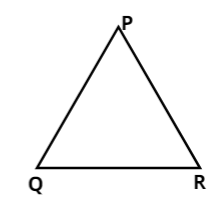
Here for triangle ABC, it is given that $BC:CA:AB = 1:2:3$
It is represented in ratio form as $\dfrac{{BC}}{1} = \dfrac{{CA}}{2} = \dfrac{{AB}}{3}$. Assuming constant one side $BC = k$, so putting this in equation $\dfrac{k}{1} = \dfrac{{CA}}{2} = \dfrac{{AB}}{3}$.
Simplifying, $\dfrac{k}{1} = \dfrac{{CA}}{2}$. So, $CA = 2k$.
And $\dfrac{k}{1} = \dfrac{{AB}}{3}$. So, $AB = 3k$.
As Triangle ABC and PQR are similar triangle, so using property of similar triangles $\dfrac{{AB}}{{PQ}} = \dfrac{{BC}}{{QR}} = \dfrac{{AC}}{{PR}}$
So, $\dfrac{{BC}}{{QR}} = \dfrac{{AC}}{{PR}}$
Putting value $BC = k$ and $CA = 2k$ in above equation,
$\dfrac{k}{{QR}} = \dfrac{{2k}}{{PR}}$
Simplifying, $\dfrac{k}{{2k}} = \dfrac{{QR}}{{PR}}$,
So, $\dfrac{1}{2} = \dfrac{{QR}}{{PR}}$.
So, $\dfrac{{QR}}{{PR}} = \dfrac{1}{2}$.
Option (B) is the correct answer.
Note: There are three ways to find if two triangles are similar: AA, SAS and SSS. AA stands for “angle, angle” means two triangles have the same corresponding angles. SAS stands for “side, angle, side” means two triangles have corresponding sides, same proportionality ratio and same corresponding included angles. SSS stands for “side, side, side” means both triangles’ corresponding sides are in the same ratio .For two triangles, if corresponding angles and corresponding sides both are equal, then they are congruent triangles. For congruent triangles, $\angle A = \angle P$, $\angle B = \angle Q$, $\angle C = \angle R$, $AB = PQ$, $BC = QR$ and $AC = PR$. Congruent triangles are represented as $\Delta ABC \cong \Delta PQR$.
So, $\angle A = \angle P$, $\angle B = \angle Q$, $\angle C = \angle R$ and $\dfrac{{AB}}{{PQ}} = \dfrac{{BC}}{{QR}} = \dfrac{{AC}}{{PR}}$. Here given that $BC:CA:AB = 1:2:3$, so assume $BC = k$, then $CA = 2k$ and $AB = 3k$. After that use $\dfrac{{AB}}{{PQ}} = \dfrac{{BC}}{{QR}} = \dfrac{{AC}}{{PR}}$ and put $BC = k$ and $CA = 2k$ to obtain $\dfrac{{QR}}{{PR}}$.
Complete step-by-step answer:
Triangles are said to be similar if they have the same shape, but same sizes may not be necessary. If one triangle is rotated, reflected or zoomed in/out to obtain another triangle, then both triangles will be similar triangles.
Here the given two triangles ABC and PQR are similar. Similar triangles are represented as $\Delta ABC \sim \Delta PQR$.
Properties of similar triangles are like corresponding angles will be the same and corresponding sides will be in the same proportions.
They are represented as $\angle A = \angle P$, $\angle B = \angle Q$, $\angle C = \angle R$ and $\dfrac{{AB}}{{PQ}} = \dfrac{{BC}}{{QR}} = \dfrac{{AC}}{{PR}}$.
Here for triangle ABC, it is given that $BC:CA:AB = 1:2:3$
It is represented in ratio form as $\dfrac{{BC}}{1} = \dfrac{{CA}}{2} = \dfrac{{AB}}{3}$. Assuming constant one side $BC = k$, so putting this in equation $\dfrac{k}{1} = \dfrac{{CA}}{2} = \dfrac{{AB}}{3}$.
Simplifying, $\dfrac{k}{1} = \dfrac{{CA}}{2}$. So, $CA = 2k$.
And $\dfrac{k}{1} = \dfrac{{AB}}{3}$. So, $AB = 3k$.
As Triangle ABC and PQR are similar triangle, so using property of similar triangles $\dfrac{{AB}}{{PQ}} = \dfrac{{BC}}{{QR}} = \dfrac{{AC}}{{PR}}$
So, $\dfrac{{BC}}{{QR}} = \dfrac{{AC}}{{PR}}$
Putting value $BC = k$ and $CA = 2k$ in above equation,
$\dfrac{k}{{QR}} = \dfrac{{2k}}{{PR}}$
Simplifying, $\dfrac{k}{{2k}} = \dfrac{{QR}}{{PR}}$,
So, $\dfrac{1}{2} = \dfrac{{QR}}{{PR}}$.
So, $\dfrac{{QR}}{{PR}} = \dfrac{1}{2}$.
Option (B) is the correct answer.
Note: There are three ways to find if two triangles are similar: AA, SAS and SSS. AA stands for “angle, angle” means two triangles have the same corresponding angles. SAS stands for “side, angle, side” means two triangles have corresponding sides, same proportionality ratio and same corresponding included angles. SSS stands for “side, side, side” means both triangles’ corresponding sides are in the same ratio .For two triangles, if corresponding angles and corresponding sides both are equal, then they are congruent triangles. For congruent triangles, $\angle A = \angle P$, $\angle B = \angle Q$, $\angle C = \angle R$, $AB = PQ$, $BC = QR$ and $AC = PR$. Congruent triangles are represented as $\Delta ABC \cong \Delta PQR$.
Recently Updated Pages
Master Class 12 Economics: Engaging Questions & Answers for Success

Master Class 12 English: Engaging Questions & Answers for Success
Master Class 12 Social Science: Engaging Questions & Answers for Success
Master Class 12 Maths: Engaging Questions & Answers for Success
Master Class 12 Physics: Engaging Questions & Answers for Success
Master Class 9 General Knowledge: Engaging Questions & Answers for Success
Trending doubts
Difference Between Plant Cell and Animal Cell
Find the sum of series 1 + 2 + 3 + 4 + 5 + + 100 class 9 maths CBSE
Fill the blanks with the suitable prepositions 1 The class 9 english CBSE
What is pollution? How many types of pollution? Define it
Name 10 Living and Non living things class 9 biology CBSE
What is the full form of pH?