




Two thermally insulated vessel 1 and 2 are filled with air at temperature \[\left( {{T}_{1}},{{T}_{2}} \right)\], volumes \[\left( {{V}_{1}},{{V}_{2}} \right)\] and pressure \[\left( {{P}_{1}},{{P}_{2}} \right)\] respectively. If the valve of joining two vessels is opened, the temperature inside the vessel at equilibrium will be (P = common pressure)
A. \[{{T}_{1}}-{{T}_{2}}\]
B. \[\dfrac{{{T}_{1}}-{{T}_{2}}}{2}\]
C. \[\dfrac{{{T}_{1}}{{T}_{2}}P\left( {{V}_{1}}+{{V}_{2}} \right)}{{{P}_{1}}{{V}_{1}}{{T}_{2}}+{{P}_{2}}{{V}_{2}}{{T}_{1}}}\]
D. \[\dfrac{{{T}_{1}}{{T}_{2}}P\left( {{P}_{1}}{{V}_{1}}+{{P}_{2}}{{V}_{2}} \right)}{{{P}_{1}}{{V}_{1}}{{T}_{2}}+{{P}_{2}}{{V}_{2}}{{T}_{1}}}\]
Answer
 Verified
656.4k+ views
Hint: If there are two thermally insulated vessels having different temperature, pressure and volume and are connected with a valve. When a valve is opened then the common temperature or temperature at equilibrium is given by conservation of moles, i.e. total initial moles is equal to total final moles.
Formula Used:
\[PV=nRT\]
Where:
P is pressure in the vessel
V is the volume of vessel
T is the temperature of vessel
R is the universal gas constant
n is the number of moles
Complete step by step answer:
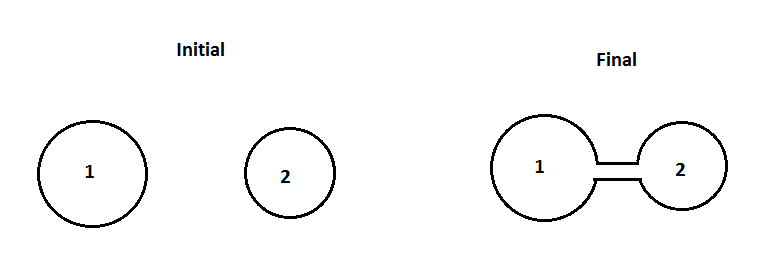
It is given that in vessel 1 has,
Temperature is \[{{T}_{1}}\]
Pressure is \[{{P}_{1}}\]
Volume is \[{{V}_{1}}\]
And in vessel 2,
Temperature is \[{{T}_{2}}\]
Pressure is \[{{P}_{2}}\]
Volume is \[{{V}_{2}}\]
Vessel 1 has \[{{n}_{1}}\] number of moles and vessel 2 has \[{{n}_{2}}\] number of moles.
And if vessel 1 and vessel 2 are connected by valve and the valve is opened, then,
Number of moles in vessel 1 is \[{{n}^{'}}_{1}\]
Number of moles in vessel 2 is \[{{n}^{'}}_{2}\]
Now applying the laws of conservation of moles and gas equation we get:
Total initial moles = Total final moles
\[\begin{align}
& {{n}_{1}}+{{n}_{2}}={{n}^{'}}_{1}+{{n}^{'}}_{2} \\
& \dfrac{{{P}_{1}}{{V}_{1}}}{R{{T}_{1}}}+\dfrac{{{P}_{2}}{{V}_{2}}}{R{{T}_{2}}}=\dfrac{P{{V}_{1}}}{RT}+\dfrac{P{{V}_{2}}}{RT} \\
\end{align}\]
Here P is common pressure and T is common temperature.
\[\begin{align}
& \dfrac{{{P}_{1}}{{V}_{1}}}{{{T}_{1}}}+\dfrac{{{P}_{2}}{{V}_{2}}}{{{T}_{2}}}=\dfrac{P{{V}_{1}}}{T}+\dfrac{P{{V}_{2}}}{T} \\
& \dfrac{{{P}_{1}}{{V}_{1}}{{T}_{2}}+{{P}_{2}}{{V}_{2}}{{T}_{1}}}{{{T}_{1}}{{T}_{2}}}=\dfrac{P\left( {{V}_{1}}+{{V}_{2}} \right)}{T} \\
& T=\dfrac{{{T}_{1}}{{T}_{2}}P\left( {{V}_{1}}+{{V}_{2}} \right)}{{{P}_{1}}{{V}_{1}}{{T}_{2}}+{{P}_{2}}{{V}_{2}}{{T}_{1}}} \\
\end{align}\]
Hence, option C. is the correct answer.
Note: Students must be careful that they do not apply energy conservation here because two vessels are connected with valves (as given in question). We apply energy conservation law when it is given that vessel 1 and vessel 2 are combined to form a single vessel. But if you apply energy conservation here you will get a different answer.
Formula Used:
\[PV=nRT\]
Where:
P is pressure in the vessel
V is the volume of vessel
T is the temperature of vessel
R is the universal gas constant
n is the number of moles
Complete step by step answer:
It is given that in vessel 1 has,
Temperature is \[{{T}_{1}}\]
Pressure is \[{{P}_{1}}\]
Volume is \[{{V}_{1}}\]
And in vessel 2,
Temperature is \[{{T}_{2}}\]
Pressure is \[{{P}_{2}}\]
Volume is \[{{V}_{2}}\]
Vessel 1 has \[{{n}_{1}}\] number of moles and vessel 2 has \[{{n}_{2}}\] number of moles.
And if vessel 1 and vessel 2 are connected by valve and the valve is opened, then,
Number of moles in vessel 1 is \[{{n}^{'}}_{1}\]
Number of moles in vessel 2 is \[{{n}^{'}}_{2}\]
Now applying the laws of conservation of moles and gas equation we get:
Total initial moles = Total final moles
\[\begin{align}
& {{n}_{1}}+{{n}_{2}}={{n}^{'}}_{1}+{{n}^{'}}_{2} \\
& \dfrac{{{P}_{1}}{{V}_{1}}}{R{{T}_{1}}}+\dfrac{{{P}_{2}}{{V}_{2}}}{R{{T}_{2}}}=\dfrac{P{{V}_{1}}}{RT}+\dfrac{P{{V}_{2}}}{RT} \\
\end{align}\]
Here P is common pressure and T is common temperature.
\[\begin{align}
& \dfrac{{{P}_{1}}{{V}_{1}}}{{{T}_{1}}}+\dfrac{{{P}_{2}}{{V}_{2}}}{{{T}_{2}}}=\dfrac{P{{V}_{1}}}{T}+\dfrac{P{{V}_{2}}}{T} \\
& \dfrac{{{P}_{1}}{{V}_{1}}{{T}_{2}}+{{P}_{2}}{{V}_{2}}{{T}_{1}}}{{{T}_{1}}{{T}_{2}}}=\dfrac{P\left( {{V}_{1}}+{{V}_{2}} \right)}{T} \\
& T=\dfrac{{{T}_{1}}{{T}_{2}}P\left( {{V}_{1}}+{{V}_{2}} \right)}{{{P}_{1}}{{V}_{1}}{{T}_{2}}+{{P}_{2}}{{V}_{2}}{{T}_{1}}} \\
\end{align}\]
Hence, option C. is the correct answer.
Note: Students must be careful that they do not apply energy conservation here because two vessels are connected with valves (as given in question). We apply energy conservation law when it is given that vessel 1 and vessel 2 are combined to form a single vessel. But if you apply energy conservation here you will get a different answer.
Recently Updated Pages
Master Class 11 Social Science: Engaging Questions & Answers for Success

Master Class 11 English: Engaging Questions & Answers for Success
Master Class 11 Accountancy: Engaging Questions & Answers for Success
Master Class 11 Physics: Engaging Questions & Answers for Success
Master Class 11 Computer Science: Engaging Questions & Answers for Success
Master Class 11 Business Studies: Engaging Questions & Answers for Success
Trending doubts
Find the value of the expression given below sin 30circ class 11 maths CBSE
One Metric ton is equal to kg A 10000 B 1000 C 100 class 11 physics CBSE
10 examples of friction in our daily life
Draw a diagram of nephron and explain its structur class 11 biology CBSE
The teeth used for biting and cutting food are called class 11 biology CBSE
Proton was discovered by A Thomson B Rutherford C Chadwick class 11 chemistry CBSE