



Two teams – team I and team II are standing in lines parallel to each other. If the distance between two players of each team is considered as 1 unit and the distance between the two teams is 5 units, then answer the following questions.
(i) In case position of A is considered as (0, 0), find the positions of C, G, P and W.
(ii) In case the position of D is considered as (0, 0), find the positions of Q, S, V, A and G.
(iii) In case the position of R is considered as (0, 0), find the positions of B, C, E, Q and T.
Answer
 Verified
511.8k+ views
Hint: Consider each subpart of the question one by one. In the first part assume A as the origin. Use the sign convention of plotting the points in four different quadrants. If we move left a horizontal line then consider the sign as negative 1 unit, for moving right consider the sign as positive 1 unit. If we move vertically upwards then consider the sign as negative 5 units, for moving vertically downwards consider the sign as negative 5 units. Similarly, consider D and R as the origin in the second and third part respectively.
Complete step by step answer:
Here we have been provided two teams whose players are standing parallel to each other. We have to determine the position of different players in each subpart considering a given player as the origin. Let us check them one by one.
(i) Here we have to consider player A as the origin (0, 0). Now, it is said that the distance between two players of each team is 1 unit and the distance between two teams is 5 units. So we have,
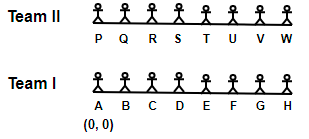
To reach C we have to move 2 places to the right, according to the convention moving right means positive sign, so position of C is (2, 0).
To reach point G we have to move 6 places to the right so the position of G is (6, 0).
To reach point P we have to move 1 place upwards, according to the convention moving upwards means positive sign, so position of P is (0, 5).
To reach point W we have to move 7 places rightwards and then 1 place upwards, so position of W is (7, 5).
(ii) Here we have to consider player D as the origin (0, 0). So we have,
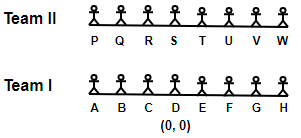
To reach Q we have to move 2 places to the left and then 1 place upwards, according to the convention moving left means negative sign, so position of Q is (-2, 5).
To reach point S we have to move 1 place upwards so the position of G is (0, 5).
To reach point V we have to move 3 places right and 1 place upwards, so the position of P is (3, 5).
To reach point A we have to move 3 places left, so position of A is (-3, 0).
To reach point G we have to move 3 places right, so the position of G is (3, 0).
(iii) Here we have to consider player R as the origin (0, 0). So we have,
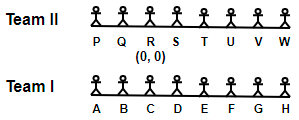
To reach B we have to move 1 place to the left and then 1 place downwards, according to the convention moving downwards means negative sign, so position of B is (-1, -5).
To reach point C we have to move 1 place downwards so the position of C is (0, -5).
To reach point E we have to move 2 places to the right and then 1 place downwards, so position of E is (2, -5).
To reach point Q we have to move 1 place to the left, so the position of Q is (-1, 0).
To reach point T we have to move 2 places to the right, so the position of T is (2, 0).
Note: Note that the position of a point plotted on a graph is also known as its coordinate. In a 2 – D plane it is represented as (x, y). Note that while writing the coordinates of a point we always write x – coordinate first and then the y – coordinate. You may see that in the above solution we have always considered the x – coordinate in the first place.
Complete step by step answer:
Here we have been provided two teams whose players are standing parallel to each other. We have to determine the position of different players in each subpart considering a given player as the origin. Let us check them one by one.
(i) Here we have to consider player A as the origin (0, 0). Now, it is said that the distance between two players of each team is 1 unit and the distance between two teams is 5 units. So we have,
To reach C we have to move 2 places to the right, according to the convention moving right means positive sign, so position of C is (2, 0).
To reach point G we have to move 6 places to the right so the position of G is (6, 0).
To reach point P we have to move 1 place upwards, according to the convention moving upwards means positive sign, so position of P is (0, 5).
To reach point W we have to move 7 places rightwards and then 1 place upwards, so position of W is (7, 5).
(ii) Here we have to consider player D as the origin (0, 0). So we have,
To reach Q we have to move 2 places to the left and then 1 place upwards, according to the convention moving left means negative sign, so position of Q is (-2, 5).
To reach point S we have to move 1 place upwards so the position of G is (0, 5).
To reach point V we have to move 3 places right and 1 place upwards, so the position of P is (3, 5).
To reach point A we have to move 3 places left, so position of A is (-3, 0).
To reach point G we have to move 3 places right, so the position of G is (3, 0).
(iii) Here we have to consider player R as the origin (0, 0). So we have,
To reach B we have to move 1 place to the left and then 1 place downwards, according to the convention moving downwards means negative sign, so position of B is (-1, -5).
To reach point C we have to move 1 place downwards so the position of C is (0, -5).
To reach point E we have to move 2 places to the right and then 1 place downwards, so position of E is (2, -5).
To reach point Q we have to move 1 place to the left, so the position of Q is (-1, 0).
To reach point T we have to move 2 places to the right, so the position of T is (2, 0).
Note: Note that the position of a point plotted on a graph is also known as its coordinate. In a 2 – D plane it is represented as (x, y). Note that while writing the coordinates of a point we always write x – coordinate first and then the y – coordinate. You may see that in the above solution we have always considered the x – coordinate in the first place.
Recently Updated Pages
Master Class 9 General Knowledge: Engaging Questions & Answers for Success

Master Class 9 Social Science: Engaging Questions & Answers for Success
Master Class 9 English: Engaging Questions & Answers for Success
Master Class 9 Maths: Engaging Questions & Answers for Success
Master Class 9 Science: Engaging Questions & Answers for Success
Class 9 Question and Answer - Your Ultimate Solutions Guide
Trending doubts
Difference Between Plant Cell and Animal Cell
Fill the blanks with the suitable prepositions 1 The class 9 english CBSE
Who is eligible for RTE class 9 social science CBSE
Which places in India experience sunrise first and class 9 social science CBSE
What is pollution? How many types of pollution? Define it
Name 10 Living and Non living things class 9 biology CBSE