




Two successive resonance frequencies in an open organ pipe are $1944Hz$ and $2592Hz$. Find the length of the tube. The speed of sound in air is $324m{{s}^{-1}}$
$\begin{align}
& A.25cm \\
& B.50cm \\
& C.12.5cm \\
& D.none \\
\end{align}$
Answer
 Verified
609k+ views
Hint: Frequency is the number of events happening of a repeating event per unit of time. It is also known as temporal frequency, which emphasizes the contrast to spatial frequency and angular frequency. Frequency is determined in units of hertz $\left( Hz \right)$ which is similar to one occurrence of a repeating event per second. Here the repeating thing is the sound wave.
Complete step by step answer:
Wave frequency is the number of waves that passes a specific point in a certain amount of time. The SI unit of wave frequency is given as hertz$\left( Hz \right)$, where one hertz is equivalent to one wave passing a constant point in one second. A higher-frequency wave has greater energy than a lower-frequency wave with the similar amplitude.
In short, frequency is the reciprocal of time period.
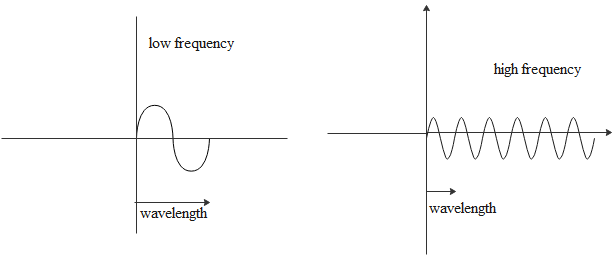
Frequency of a wave can be found by the formula,
$f=\dfrac{v}{\lambda }$
In this question, the two resonance frequencies given are $1944Hz$ and $2592Hz$
So the difference in resonance frequencies will be,
${{f}_{0}}=2592-1944=648Hz$
Therefore the wavelength of the wave is given by the equation,
$\lambda =\dfrac{v}{f}$
Substituting the value in it will give,
$\lambda =\dfrac{324}{648}=\dfrac{1}{2}m$
So the length of the tube will be equal to the half of the wavelength of the wave. Therefore the length of resonance tube is given as
$l=\dfrac{\lambda }{2}$
That is,
$\begin{align}
& l=\dfrac{0.5}{2}=0.25m \\
& l=25cm \\
\end{align}$
Therefore the correct answer is option A.
Note:
Resonant frequency is meant by the oscillation of a system in its natural or unforced resonance. Resonance occurs only if a system is capable of storing and easily transferring energy between variety storage modes, like kinetic energy or potential energy.
Complete step by step answer:
Wave frequency is the number of waves that passes a specific point in a certain amount of time. The SI unit of wave frequency is given as hertz$\left( Hz \right)$, where one hertz is equivalent to one wave passing a constant point in one second. A higher-frequency wave has greater energy than a lower-frequency wave with the similar amplitude.
In short, frequency is the reciprocal of time period.
Frequency of a wave can be found by the formula,
$f=\dfrac{v}{\lambda }$
In this question, the two resonance frequencies given are $1944Hz$ and $2592Hz$
So the difference in resonance frequencies will be,
${{f}_{0}}=2592-1944=648Hz$
Therefore the wavelength of the wave is given by the equation,
$\lambda =\dfrac{v}{f}$
Substituting the value in it will give,
$\lambda =\dfrac{324}{648}=\dfrac{1}{2}m$
So the length of the tube will be equal to the half of the wavelength of the wave. Therefore the length of resonance tube is given as
$l=\dfrac{\lambda }{2}$
That is,
$\begin{align}
& l=\dfrac{0.5}{2}=0.25m \\
& l=25cm \\
\end{align}$
Therefore the correct answer is option A.
Note:
Resonant frequency is meant by the oscillation of a system in its natural or unforced resonance. Resonance occurs only if a system is capable of storing and easily transferring energy between variety storage modes, like kinetic energy or potential energy.
Recently Updated Pages
Master Class 12 Economics: Engaging Questions & Answers for Success

Master Class 12 English: Engaging Questions & Answers for Success
Master Class 12 Social Science: Engaging Questions & Answers for Success
Master Class 12 Maths: Engaging Questions & Answers for Success
Master Class 12 Physics: Engaging Questions & Answers for Success
Master Class 11 Social Science: Engaging Questions & Answers for Success
Trending doubts
One Metric ton is equal to kg A 10000 B 1000 C 100 class 11 physics CBSE
Difference Between Prokaryotic Cells and Eukaryotic Cells
Find the value of the expression given below sin 30circ class 11 maths CBSE
1 ton equals to A 100 kg B 1000 kg C 10 kg D 10000 class 11 physics CBSE
Two of the body parts which do not appear in MRI are class 11 biology CBSE
Draw a diagram of nephron and explain its structur class 11 biology CBSE