




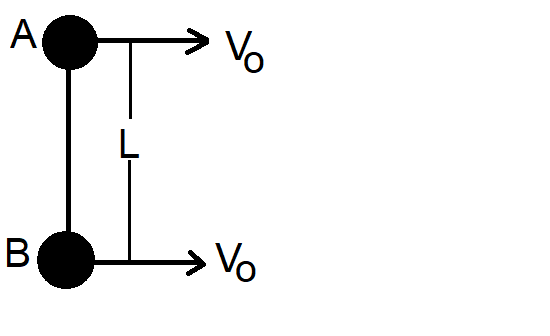
Two small balls A and B, each of mass m, are joined rigidly at the ends of a light rod of length L. The system translates on a frictionless horizontal surface with a velocity ${{v}_{0}}$ in a direction perpendicular to the rod. A particle P of mass m kept at rest on the surface sticks to the ball A as the ball collides with it. Find:
a) the linear speeds of the balls A and B after the collision
b) the velocity of the centre of mass C of the system A+B+P and
c) the angular speed of the system about C after the collision
Answer
 Verified
610.5k+ views
Hint: For solving this question, we must go part by part starting from A to C, because for solving each part, the data that we get from the previous part will be used. For A part, it can easily be solved using the law of conservation of momentum. After we get the relationship between the velocities, we can use that to solve part B for getting the velocity that is required. The key part for solving the C part is \[{{P}_{cm}}={{I}_{cm}}\times \omega \]
Complete answer:
Two balls of mass m, A and B respectively, are rigidly joined to the light ends of the rod of length L. The machine films in the direction perpendicular to the rod at a velocity ${{v}_{0}}$.
As the ball collides with the ball, a particle P of mass m held at rest on the surface adheres to ball A.
So,For the part A ,We have,
Just over its length can the light rod exert a force on the ball B.
But the impact won't change the speed.
B has velocity = ${{v}_{0}}$
So, If we treat the three bodies as a device,
Applying the law of linear momentum conservation,
\[\Rightarrow m{{v}_{0}}=2mv\prime \]
$\Rightarrow v'=\dfrac{{{v}_{0}}}{2}$
Therefore, A will be having the velocity
$\Rightarrow v'=\dfrac{{{v}_{0}}}{2}$
(b) Now, let us solve for the B part
If we consider the three bodies to be a system
Therefore, net external force = 0
Therefore, the velocity of the centre of mass will be given as:
\[\Rightarrow {{V}_{cm}}=\dfrac{m{{v}_{0}}+2m(\dfrac{{{v}_{0}}}{2})}{m+2m}\]
\[\Rightarrow {{V}_{cm}}=\dfrac{m{{v}_{0}}+m{{v}_{0}}}{3m}\]
\[\Rightarrow {{V}_{cm}}=\dfrac{2m{{v}_{0}}}{3m}\]
\[\Rightarrow {{V}_{cm}}=\dfrac{2}{3}{{v}_{0}}\]
Therefore, the velocity of the centre of mass C of the system A+B+P will be
\[\Rightarrow {{V}_{cm}}=\dfrac{2}{3}{{v}_{0}}\]
(c) Now, for the part C
So,
The velocity of (A+P) with respect to the centre of mass will be
$\Rightarrow \dfrac{2{{v}_{0}}}{3}-\dfrac{{{v}_{0}}}{2}=\dfrac{{{v}_{0}}}{6}$
Now,
The velocity of B with respect to the centre of mass will be
\[\Rightarrow {{v}_{0}}-\dfrac{2{{v}_{0}}}{3}=\dfrac{{{v}_{0}}}{3}\] (Only considering the magnitude)
Now,
The distance of the (A+P) from centre of mass will be
$=\dfrac{1}{3}$
And that for B will be = $\dfrac{21}{3}$
So, now
By using conservation of angular momentum
We have,
\[{{P}_{cm}}={{I}_{cm}}\times \omega \]
Using the values we have
\[\Rightarrow 2m\times \dfrac{{{v}_{0}}}{6}\times \dfrac{1}{3}+m\times \dfrac{{{v}_{o}}}{3}\times \dfrac{21}{3}=2m{{(\dfrac{1}{3})}^{2}}+m{{(\dfrac{21}{3})}^{2}}\times \omega \]
\[\Rightarrow \dfrac{6m{{v}_{0}}l}{18}=\dfrac{6ml}{9}\times \omega \]
$\Rightarrow \omega =\dfrac{{{v}_{0}}}{2l}$
So, the angular speed of the system about C after the collision will be
$\Rightarrow \omega =\dfrac{{{v}_{0}}}{2l}$
Note:
The law of conservation of momentum says in physics and chemistry that the momentum of an independent device remains constant. Therefore, momentum is said to be retained over time; that is, momentum is not produced or lost, only converted or shifted from one form to another.
Complete answer:
Two balls of mass m, A and B respectively, are rigidly joined to the light ends of the rod of length L. The machine films in the direction perpendicular to the rod at a velocity ${{v}_{0}}$.
As the ball collides with the ball, a particle P of mass m held at rest on the surface adheres to ball A.
So,For the part A ,We have,
Just over its length can the light rod exert a force on the ball B.
But the impact won't change the speed.
B has velocity = ${{v}_{0}}$
So, If we treat the three bodies as a device,
Applying the law of linear momentum conservation,
\[\Rightarrow m{{v}_{0}}=2mv\prime \]
$\Rightarrow v'=\dfrac{{{v}_{0}}}{2}$
Therefore, A will be having the velocity
$\Rightarrow v'=\dfrac{{{v}_{0}}}{2}$
(b) Now, let us solve for the B part
If we consider the three bodies to be a system
Therefore, net external force = 0
Therefore, the velocity of the centre of mass will be given as:
\[\Rightarrow {{V}_{cm}}=\dfrac{m{{v}_{0}}+2m(\dfrac{{{v}_{0}}}{2})}{m+2m}\]
\[\Rightarrow {{V}_{cm}}=\dfrac{m{{v}_{0}}+m{{v}_{0}}}{3m}\]
\[\Rightarrow {{V}_{cm}}=\dfrac{2m{{v}_{0}}}{3m}\]
\[\Rightarrow {{V}_{cm}}=\dfrac{2}{3}{{v}_{0}}\]
Therefore, the velocity of the centre of mass C of the system A+B+P will be
\[\Rightarrow {{V}_{cm}}=\dfrac{2}{3}{{v}_{0}}\]
(c) Now, for the part C
So,
The velocity of (A+P) with respect to the centre of mass will be
$\Rightarrow \dfrac{2{{v}_{0}}}{3}-\dfrac{{{v}_{0}}}{2}=\dfrac{{{v}_{0}}}{6}$
Now,
The velocity of B with respect to the centre of mass will be
\[\Rightarrow {{v}_{0}}-\dfrac{2{{v}_{0}}}{3}=\dfrac{{{v}_{0}}}{3}\] (Only considering the magnitude)
Now,
The distance of the (A+P) from centre of mass will be
$=\dfrac{1}{3}$
And that for B will be = $\dfrac{21}{3}$
So, now
By using conservation of angular momentum
We have,
\[{{P}_{cm}}={{I}_{cm}}\times \omega \]
Using the values we have
\[\Rightarrow 2m\times \dfrac{{{v}_{0}}}{6}\times \dfrac{1}{3}+m\times \dfrac{{{v}_{o}}}{3}\times \dfrac{21}{3}=2m{{(\dfrac{1}{3})}^{2}}+m{{(\dfrac{21}{3})}^{2}}\times \omega \]
\[\Rightarrow \dfrac{6m{{v}_{0}}l}{18}=\dfrac{6ml}{9}\times \omega \]
$\Rightarrow \omega =\dfrac{{{v}_{0}}}{2l}$
So, the angular speed of the system about C after the collision will be
$\Rightarrow \omega =\dfrac{{{v}_{0}}}{2l}$
Note:
The law of conservation of momentum says in physics and chemistry that the momentum of an independent device remains constant. Therefore, momentum is said to be retained over time; that is, momentum is not produced or lost, only converted or shifted from one form to another.
Recently Updated Pages
Master Class 12 Economics: Engaging Questions & Answers for Success

Master Class 12 English: Engaging Questions & Answers for Success
Master Class 12 Social Science: Engaging Questions & Answers for Success
Master Class 12 Maths: Engaging Questions & Answers for Success
Master Class 12 Physics: Engaging Questions & Answers for Success
Master Class 9 General Knowledge: Engaging Questions & Answers for Success
Trending doubts
One Metric ton is equal to kg A 10000 B 1000 C 100 class 11 physics CBSE
Difference Between Prokaryotic Cells and Eukaryotic Cells
Find the value of the expression given below sin 30circ class 11 maths CBSE
Two of the body parts which do not appear in MRI are class 11 biology CBSE
1 ton equals to A 100 kg B 1000 kg C 10 kg D 10000 class 11 physics CBSE
Draw a diagram of nephron and explain its structur class 11 biology CBSE