




Two similar cones have volume $12\pi $ cubic units and $96\pi $ cubic units. If the curved surface area of the smaller cone is $15\pi $ square units, what is the curved surface area of the larger cone?
Answer
 Verified
612.9k+ views
Hint:Use the fact that similar cones have the same ratio of height, radius, and slant height. Assume that this ratio is ‘x’. Write the volume of both the cones using the formula $\dfrac{1}{3}\pi {{r}^{2}}h$. Take the ratio of the volume of both the cones and write dimensions of one cone in terms of dimensions of another cone. Simplify the expression to calculate the value of ‘x’. Calculate the curved surface area of the larger cone using formula $\pi rl$. Write its dimensions in terms of dimensions of the smaller cone and substitute the value of variable ‘x’ to calculate its value.
Complete step-by-step answer:
We know that the volume of two similar cones is $12\pi $ cubic units and $96\pi $ cubic units and the curved surface area of the smaller cone is $15\pi $ square units. We have to calculate the curved surface area of the larger cone.
We know that the volume of the cone is $\dfrac{1}{3}\pi {{r}^{2}}h$, where ‘r’ is the radius of the cone and ‘h’ is the height of the cone.
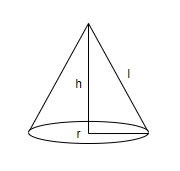
Let’s assume that the radius, height, and slant height of the smaller and larger cone is ${{r}_{1}},{{h}_{1}},{{l}_{1}}$ and ${{r}_{2}},{{h}_{2}},{{l}_{2}}$ respectively. We know that the two cones are similar.
We know that the ratio of radii, heights, and slant heights of two similar cones is constant. Assume that this ratio is ‘x’.
Thus, we have $\dfrac{{{r}_{1}}}{{{r}_{2}}}=\dfrac{{{h}_{1}}}{{{h}_{2}}}=\dfrac{{{l}_{1}}}{{{l}_{2}}}=x$.
We can rewrite the above equation as ${{r}_{1}}=x{{r}_{2}},{{h}_{1}}=x{{h}_{2}},{{l}_{1}}=x{{l}_{2}}.....\left( 1 \right)$.
The volume of the smaller cone is $\dfrac{1}{3}\pi r_{1}^{2}{{h}_{1}}=12\pi .....\left( 2 \right)$.
Similarly, the volume of the larger cone is $\dfrac{1}{3}\pi r_{2}^{2}{{h}_{2}}=96\pi .....\left( 3 \right)$.
Dividing equation (2) and (3), we have \[\dfrac{\dfrac{1}{3}\pi r_{1}^{2}{{h}_{1}}}{\dfrac{1}{3}\pi r_{2}^{2}{{h}_{2}}}=\dfrac{12\pi }{96\pi }\].
Simplifying the above expression, we have $\dfrac{r_{1}^{2}{{h}_{1}}}{r_{2}^{2}{{h}_{2}}}=\dfrac{12}{96}$.
Substituting the values of equation (1) in the above equation, we have $\dfrac{{{x}^{2}}r_{2}^{2}x{{h}_{2}}}{r_{2}^{2}{{h}_{2}}}=\dfrac{12}{96}=\dfrac{1}{8}$.
Simplifying the above expression, we have ${{x}^{3}}=\dfrac{1}{8}$.
Taking the cube root on both sides, we have $x={{\left( \dfrac{1}{8} \right)}^{\dfrac{1}{3}}}=\dfrac{1}{2}$.
Substituting the above value in equation (1), we have ${{r}_{1}}=\dfrac{{{r}_{2}}}{2},{{h}_{1}}=\dfrac{{{h}_{2}}}{2},{{l}_{1}}=\dfrac{{{l}_{2}}}{2}$.
We can rewrite the above equation as ${{r}_{2}}=2{{r}_{1}},{{h}_{2}}=2{{h}_{1}},{{l}_{2}}=2{{l}_{1}}.....\left( 4 \right)$
We know that the curved surface area of a cone is $\pi rl$, ‘r’ is the radius of the cone and ‘l’ is the slant height of the cone.
So, the curved surface area of the smaller cone is $\pi {{r}_{1}}{{l}_{1}}=15\pi .....\left( 5 \right)$.
The curved surface area of the larger cone is $\pi {{r}_{2}}{{l}_{2}}$.
Substituting equation (4) in the above expression, the curved surface area of the larger cone is $=\pi {{r}_{2}}{{l}_{2}}=2\times 2\times \pi {{r}_{1}}{{l}_{1}}$.
Substituting equation (5) in the above expression, the curved surface area of the larger cone is $=\pi {{r}_{2}}{{l}_{2}}=2\times 2\times \pi {{r}_{1}}{{l}_{1}}=4\times 15\pi =60\pi $ square units.
Hence, the curved surface area of the larger cone is $60\pi $ square units.
Note: One must be careful about units while calculating the volume and area of the cone. We can’t solve this question without using the fact that if two cones are similar, the ratio of their heights, radii, and slant heights is a constant.We should remember the formulas of volume and curved surface area of cone for solving these types of questions.Writing the dimensions of larger cone to calculate curved surface area in terms of dimensions of smaller cone is the main key to get the answer.
Complete step-by-step answer:
We know that the volume of two similar cones is $12\pi $ cubic units and $96\pi $ cubic units and the curved surface area of the smaller cone is $15\pi $ square units. We have to calculate the curved surface area of the larger cone.
We know that the volume of the cone is $\dfrac{1}{3}\pi {{r}^{2}}h$, where ‘r’ is the radius of the cone and ‘h’ is the height of the cone.
Let’s assume that the radius, height, and slant height of the smaller and larger cone is ${{r}_{1}},{{h}_{1}},{{l}_{1}}$ and ${{r}_{2}},{{h}_{2}},{{l}_{2}}$ respectively. We know that the two cones are similar.
We know that the ratio of radii, heights, and slant heights of two similar cones is constant. Assume that this ratio is ‘x’.
Thus, we have $\dfrac{{{r}_{1}}}{{{r}_{2}}}=\dfrac{{{h}_{1}}}{{{h}_{2}}}=\dfrac{{{l}_{1}}}{{{l}_{2}}}=x$.
We can rewrite the above equation as ${{r}_{1}}=x{{r}_{2}},{{h}_{1}}=x{{h}_{2}},{{l}_{1}}=x{{l}_{2}}.....\left( 1 \right)$.
The volume of the smaller cone is $\dfrac{1}{3}\pi r_{1}^{2}{{h}_{1}}=12\pi .....\left( 2 \right)$.
Similarly, the volume of the larger cone is $\dfrac{1}{3}\pi r_{2}^{2}{{h}_{2}}=96\pi .....\left( 3 \right)$.
Dividing equation (2) and (3), we have \[\dfrac{\dfrac{1}{3}\pi r_{1}^{2}{{h}_{1}}}{\dfrac{1}{3}\pi r_{2}^{2}{{h}_{2}}}=\dfrac{12\pi }{96\pi }\].
Simplifying the above expression, we have $\dfrac{r_{1}^{2}{{h}_{1}}}{r_{2}^{2}{{h}_{2}}}=\dfrac{12}{96}$.
Substituting the values of equation (1) in the above equation, we have $\dfrac{{{x}^{2}}r_{2}^{2}x{{h}_{2}}}{r_{2}^{2}{{h}_{2}}}=\dfrac{12}{96}=\dfrac{1}{8}$.
Simplifying the above expression, we have ${{x}^{3}}=\dfrac{1}{8}$.
Taking the cube root on both sides, we have $x={{\left( \dfrac{1}{8} \right)}^{\dfrac{1}{3}}}=\dfrac{1}{2}$.
Substituting the above value in equation (1), we have ${{r}_{1}}=\dfrac{{{r}_{2}}}{2},{{h}_{1}}=\dfrac{{{h}_{2}}}{2},{{l}_{1}}=\dfrac{{{l}_{2}}}{2}$.
We can rewrite the above equation as ${{r}_{2}}=2{{r}_{1}},{{h}_{2}}=2{{h}_{1}},{{l}_{2}}=2{{l}_{1}}.....\left( 4 \right)$
We know that the curved surface area of a cone is $\pi rl$, ‘r’ is the radius of the cone and ‘l’ is the slant height of the cone.
So, the curved surface area of the smaller cone is $\pi {{r}_{1}}{{l}_{1}}=15\pi .....\left( 5 \right)$.
The curved surface area of the larger cone is $\pi {{r}_{2}}{{l}_{2}}$.
Substituting equation (4) in the above expression, the curved surface area of the larger cone is $=\pi {{r}_{2}}{{l}_{2}}=2\times 2\times \pi {{r}_{1}}{{l}_{1}}$.
Substituting equation (5) in the above expression, the curved surface area of the larger cone is $=\pi {{r}_{2}}{{l}_{2}}=2\times 2\times \pi {{r}_{1}}{{l}_{1}}=4\times 15\pi =60\pi $ square units.
Hence, the curved surface area of the larger cone is $60\pi $ square units.
Note: One must be careful about units while calculating the volume and area of the cone. We can’t solve this question without using the fact that if two cones are similar, the ratio of their heights, radii, and slant heights is a constant.We should remember the formulas of volume and curved surface area of cone for solving these types of questions.Writing the dimensions of larger cone to calculate curved surface area in terms of dimensions of smaller cone is the main key to get the answer.
Recently Updated Pages
Master Class 11 Computer Science: Engaging Questions & Answers for Success

Master Class 11 Business Studies: Engaging Questions & Answers for Success
Master Class 11 Economics: Engaging Questions & Answers for Success
Master Class 11 English: Engaging Questions & Answers for Success
Master Class 11 Maths: Engaging Questions & Answers for Success
Master Class 11 Biology: Engaging Questions & Answers for Success
Trending doubts
One Metric ton is equal to kg A 10000 B 1000 C 100 class 11 physics CBSE
There are 720 permutations of the digits 1 2 3 4 5 class 11 maths CBSE
Discuss the various forms of bacteria class 11 biology CBSE
Draw a diagram of a plant cell and label at least eight class 11 biology CBSE
State the laws of reflection of light
Explain zero factorial class 11 maths CBSE