




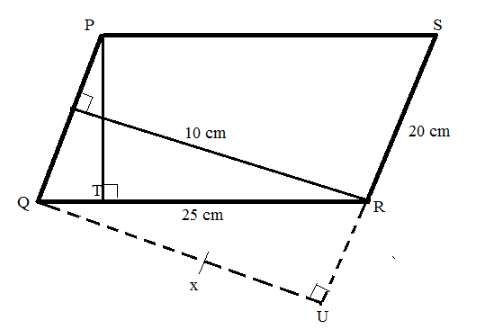
Two sides of a parallelogram are 20 cm and 25 cm. If the altitude corresponds to the sides of length 25 cm is 10 cm. Find the altitude corresponding to the other pair of the sides.
Answer
 Verified
605.4k+ views
Hint: Area of a parallelogram is equal to the product of the base and the height of the parallelogram. In this question length of both sides of parallelogram are given and length of their corresponding altitudes are also given so by using the area of the parallelogram formula we will equate the areas to find the missing side.
Complete step-by-step answer:
Given the two sides of the parallelogram PQRS as
PS=QR=25 cm
PQ=SR=20 cm
We know the area of a parallelogram is the product of their base and their height and for the base QR we can see PT is its altitude and for the base SR its altitude is QU, hence we can write this as
\[QR \times PT = SR \times QU\]
Now we will substitute the values of the corresponding base and their altitude to find the length of the side QU
\[
\Rightarrow 25 \times 10 = 20 \times QU \\
\Rightarrow QU = \dfrac{{250}}{{20}} \\
= 12.5\;cm \\
\]
Now since the side QU is denoted as the symbol x, hence we can the altitude corresponding to the other pair of the sides is \[x = 12.5\;cm\]
So, the correct answer is “12.5 cm”.
Note: Another method to find the area of a parallelogram is the half of the product of the length of the diagonals which are intersecting at any angle in corresponding to the sine function.
Given by the formula \[Area = \dfrac{1}{2} \times {d_1} \times {d_2}\sin \left( x \right)\] . In this question since the length of the diagonals are not given so we will find the area using base and the altitude.
Complete step-by-step answer:
Given the two sides of the parallelogram PQRS as
PS=QR=25 cm
PQ=SR=20 cm
We know the area of a parallelogram is the product of their base and their height and for the base QR we can see PT is its altitude and for the base SR its altitude is QU, hence we can write this as
\[QR \times PT = SR \times QU\]
Now we will substitute the values of the corresponding base and their altitude to find the length of the side QU
\[
\Rightarrow 25 \times 10 = 20 \times QU \\
\Rightarrow QU = \dfrac{{250}}{{20}} \\
= 12.5\;cm \\
\]
Now since the side QU is denoted as the symbol x, hence we can the altitude corresponding to the other pair of the sides is \[x = 12.5\;cm\]
So, the correct answer is “12.5 cm”.
Note: Another method to find the area of a parallelogram is the half of the product of the length of the diagonals which are intersecting at any angle in corresponding to the sine function.
Given by the formula \[Area = \dfrac{1}{2} \times {d_1} \times {d_2}\sin \left( x \right)\] . In this question since the length of the diagonals are not given so we will find the area using base and the altitude.
Recently Updated Pages
Master Class 11 English: Engaging Questions & Answers for Success

Master Class 11 Social Science: Engaging Questions & Answers for Success
Master Class 11 Maths: Engaging Questions & Answers for Success
Master Class 11 Chemistry: Engaging Questions & Answers for Success
Master Class 11 Biology: Engaging Questions & Answers for Success
Master Class 11 Physics: Engaging Questions & Answers for Success
Trending doubts
What is BLO What is the full form of BLO class 8 social science CBSE
Which Indian state shares the longest international class 8 social science CBSE
Citizens of India can vote at the age of A 18 years class 8 social science CBSE
In Indian rupees 1 trillion is equal to how many c class 8 maths CBSE
Full form of STD, ISD and PCO
Give me the opposite gender of Duck class 8 english CBSE