




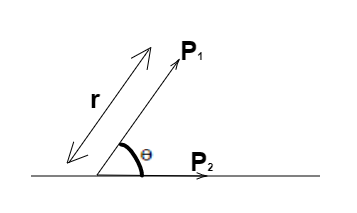
Two short electric dipoles are placed as shown. The energy of electric interaction between these dipoles will be
A.$\dfrac{2k{{P}_{1}}{{P}_{2}}\cos \theta }{{{r}^{3}}}$
B.$\dfrac{-2k{{P}_{1}}{{P}_{2}}\cos \theta }{{{r}^{3}}}$
C.$\dfrac{-2k{{P}_{1}}{{P}_{2}}\sin \theta }{{{r}^{3}}}$
D.$\dfrac{-4k{{P}_{1}}{{P}_{2}}\cos \theta }{{{r}^{3}}}$
Answer
 Verified
577.8k+ views
Hint:We are given two short electric dipoles which are inclined at an angle $\theta $ with each other. They have some potential energy due to their mutual interaction. We shall therefore apply the basic formula of potential energy of the dipoles but while substituting the values, we must take care of the orientation of the two dipoles with respect to each other.
Complete answer:
The potential energy of interaction of dipoles, $U$ is expressed as:
$U=-\dfrac{2k{{P}_{1}}{{P}_{2}}}{{{r}^{3}}}$
Where,
$k=\dfrac{1}{4\pi {{\varepsilon }_{0}}}$ and ${{\varepsilon }_{0}}=8.85\times {{10}^{-12}}F{{m}^{-1}}$ and is called the permittivity of free space
$\Rightarrow k=9\times {{10}^{9}}$
${{P}_{1}}=$ dipole moment of one dipole
${{P}_{2}}=$ dipole moment of second dipole
$r=$ distance between the dipole and the position vector
Here, those component dipole moments must be taken which is parallel to the position vector of the dipole.
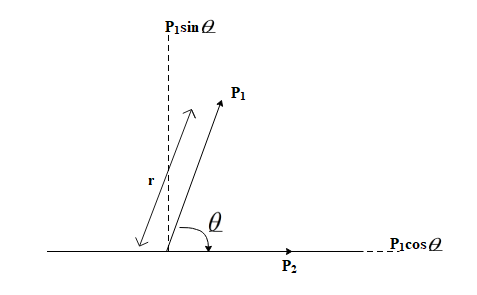
The vertical component of dipole ${{P}_{1}}$ becomes equal to zero and the horizontal component is considered further. Therefore, we shall the dipole moments as ${{P}_{1}}\cos \theta $ and ${{P}_{2}}$ because the two dipoles are inclined at angle $\theta $with each other.
Thus, substituting the values, we get
$U=-\dfrac{2k{{P}_{1}}\cos \theta {{P}_{2}}}{{{r}^{3}}}$
$\Rightarrow U=-\dfrac{2k{{P}_{1}}{{P}_{2}}\cos \theta }{{{r}^{3}}}$
Hence, the energy of electric interaction between these dipoles is $-\dfrac{2k{{P}_{1}}{{P}_{2}}\cos \theta }{{{r}^{3}}}$.
Therefore, the correct option is (B) $-\dfrac{2k{{P}_{1}}{{P}_{2}}\cos \theta }{{{r}^{3}}}$.
Note:
Every dipole has its own electric potential which is given by $\dfrac{kP\cos \theta }{{{r}^{2}}}$ where the symbols have their usual meaning. However, the dipole does not have any potential energy when it is isolated. It develops a potential energy only when another dipole comes in its vicinity and interacts with it. In that case, both the dipoles develop their own potential energy due to their mutual interaction.
Complete answer:
The potential energy of interaction of dipoles, $U$ is expressed as:
$U=-\dfrac{2k{{P}_{1}}{{P}_{2}}}{{{r}^{3}}}$
Where,
$k=\dfrac{1}{4\pi {{\varepsilon }_{0}}}$ and ${{\varepsilon }_{0}}=8.85\times {{10}^{-12}}F{{m}^{-1}}$ and is called the permittivity of free space
$\Rightarrow k=9\times {{10}^{9}}$
${{P}_{1}}=$ dipole moment of one dipole
${{P}_{2}}=$ dipole moment of second dipole
$r=$ distance between the dipole and the position vector
Here, those component dipole moments must be taken which is parallel to the position vector of the dipole.
The vertical component of dipole ${{P}_{1}}$ becomes equal to zero and the horizontal component is considered further. Therefore, we shall the dipole moments as ${{P}_{1}}\cos \theta $ and ${{P}_{2}}$ because the two dipoles are inclined at angle $\theta $with each other.
Thus, substituting the values, we get
$U=-\dfrac{2k{{P}_{1}}\cos \theta {{P}_{2}}}{{{r}^{3}}}$
$\Rightarrow U=-\dfrac{2k{{P}_{1}}{{P}_{2}}\cos \theta }{{{r}^{3}}}$
Hence, the energy of electric interaction between these dipoles is $-\dfrac{2k{{P}_{1}}{{P}_{2}}\cos \theta }{{{r}^{3}}}$.
Therefore, the correct option is (B) $-\dfrac{2k{{P}_{1}}{{P}_{2}}\cos \theta }{{{r}^{3}}}$.
Note:
Every dipole has its own electric potential which is given by $\dfrac{kP\cos \theta }{{{r}^{2}}}$ where the symbols have their usual meaning. However, the dipole does not have any potential energy when it is isolated. It develops a potential energy only when another dipole comes in its vicinity and interacts with it. In that case, both the dipoles develop their own potential energy due to their mutual interaction.
Recently Updated Pages
Master Class 11 Social Science: Engaging Questions & Answers for Success

Master Class 11 English: Engaging Questions & Answers for Success
Master Class 11 Maths: Engaging Questions & Answers for Success
Master Class 11 Chemistry: Engaging Questions & Answers for Success
Master Class 11 Biology: Engaging Questions & Answers for Success
Master Class 11 Physics: Engaging Questions & Answers for Success
Trending doubts
Which gas is abundant in air class 11 chemistry CBSE
10 examples of friction in our daily life
Explain zero factorial class 11 maths CBSE
Difference between unicellular and multicellular o class 11 biology CBSE
Draw a diagram showing the external features of fish class 11 biology CBSE
What organs are located on the left side of your body class 11 biology CBSE