




Two ships are there in the sea on either side of a lighthouse in such a way that the ships and the lighthouse are in the same straight line. The angles of depression of two ships observed from the top of the lighthouse are ${60^ \circ }$ and ${45^ \circ }$ respectively. If the height of the lighthouse is $200$ m, find the distance between the two ships. (Use $\sqrt 3 = 1.73$)
Answer
 Verified
557.4k+ views
Hint: We will use trigonometric formulas to solve this question. First, we will draw the figure according to the condition and we will apply the trigonometric formulas such as $\tan {\theta ^ \circ } = \dfrac{{opposite}}{{adjacent}}$.
Complete step-by-step solution:
Let us draw a figure in which PR represents the lighthouse and QS represents the distance between two ships such that Q – R – S.
Q is the ${1^{st}}$ ship and S is the ${2^{st}}$
The height of the lighthouse is $PR = 200m$
The angle of depression for ${1^{st}}$ ship is ${60^ \circ }$ and the angle of depression for ${2^{st}}$ ship is ${45^ \circ }$
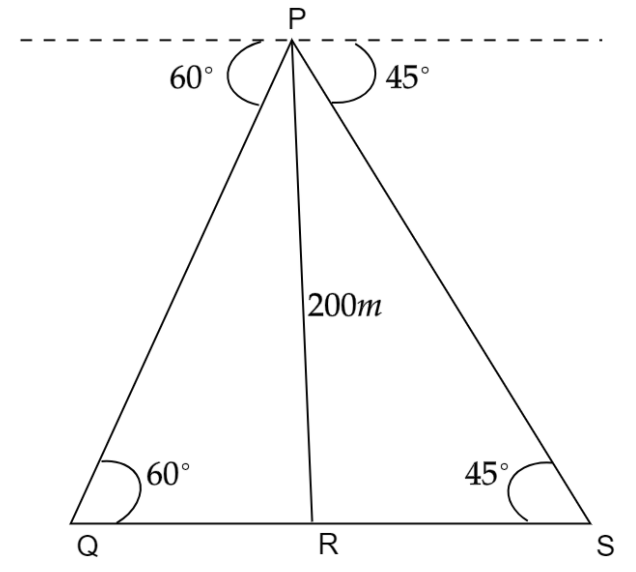
Line P and line QS are parallel.
Therefore,
$\angle PQS = {60^ \circ }$ and $\angle PSQ = {45^ \circ }$ (Alternate angles between two parallel lines are congruent)
In $\Delta PQR$,
$\tan {60^ \circ } = \dfrac{{opposite}}{{adjacent}} = \dfrac{{PR}}{{QR}}$
Substituting $\tan {60^ \circ } = \sqrt 3 $ and $PR = 200m$,
$\sqrt 3 = \dfrac{{200}}{{QR}}$
Rearranging the terms,
$QR = \dfrac{{200}}{{\sqrt 3 }}$
Putting value of $\sqrt 3 = 1.73$,
$QR = \dfrac{{200}}{{1.73}}m$
In $\Delta PRS$,
$\tan {45^ \circ } = \dfrac{{opposite}}{{adjacent}} = \dfrac{{PR}}{{RS}}$
Substituting $\tan {45^ \circ } = 1$ and $PR = 200m$,
$1 = \dfrac{{200}}{{RS}}$
Rearranging the terms,
$RS = 200m$
The ships and the lighthouse are all in a straight line such that Q – R – S.
Therefore, we can write,
$QS = QR + RS$
We know the values of QR and RS,
Substituting those values,
$QS = \dfrac{{200}}{{\sqrt 3 }} + 200$
Making the denominator same,
$QS = \dfrac{{200}}{{\sqrt 3 }} + \dfrac{{200\sqrt 3 }}{{\sqrt 3 }}$
Since the denominator is same, we can add the numerator part,
$QS = \dfrac{{200 + 200\sqrt 3 }}{{\sqrt 3 }}$
Taking $200$ common from numerator,
$QS = \dfrac{{200(1 + \sqrt 3 )}}{{\sqrt 3 }}$
Substituting the value of $\sqrt 3 = 1.73$,
$QS = \dfrac{{200(1 + 1.73)}}{{1.73}}$
Adding the terms,
$QS = \dfrac{{200(2.73)}}{{1.73}}$
Simplifying the terms,
$QS = 315.60$
Therefore, the distance between the two ships is $315.60m$.
Note: The angle of depression is the angle between a horizontal line from the observer and the line of sight to an object that is below the horizontal line. The angle of elevation is the angle between a horizontal line from the observer and the line of sight to an object that is above the horizontal line. This problem is based on solutions of triangles where we establish a relation b/w unknown values and given data with the help of different trigonometric ratios.
Complete step-by-step solution:
Let us draw a figure in which PR represents the lighthouse and QS represents the distance between two ships such that Q – R – S.
Q is the ${1^{st}}$ ship and S is the ${2^{st}}$
The height of the lighthouse is $PR = 200m$
The angle of depression for ${1^{st}}$ ship is ${60^ \circ }$ and the angle of depression for ${2^{st}}$ ship is ${45^ \circ }$
Line P and line QS are parallel.
Therefore,
$\angle PQS = {60^ \circ }$ and $\angle PSQ = {45^ \circ }$ (Alternate angles between two parallel lines are congruent)
In $\Delta PQR$,
$\tan {60^ \circ } = \dfrac{{opposite}}{{adjacent}} = \dfrac{{PR}}{{QR}}$
Substituting $\tan {60^ \circ } = \sqrt 3 $ and $PR = 200m$,
$\sqrt 3 = \dfrac{{200}}{{QR}}$
Rearranging the terms,
$QR = \dfrac{{200}}{{\sqrt 3 }}$
Putting value of $\sqrt 3 = 1.73$,
$QR = \dfrac{{200}}{{1.73}}m$
In $\Delta PRS$,
$\tan {45^ \circ } = \dfrac{{opposite}}{{adjacent}} = \dfrac{{PR}}{{RS}}$
Substituting $\tan {45^ \circ } = 1$ and $PR = 200m$,
$1 = \dfrac{{200}}{{RS}}$
Rearranging the terms,
$RS = 200m$
The ships and the lighthouse are all in a straight line such that Q – R – S.
Therefore, we can write,
$QS = QR + RS$
We know the values of QR and RS,
Substituting those values,
$QS = \dfrac{{200}}{{\sqrt 3 }} + 200$
Making the denominator same,
$QS = \dfrac{{200}}{{\sqrt 3 }} + \dfrac{{200\sqrt 3 }}{{\sqrt 3 }}$
Since the denominator is same, we can add the numerator part,
$QS = \dfrac{{200 + 200\sqrt 3 }}{{\sqrt 3 }}$
Taking $200$ common from numerator,
$QS = \dfrac{{200(1 + \sqrt 3 )}}{{\sqrt 3 }}$
Substituting the value of $\sqrt 3 = 1.73$,
$QS = \dfrac{{200(1 + 1.73)}}{{1.73}}$
Adding the terms,
$QS = \dfrac{{200(2.73)}}{{1.73}}$
Simplifying the terms,
$QS = 315.60$
Therefore, the distance between the two ships is $315.60m$.
Note: The angle of depression is the angle between a horizontal line from the observer and the line of sight to an object that is below the horizontal line. The angle of elevation is the angle between a horizontal line from the observer and the line of sight to an object that is above the horizontal line. This problem is based on solutions of triangles where we establish a relation b/w unknown values and given data with the help of different trigonometric ratios.
Recently Updated Pages
Class 10 Question and Answer - Your Ultimate Solutions Guide

Master Class 10 Computer Science: Engaging Questions & Answers for Success
Master Class 10 General Knowledge: Engaging Questions & Answers for Success
Master Class 12 Economics: Engaging Questions & Answers for Success
Master Class 12 Social Science: Engaging Questions & Answers for Success
Master Class 12 English: Engaging Questions & Answers for Success
Trending doubts
Explain the Treaty of Vienna of 1815 class 10 social science CBSE
The slogan Jai Hind was given by A Lal Bahadur Shastri class 10 social science CBSE
10 examples of evaporation in daily life with explanations
What is the full form of POSCO class 10 social science CBSE
Identify the feminine form of noun nephew a shenephew class 10 english CBSE
CSIR full form?