




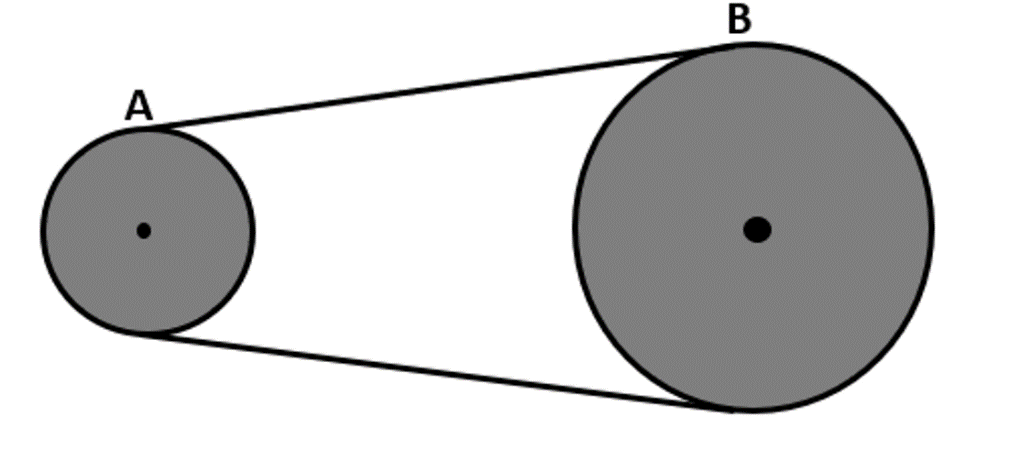
Two pulleys of radius $6cm$ and $10cm$ are connected by a belt. The larger pulley rotates at 40 times per minute. What is the angular velocity (radians per minute) of each pulley?
Answer
 Verified
588.9k+ views
Hint: The rate of revolution of the larger pulley has been provided to us. So, we can use it to easily calculate the angular velocity of the larger pulley. Now, to calculate the angular velocity of the smaller pulley, we use the basic analysis of the system that the speed of the belt at every point will remain constant.
Complete step-by-step solution:
The speed of rotation of the larger pulley is 40 times per minute. By 40 times, it means 40 revolutions per minute. Now we know that one revolution is equal to $2\pi $ radian. Then, 40 revolutions per minute will be equal to:
$=2\pi \times 40$
$=80\pi $ radians per minute
Now, using the value of $\pi $ as 3.14, we get:
$=80\times 3.14$
$=251.2$ radians per minute
Hence, the angular velocity of the larger pulley comes out to be $251.2$ radians per minute.
Now, for the smaller pulley we use the fact that the linear speed of belt is same at all the points. And this linear speed at the contact with the two pulleys is given to be:
For the smaller pulley:
$\Rightarrow v={{r}_{1}}{{\omega }_{1}}$
Where,
${{r}_{1}}$ is the radius of the smaller pulley which is equal to 6cm.
${{\omega }_{1}}$ is the angular velocity of the smaller pulley
For the larger pulley:
$\Rightarrow v={{r}_{2}}{{\omega }_{2}}$
Where,
${{r}_{2}}$ is the radius of the bigger pulley which is equal to 10cm.
${{\omega }_{2}}$ is the angular velocity of the bigger pulley which is equal to $80\pi $ radians per minute.
Thus, equating the linear speed of these two pulleys we get:
$\begin{align}
& \Rightarrow 6({{\omega }_{1}})=10(80\pi ) \\
& \Rightarrow {{\omega }_{1}}=\dfrac{800\times 3.14}{6} \\
& \Rightarrow {{\omega }_{1}}=\dfrac{2512}{6} \\
\end{align}$
$\Rightarrow {{\omega }_{1}}=418.66$ radians per minute.
Hence, the angular velocity of the smaller pulley comes out to be $418.66$ radians per minute.
Note: Our analysis of the fact that the linear speed of the belt is the same at every point and is equal to the speed of the pulleys at their circumference is only valid when there is no mention of sliding in the question. That is, there is sufficient friction between the pulley and the belt.
Complete step-by-step solution:
The speed of rotation of the larger pulley is 40 times per minute. By 40 times, it means 40 revolutions per minute. Now we know that one revolution is equal to $2\pi $ radian. Then, 40 revolutions per minute will be equal to:
$=2\pi \times 40$
$=80\pi $ radians per minute
Now, using the value of $\pi $ as 3.14, we get:
$=80\times 3.14$
$=251.2$ radians per minute
Hence, the angular velocity of the larger pulley comes out to be $251.2$ radians per minute.
Now, for the smaller pulley we use the fact that the linear speed of belt is same at all the points. And this linear speed at the contact with the two pulleys is given to be:
For the smaller pulley:
$\Rightarrow v={{r}_{1}}{{\omega }_{1}}$
Where,
${{r}_{1}}$ is the radius of the smaller pulley which is equal to 6cm.
${{\omega }_{1}}$ is the angular velocity of the smaller pulley
For the larger pulley:
$\Rightarrow v={{r}_{2}}{{\omega }_{2}}$
Where,
${{r}_{2}}$ is the radius of the bigger pulley which is equal to 10cm.
${{\omega }_{2}}$ is the angular velocity of the bigger pulley which is equal to $80\pi $ radians per minute.
Thus, equating the linear speed of these two pulleys we get:
$\begin{align}
& \Rightarrow 6({{\omega }_{1}})=10(80\pi ) \\
& \Rightarrow {{\omega }_{1}}=\dfrac{800\times 3.14}{6} \\
& \Rightarrow {{\omega }_{1}}=\dfrac{2512}{6} \\
\end{align}$
$\Rightarrow {{\omega }_{1}}=418.66$ radians per minute.
Hence, the angular velocity of the smaller pulley comes out to be $418.66$ radians per minute.
Note: Our analysis of the fact that the linear speed of the belt is the same at every point and is equal to the speed of the pulleys at their circumference is only valid when there is no mention of sliding in the question. That is, there is sufficient friction between the pulley and the belt.
Recently Updated Pages
Basicity of sulphurous acid and sulphuric acid are

Master Class 11 English: Engaging Questions & Answers for Success
Master Class 11 Physics: Engaging Questions & Answers for Success
Master Class 11 Computer Science: Engaging Questions & Answers for Success
Master Class 11 Chemistry: Engaging Questions & Answers for Success
Master Class 11 Social Science: Engaging Questions & Answers for Success
Trending doubts
Difference Between Prokaryotic Cells and Eukaryotic Cells
Two of the body parts which do not appear in MRI are class 11 biology CBSE
One Metric ton is equal to kg A 10000 B 1000 C 100 class 11 physics CBSE
10 examples of friction in our daily life
Draw a diagram of nephron and explain its structur class 11 biology CBSE
What will happen if the mucus is not secreted by the class 11 biology CBSE