




Two polypeptide chains are joined by hydrogen bonds to produce
A)Alpha helix
B)Tertiary structure
C)Beta pleated sheet
D)All of the above
Answer
 Verified
618.6k+ views
Hint: It is a segment of a polypeptide chain that is lined next to each other and forms a structure that is stabilized by hydrogen bond form between carbonyl (CO) and N-H groups in the polypeptide backbone.
Complete answer:
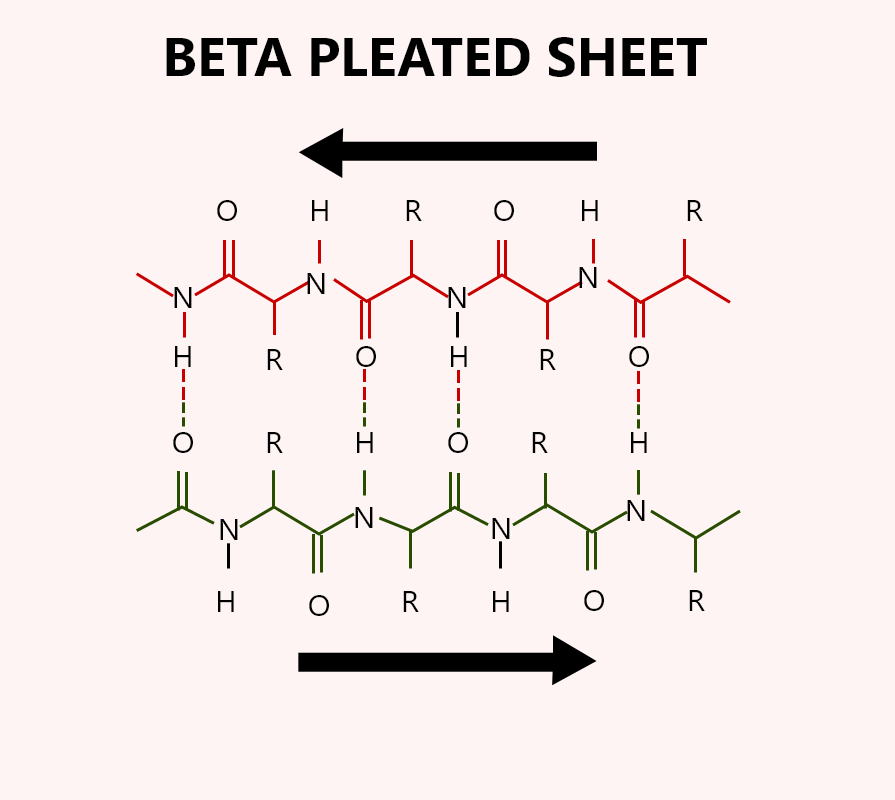
Beta pleated sheets are formed when two or more than two polypeptide chains segments line up side by side and each individual segment is called a beta-strand. The beta-strand is fully extended.
-Beta pleated sheet held together by hydrogen bonds between carbonyl and the N-H group of the polypeptide backbone. Beta strands may be parallel, pointing in the same direction or antiparallel, pointing in the opposite direction.
-In an antiparallel sheet, adjacent strands run in the opposite direction, and hydrogen bonds between N-H and CO groups connect each amino acid to a single amino acid on the adjacent strand.
-In parallel sheet adjacent strands run in the same direction and a hydrogen bond connects amino acid on one strand with two different amino acids on the adjacent strand.
-For each amino acid the N-H group is hydrogen-bonded to the group of one amino acid on the adjacent strand.
Additional Information: Alpha helix - it is a rod-like structure that forms when a polypeptide chain is twisted into a helical conformation. It can be right-handed or left-handed.except for amino acid near the ends of an alpha helix, all the main chain CO and NH groups are hydrogen bonds.
Tertiary structure- it refers to the unique 3D conformation in which globular protein interactions between the side chains in their primary structure
So, the correct answer is, "beta-pleated sheet".
Note: Most proteins have a globular shape and require reversal in a direction of the polypeptide chain. These reversals are done by a common structural element called the turn.
-Turns are classified according to the separation between the two end residues participating in hydrogen bonds.
-They are alpha turns, beta-turn, and gamma turn.
Complete answer:
Beta pleated sheets are formed when two or more than two polypeptide chains segments line up side by side and each individual segment is called a beta-strand. The beta-strand is fully extended.
-Beta pleated sheet held together by hydrogen bonds between carbonyl and the N-H group of the polypeptide backbone. Beta strands may be parallel, pointing in the same direction or antiparallel, pointing in the opposite direction.
-In an antiparallel sheet, adjacent strands run in the opposite direction, and hydrogen bonds between N-H and CO groups connect each amino acid to a single amino acid on the adjacent strand.
-In parallel sheet adjacent strands run in the same direction and a hydrogen bond connects amino acid on one strand with two different amino acids on the adjacent strand.
-For each amino acid the N-H group is hydrogen-bonded to the group of one amino acid on the adjacent strand.
Additional Information: Alpha helix - it is a rod-like structure that forms when a polypeptide chain is twisted into a helical conformation. It can be right-handed or left-handed.except for amino acid near the ends of an alpha helix, all the main chain CO and NH groups are hydrogen bonds.
Tertiary structure- it refers to the unique 3D conformation in which globular protein interactions between the side chains in their primary structure
So, the correct answer is, "beta-pleated sheet".
Note: Most proteins have a globular shape and require reversal in a direction of the polypeptide chain. These reversals are done by a common structural element called the turn.
-Turns are classified according to the separation between the two end residues participating in hydrogen bonds.
-They are alpha turns, beta-turn, and gamma turn.
Recently Updated Pages
Master Class 11 English: Engaging Questions & Answers for Success

Master Class 11 Social Science: Engaging Questions & Answers for Success
Master Class 11 Maths: Engaging Questions & Answers for Success
Master Class 11 Biology: Engaging Questions & Answers for Success
Master Class 11 Physics: Engaging Questions & Answers for Success
Master Class 11 Chemistry: Engaging Questions & Answers for Success
Trending doubts
One Metric ton is equal to kg A 10000 B 1000 C 100 class 11 physics CBSE
Difference Between Prokaryotic Cells and Eukaryotic Cells
Two of the body parts which do not appear in MRI are class 11 biology CBSE
Find the value of the expression given below sin 30circ class 11 maths CBSE
Draw a diagram of a plant cell and label at least eight class 11 biology CBSE
10 examples of friction in our daily life