




Two point-masses m and 4 m are separated by a distance d on a line. A third point mass ${m_0}$is to be placed at a point on the line such that the net gravitational force on it is zero. The distance of that point from the m mass is

Answer
 Verified
642k+ views
Hint: For the gravitational force to be zero on the line joining these two masses, there must be equal and opposite forces acting on the mass at a point on the line. By equating the forces, we can find the distance at which this occurs.
Complete step by step solution:
The concept of gravitational force is based on the Newton’s law of universal gravitation which states that – everybody in this universe exerts a gravitational force on another body whose magnitude is directly proportional to the product of the masses of the bodies and inversely proportional to the square of distance between the bodies and acts along the line joining the centres of the two bodies.
If two bodies of mass ${m_1}$ and ${m_2}$ are separated by a distance r,
Gravitational force,
$F \propto {m_1}{m_2}$
$F \propto \dfrac{1}{{{r^2}}}$
Combining,
$F \propto \dfrac{{{m_1}{m_2}}}{{{r^2}}}$
$ \Rightarrow F = G\dfrac{{{m_1}{m_2}}}{{{r^2}}}$
where G is called the universal gravitational constant and its value is equal to $6 \cdot 67 \times {10^{ - 11}}N{m^2}k{g^{ - 2}}$
Consider two point-masses of mass m and 4m separated by a distance d. Let a point mass ${m_0}$ be kept at a distance of $x$ from the mass m, such that the net gravitational force acting on it is zero, as shown:
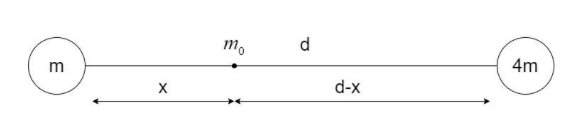
The gravitational force experienced by ${m_0}$ from both the masses is equal.
Hence,
${F_1} = {F_2}$
$\dfrac{{G \times m \times {m_0}}}{{{x^2}}} = \dfrac{{G \times 4m \times {m_0}}}{{{{\left( {d - x} \right)}^2}}}$
$ \Rightarrow \dfrac{{{{\left( {d - x} \right)}^2}}}{{{x^2}}} = 4$
$ \Rightarrow \dfrac{{{{\left( {d - x} \right)}^2}}}{{{x^2}}} = {2^2}$
Squaring on both sides
$\dfrac{{d - x}}{x} = 2$
$ \Rightarrow d - x = 2x$
$ \Rightarrow 3x = d$
$\therefore x = \dfrac{d}{3}$
The distance at which the mass should be placed is 1/3rd of the total distance of separation, measured from the mass m.
Note: The principle that says that the equal forces acting on the opposite directions cause net effect to be zero, is the principle of equilibrium of forces. According to the equilibrium of forces, Net forces in the direction X = 0 $\sum {F_x} = 0$
Complete step by step solution:
The concept of gravitational force is based on the Newton’s law of universal gravitation which states that – everybody in this universe exerts a gravitational force on another body whose magnitude is directly proportional to the product of the masses of the bodies and inversely proportional to the square of distance between the bodies and acts along the line joining the centres of the two bodies.
If two bodies of mass ${m_1}$ and ${m_2}$ are separated by a distance r,
Gravitational force,
$F \propto {m_1}{m_2}$
$F \propto \dfrac{1}{{{r^2}}}$
Combining,
$F \propto \dfrac{{{m_1}{m_2}}}{{{r^2}}}$
$ \Rightarrow F = G\dfrac{{{m_1}{m_2}}}{{{r^2}}}$
where G is called the universal gravitational constant and its value is equal to $6 \cdot 67 \times {10^{ - 11}}N{m^2}k{g^{ - 2}}$
Consider two point-masses of mass m and 4m separated by a distance d. Let a point mass ${m_0}$ be kept at a distance of $x$ from the mass m, such that the net gravitational force acting on it is zero, as shown:
The gravitational force experienced by ${m_0}$ from both the masses is equal.
Hence,
${F_1} = {F_2}$
$\dfrac{{G \times m \times {m_0}}}{{{x^2}}} = \dfrac{{G \times 4m \times {m_0}}}{{{{\left( {d - x} \right)}^2}}}$
$ \Rightarrow \dfrac{{{{\left( {d - x} \right)}^2}}}{{{x^2}}} = 4$
$ \Rightarrow \dfrac{{{{\left( {d - x} \right)}^2}}}{{{x^2}}} = {2^2}$
Squaring on both sides
$\dfrac{{d - x}}{x} = 2$
$ \Rightarrow d - x = 2x$
$ \Rightarrow 3x = d$
$\therefore x = \dfrac{d}{3}$
The distance at which the mass should be placed is 1/3rd of the total distance of separation, measured from the mass m.
Note: The principle that says that the equal forces acting on the opposite directions cause net effect to be zero, is the principle of equilibrium of forces. According to the equilibrium of forces, Net forces in the direction X = 0 $\sum {F_x} = 0$
Recently Updated Pages
If x a + bt + ct2 where x is in meters and t is in class 11 physics CBSE

A car covers the first half distance between two places class 11 physics CBSE
The resultant of two vectors overrightarrow P and overrightarrow class 11 physics CBSE
Find the value of cos 135 class 11 maths CBSE
A mass M is held in place by an applied force F and class 11 physics CBSE
A solution of glucose in water is labelled as 10 dfracwv class 11 chemistry CBSE
Trending doubts
One Metric ton is equal to kg A 10000 B 1000 C 100 class 11 physics CBSE
Find the value of the expression given below sin 30circ class 11 maths CBSE
Draw a diagram of nephron and explain its structur class 11 biology CBSE
10 examples of friction in our daily life
Proton was discovered by A Thomson B Rutherford C Chadwick class 11 chemistry CBSE
Bond order ofO2 O2+ O2 and O22 is in order A O2 langle class 11 chemistry CBSE