




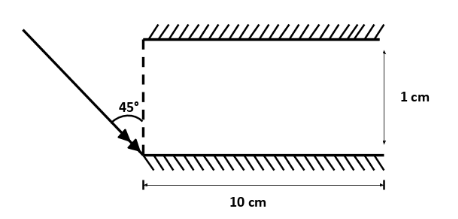
Two plane mirrors each of length 10cm are placed at a separation of 1cm. A ray of light is incident at an angle of \[{45^ \circ }\]on one of the mirrors as shown in the figure. How many reflections, the ray have before going out from the other end?
Answer
 Verified
571.8k+ views
Hint: The angle of incidence is equal to the angle of reflection. It is given that the angle of incidence made by the ray of light incident on one of the mirrors is \[{45^ \circ }\]. So, every reflection that occurs between the two mirrors will make an angle of \[{45^ \circ }\]with the normal.
Formula Used:
Angle of incidence = Angle of reflection.
Complete step by step answer:
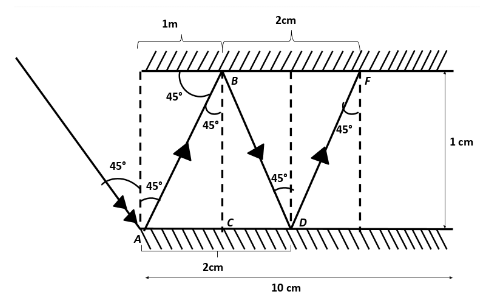
The two mirrors of 10cm are placed 1cm apart from each other. Since, the mirrors are 1cm apart, they are parallel to each other. The ray of light makes an angle of incidence \[{45^ \circ }\] with the normal at mirror \[X\]. As the angle of incidence is equal to the angle of reflection, the angle of reflection will be \[\angle (OAB) = {45^ \circ }\]. The beam will again travel and reach the mirror\[Y\] making an angle of incidence \[\angle (ABC) = {45^ \circ }\] with the normal. Therefore, \[\angle (OBA) = {45^ \circ }\]. Thus, \[\Delta (OAB)\]will be an isosceles triangle. Hence, if \[l(OA) = 1cm\], then \[l(OB) = 1cm\].
If angle of incidence\[\angle (ABC) = {45^ \circ }\], then angle of reflection \[\angle (CBD) = {45^ \circ }\]. Then, \[l(AD) = 2cm\]. If \[l(OB) = 1cm\], then \[l(BE) = 2cm\]. Thus, the ray of light will continue making reflections at the length of 2cm. The length of both the mirrors is 10 cm. Therefore, the given ray of light will make 6 reflections on mirror \[X\](since the first reflection is at 0cm) and 5 reflections on mirror \[Y\]. Therefore, the total number of reflections the ray will have before going out from the other end is 11.
Note: For perfect \[{45^ \circ }\]reflections to occur inside the mirrors, the two mirrors should be correctly placed 1cm apart so that they are parallel to each other throughout the other end. Also, for the angle of incidence to be equal to the angle of reflection, the mirrors used must be plane polished surfaces.
Formula Used:
Angle of incidence = Angle of reflection.
Complete step by step answer:
The two mirrors of 10cm are placed 1cm apart from each other. Since, the mirrors are 1cm apart, they are parallel to each other. The ray of light makes an angle of incidence \[{45^ \circ }\] with the normal at mirror \[X\]. As the angle of incidence is equal to the angle of reflection, the angle of reflection will be \[\angle (OAB) = {45^ \circ }\]. The beam will again travel and reach the mirror\[Y\] making an angle of incidence \[\angle (ABC) = {45^ \circ }\] with the normal. Therefore, \[\angle (OBA) = {45^ \circ }\]. Thus, \[\Delta (OAB)\]will be an isosceles triangle. Hence, if \[l(OA) = 1cm\], then \[l(OB) = 1cm\].
If angle of incidence\[\angle (ABC) = {45^ \circ }\], then angle of reflection \[\angle (CBD) = {45^ \circ }\]. Then, \[l(AD) = 2cm\]. If \[l(OB) = 1cm\], then \[l(BE) = 2cm\]. Thus, the ray of light will continue making reflections at the length of 2cm. The length of both the mirrors is 10 cm. Therefore, the given ray of light will make 6 reflections on mirror \[X\](since the first reflection is at 0cm) and 5 reflections on mirror \[Y\]. Therefore, the total number of reflections the ray will have before going out from the other end is 11.
Note: For perfect \[{45^ \circ }\]reflections to occur inside the mirrors, the two mirrors should be correctly placed 1cm apart so that they are parallel to each other throughout the other end. Also, for the angle of incidence to be equal to the angle of reflection, the mirrors used must be plane polished surfaces.
Recently Updated Pages
Master Class 9 General Knowledge: Engaging Questions & Answers for Success

Master Class 9 Social Science: Engaging Questions & Answers for Success
Master Class 9 English: Engaging Questions & Answers for Success
Master Class 9 Maths: Engaging Questions & Answers for Success
Master Class 9 Science: Engaging Questions & Answers for Success
Class 9 Question and Answer - Your Ultimate Solutions Guide
Trending doubts
Difference Between Plant Cell and Animal Cell
Fill the blanks with the suitable prepositions 1 The class 9 english CBSE
Who is eligible for RTE class 9 social science CBSE
Which places in India experience sunrise first and class 9 social science CBSE
What is pollution? How many types of pollution? Define it
Name 10 Living and Non living things class 9 biology CBSE