




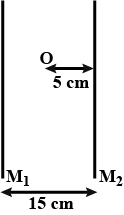
Two plane mirrors are parallel to each other and an object \[O\] is placed between them. Then the distance of the first three images from the mirror \[{M_2}\] will be (in cm):
A. \[\;5,{\text{ }}10{\text{ }},15\]
B. \[\;\;5,{\text{ }}15,{\text{ }}30\]
C. \[5,{\text{ }}25,{\text{ }}35\]
D. \[5,{\text{ }}15,{\text{ }}25\]
Answer
 Verified
547.2k+ views
Hint: Two mirrors are placed parallel to each other and an object is kept between them at some distance to both the mirrors. Image development in mirrors takes place by reflection and it abides by the laws of reflection. When two mirrors are placed at some angle to each other, several images are formed by each mirror.
Complete step by step solution:
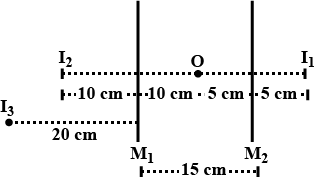
Given two mirrors are kept parallel to each other and an object is kept between them. The number of images created when two mirrors are placed parallel to each other is given as shown in the ray diagram below
$n = \dfrac{{360}}{\theta }$
Here, $n$is the number of images formed
$\theta $ is the angle between the mirrors
Substituting for the above condition,
$n = \dfrac{{360}}{0} = \infty $
An infinite number of images are formed.
The object is at distance $5cm$ from the mirror \[2\], then its distance from the mirror $1$ will be-
$15 - 5 = 10cm$
As given in the ray diagram above, we identify that the distance of the image formed by a plane mirror is equal to the distance of the object from the mirror.
The first image in the mirror \[2\] will be at distance $\dfrac{L}{3} = \dfrac{{15}}{3} = 5cm$,
the second image will be a reflection of the image in the mirror \[1\],
that is, at $\dfrac{{2 \times L}}{3} = \dfrac{{2 \times 15}}{3} = 10cm$ behind the mirror \[1\]
and, the third image will be at a distance of $\dfrac{{4 \times L}}{3} = \dfrac{{4 \times 15}}{3} = 20cm$ behind the mirror \[1\].
Therefore the distances from the mirror \[{M_2}\] for all the \[3\] images will be $5cm,25cm,35cm$.
Hence, the correct option is C.
Note:
As the angle between the mirrors rises, the number of images created reduces. Light rays that travel along the normal trace their primary path after reflection. The several images created are reflections of objects in addition to reflections. Reflection can only happen on a smooth, shiny surface.
Complete step by step solution:
Given two mirrors are kept parallel to each other and an object is kept between them. The number of images created when two mirrors are placed parallel to each other is given as shown in the ray diagram below
$n = \dfrac{{360}}{\theta }$
Here, $n$is the number of images formed
$\theta $ is the angle between the mirrors
Substituting for the above condition,
$n = \dfrac{{360}}{0} = \infty $
An infinite number of images are formed.
The object is at distance $5cm$ from the mirror \[2\], then its distance from the mirror $1$ will be-
$15 - 5 = 10cm$
As given in the ray diagram above, we identify that the distance of the image formed by a plane mirror is equal to the distance of the object from the mirror.
The first image in the mirror \[2\] will be at distance $\dfrac{L}{3} = \dfrac{{15}}{3} = 5cm$,
the second image will be a reflection of the image in the mirror \[1\],
that is, at $\dfrac{{2 \times L}}{3} = \dfrac{{2 \times 15}}{3} = 10cm$ behind the mirror \[1\]
and, the third image will be at a distance of $\dfrac{{4 \times L}}{3} = \dfrac{{4 \times 15}}{3} = 20cm$ behind the mirror \[1\].
Therefore the distances from the mirror \[{M_2}\] for all the \[3\] images will be $5cm,25cm,35cm$.
Hence, the correct option is C.
Note:
As the angle between the mirrors rises, the number of images created reduces. Light rays that travel along the normal trace their primary path after reflection. The several images created are reflections of objects in addition to reflections. Reflection can only happen on a smooth, shiny surface.
Recently Updated Pages
Basicity of sulphurous acid and sulphuric acid are

Master Class 12 Economics: Engaging Questions & Answers for Success
Master Class 12 Biology: Engaging Questions & Answers for Success
Master Class 11 English: Engaging Questions & Answers for Success
Master Class 11 Physics: Engaging Questions & Answers for Success
Master Class 11 Computer Science: Engaging Questions & Answers for Success
Trending doubts
Draw a labelled sketch of the human eye class 12 physics CBSE
The chemical formula of tear gas is A CO Cl 2 B C 10 class 12 chemistry CBSE
Draw ray diagrams each showing i myopic eye and ii class 12 physics CBSE
Which are the Top 10 Largest Countries of the World?
Differentiate between homogeneous and heterogeneous class 12 chemistry CBSE
Which is the correct genotypic ratio of mendel dihybrid class 12 biology CBSE