




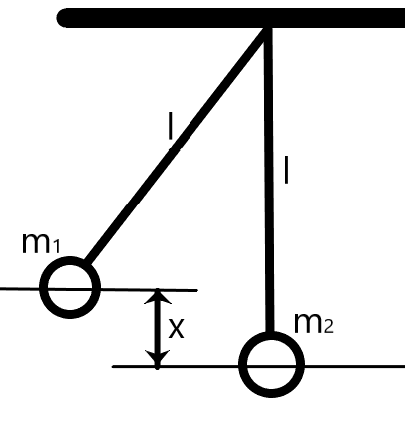
Two pendulums each of length l are initially situated as shown in figure. The first pendulum is released and strikes the second. Assume that the collision is completely inelastic and neglect the mass of the string and any frictional effects. How high does the center of mass rise after the collision?
\[\begin{align}
& \text{A) }x{{\left( \dfrac{{{m}_{1}}}{({{m}_{1}}+{{m}_{2}})} \right)}^{2}} \\
& \text{B) }x\left( \dfrac{{{m}_{1}}}{({{m}_{1}}+{{m}_{2}})} \right) \\
& \text{C) }x{{\left( \dfrac{{{m}_{1}}+{{m}_{2}}}{{{m}_{2}}} \right)}^{2}} \\
& \text{D) }x{{\left( \dfrac{{{m}_{2}}}{({{m}_{1}}+{{m}_{2}})} \right)}^{2}} \\
\end{align}\]
Answer
 Verified
589.5k+ views
Hint: We need to understand the relation between the velocity of the first ball with the momentum that is imparted to the second ball after collision. We can use the mechanical energy conversions involved for getting the velocities of the balls.
Complete answer:
We are given a system of simple pendulums in which two bobs are attached to a single point and one is swung initially. The velocity of the first bob is used to impart a momentum on the second bob which results in the completely inelastic collision, i.e., the two bobs stick together after collision.
We know that the first bob has initially only the potential energy stored due to the displacement from the mean position. This potential completely turns into kinetic energy once the bob comes to the mean position just before collision (\[{{m}_{1}}\] is the mass of the first bob) as –
\[\begin{align}
& P{{E}_{\max }}={{m}_{1}}gx \\
& K{{E}_{\max }}=\dfrac{1}{2}{{m}_{1}}{{v}^{2}} \\
& \text{At mean position,} \\
& K{{E}_{\max }}=P{{E}_{\max }} \\
& \Rightarrow \dfrac{1}{2}{{m}_{1}}{{v}^{2}}={{m}_{1}}gx \\
& \therefore {{v}^{2}}=2gx \\
\end{align}\]
Now, once the bob 1 collides with the bob 2 with the velocity ‘v’, the momentum in the system at the point of collision will be due to this velocity, which is given as –
\[\begin{align}
& \text{Momentum before collision = Momentum after collision} \\
& \Rightarrow {{m}_{1}}v=({{m}_{1}}+{{m}_{2}})v' \\
& \therefore v'=\dfrac{{{m}_{1}}v}{({{m}_{1}}+{{m}_{2}})} \\
\end{align}\]
Now, we can use the information on the two velocities to find the maximum displacement of the system of bobs as –
\[\begin{align}
& \text{Kinetic energy after collision = Potential energy at the max}\text{. displacement x }\!\!'\!\!\text{ } \\
& \Rightarrow \dfrac{1}{2}({{m}_{1}}+{{m}_{2}})v{{'}^{2}}=({{m}_{1}}+{{m}_{2}})gx' \\
& \Rightarrow \dfrac{1}{2}{{(\dfrac{{{m}_{1}}v}{({{m}_{1}}+{{m}_{2}})})}^{2}}=gx' \\
& \Rightarrow \dfrac{1}{2}{{(\dfrac{{{m}_{1}}}{({{m}_{1}}+{{m}_{2}})})}^{2}}(2gx)=gx' \\
& \therefore x'=x{{\left( \dfrac{{{m}_{1}}}{({{m}_{1}}+{{m}_{2}})} \right)}^{2}} \\
\end{align}\]
The maximum height attained by the system of pendulum bobs after collision is given by the variable x’.
The correct answer is option A.
Note:
We can very easily find the height attained after an inelastic collision as we have done here. For a perfectly elastic collision, the total momentum or the kinetic energy of the first bob will be transferred to the second thus leaving the first one to be at rest.
Complete answer:
We are given a system of simple pendulums in which two bobs are attached to a single point and one is swung initially. The velocity of the first bob is used to impart a momentum on the second bob which results in the completely inelastic collision, i.e., the two bobs stick together after collision.
We know that the first bob has initially only the potential energy stored due to the displacement from the mean position. This potential completely turns into kinetic energy once the bob comes to the mean position just before collision (\[{{m}_{1}}\] is the mass of the first bob) as –
\[\begin{align}
& P{{E}_{\max }}={{m}_{1}}gx \\
& K{{E}_{\max }}=\dfrac{1}{2}{{m}_{1}}{{v}^{2}} \\
& \text{At mean position,} \\
& K{{E}_{\max }}=P{{E}_{\max }} \\
& \Rightarrow \dfrac{1}{2}{{m}_{1}}{{v}^{2}}={{m}_{1}}gx \\
& \therefore {{v}^{2}}=2gx \\
\end{align}\]
Now, once the bob 1 collides with the bob 2 with the velocity ‘v’, the momentum in the system at the point of collision will be due to this velocity, which is given as –
\[\begin{align}
& \text{Momentum before collision = Momentum after collision} \\
& \Rightarrow {{m}_{1}}v=({{m}_{1}}+{{m}_{2}})v' \\
& \therefore v'=\dfrac{{{m}_{1}}v}{({{m}_{1}}+{{m}_{2}})} \\
\end{align}\]
Now, we can use the information on the two velocities to find the maximum displacement of the system of bobs as –
\[\begin{align}
& \text{Kinetic energy after collision = Potential energy at the max}\text{. displacement x }\!\!'\!\!\text{ } \\
& \Rightarrow \dfrac{1}{2}({{m}_{1}}+{{m}_{2}})v{{'}^{2}}=({{m}_{1}}+{{m}_{2}})gx' \\
& \Rightarrow \dfrac{1}{2}{{(\dfrac{{{m}_{1}}v}{({{m}_{1}}+{{m}_{2}})})}^{2}}=gx' \\
& \Rightarrow \dfrac{1}{2}{{(\dfrac{{{m}_{1}}}{({{m}_{1}}+{{m}_{2}})})}^{2}}(2gx)=gx' \\
& \therefore x'=x{{\left( \dfrac{{{m}_{1}}}{({{m}_{1}}+{{m}_{2}})} \right)}^{2}} \\
\end{align}\]
The maximum height attained by the system of pendulum bobs after collision is given by the variable x’.
The correct answer is option A.
Note:
We can very easily find the height attained after an inelastic collision as we have done here. For a perfectly elastic collision, the total momentum or the kinetic energy of the first bob will be transferred to the second thus leaving the first one to be at rest.
Recently Updated Pages
Three beakers labelled as A B and C each containing 25 mL of water were taken A small amount of NaOH anhydrous CuSO4 and NaCl were added to the beakers A B and C respectively It was observed that there was an increase in the temperature of the solutions contained in beakers A and B whereas in case of beaker C the temperature of the solution falls Which one of the following statements isarecorrect i In beakers A and B exothermic process has occurred ii In beakers A and B endothermic process has occurred iii In beaker C exothermic process has occurred iv In beaker C endothermic process has occurred

Master Class 11 Social Science: Engaging Questions & Answers for Success
Master Class 11 Physics: Engaging Questions & Answers for Success
Master Class 11 Maths: Engaging Questions & Answers for Success
Master Class 11 Economics: Engaging Questions & Answers for Success
Master Class 11 Computer Science: Engaging Questions & Answers for Success
Three beakers labelled as A B and C each containing 25 mL of water were taken A small amount of NaOH anhydrous CuSO4 and NaCl were added to the beakers A B and C respectively It was observed that there was an increase in the temperature of the solutions contained in beakers A and B whereas in case of beaker C the temperature of the solution falls Which one of the following statements isarecorrect i In beakers A and B exothermic process has occurred ii In beakers A and B endothermic process has occurred iii In beaker C exothermic process has occurred iv In beaker C endothermic process has occurred
Master Class 11 Social Science: Engaging Questions & Answers for Success
Master Class 11 Physics: Engaging Questions & Answers for Success
Trending doubts
One Metric ton is equal to kg A 10000 B 1000 C 100 class 11 physics CBSE
There are 720 permutations of the digits 1 2 3 4 5 class 11 maths CBSE
1 Quintal is equal to a 110 kg b 10 kg c 100kg d 1000 class 11 physics CBSE
State and prove Bernoullis theorem class 11 physics CBSE
Difference Between Prokaryotic Cells and Eukaryotic Cells
Which among the following are examples of coming together class 11 social science CBSE