




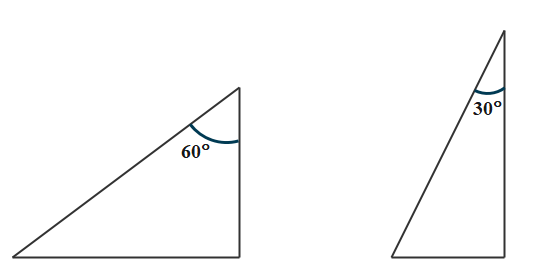
Two particles start together from a point O and slide down along straight smooth wires inclined at ${30^ \circ }{\text{ and }}{60^ \circ }$ to the vertical plane and on the same side of vertical through O. The relative acceleration of second with respect to first will be of magnitude:
A. $\dfrac{g}{2}$ in the vertical direction
B. $\dfrac{{\sqrt 3 g}}{2}$ at ${45^ \circ }$ with vertical
C. $\dfrac{g}{{\sqrt 3 }}$ inclined at ${60^ \circ }$ to the vertical
D. $g$ in the vertical direction.
Answer
 Verified
664.8k+ views
Hint: A particle sliding down a smooth surface is free of frictional influence. Deduce the components of forces acting on the ball with help of a suitable example. Then find expression for acceleration and hence calculate the relative acceleration between the two particles by finding the angle between the two.
Formula Used:
The magnitude of relative acceleration:
${a_r} = \sqrt {a_1^2 + a_2^2 - 2{a_1}{a_2}\cos {{30}^ \circ }} $
Complete step by step answer:
When a particle slides down a smooth straight wire inclined to the vertical with angle $\theta $. Then there are a total of two major forces acting on it, which on dividing into their respective components is shown in the figure below:
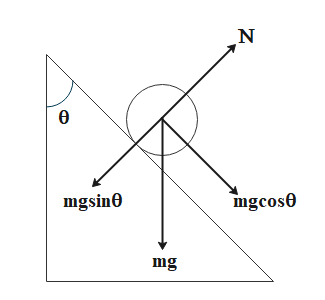
The weight of the particle acts vertically downwards. But, because friction does not come into play for this setup, so the acceleration achieved by the particle is completely the cosine component of its weight. Additionally, the sine component of the weight gets balanced out by the normal reaction force, as they are two equal forces acting in opposite directions.
Mathematically,
$mg\sin \theta = N$
And
$\eqalign{
& mg\cos \theta = ma \cr
& \Rightarrow a = g\cos \theta \cdots \cdots \cdots \cdots \left( 1 \right) \cr} $
Now, let ${a_{1{\text{ }}}}{\text{and }}{a_2}$ be the acceleration of the two particles inclined with vertical at angle ${30^ \circ }{\text{ and }}{60^ \circ }$respectively.
So, from equation (1) we get acceleration for the first particle as:
$\eqalign{
& {a_1} = g\cos {30^ \circ } \cr
& \Rightarrow {a_1} = \dfrac{{\sqrt 3 g}}{2} \cdots \cdots \cdots \left( 2 \right){\text{ }}\left[ {\because \cos {{30}^ \circ } = \dfrac{{\sqrt 3 }}{2}} \right] \cr} $
Similarly, we get acceleration for the second particle as:
$\eqalign{
& {a_2} = g\cos {60^ \circ } \cr
& \Rightarrow {a_2} = \dfrac{g}{2} \cdots \cdots \cdots \cdots \left( 3 \right){\text{ }}\left[ {\because \cos {{60}^ \circ } = \dfrac{1}{2}} \right] \cr} $
Relative acceleration is given by:
${a_r} = \left| {{a_1} - {a_2}} \right|$
Angle between the two accelerations${a_{1{\text{ }}}}{\text{and }}{a_2}$ is given by:
${60^ \circ } - {30^ \circ } = {30^ \circ }$
Thus the relative acceleration of second particle with respect to the first in magnitude will be:
$\eqalign{
& {a_r} = \sqrt {a_1^2 + a_2^2 - 2{a_1}{a_2}\cos {{30}^ \circ }} \cr
& \Rightarrow {a_r} = \sqrt {{{\left( {\dfrac{{\sqrt 3 g}}{2}} \right)}^2} + {{\left( {\dfrac{g}{2}} \right)}^2} - 2 \times \dfrac{{\sqrt 3 g}}{2} \times \dfrac{g}{2} \times \dfrac{{\sqrt 3 }}{2}} \cr
& \Rightarrow {a_r} = \sqrt {\dfrac{{3{g^2}}}{4} + \dfrac{{{g^2}}}{4} - \dfrac{{3{g^2}}}{4}} \cr
& \Rightarrow {a_r} = \sqrt {\dfrac{{3{g^2}}}{4} + \dfrac{{{g^2}}}{4} - \dfrac{{3{g^2}}}{4}} \cr
& \therefore {a_r} = \dfrac{g}{2} \cr} $
Therefore, the correct option is A. i.e., $\dfrac{g}{2}$ in the vertical direction.
Note: Whenever two bodies slip over each other, the force of friction that comes into action is called kinetic friction. But if these bodies do not slide then the force of friction is said to be static friction. Additionally, the frictional force exerted by fluids is known as viscosity.
Formula Used:
The magnitude of relative acceleration:
${a_r} = \sqrt {a_1^2 + a_2^2 - 2{a_1}{a_2}\cos {{30}^ \circ }} $
Complete step by step answer:
When a particle slides down a smooth straight wire inclined to the vertical with angle $\theta $. Then there are a total of two major forces acting on it, which on dividing into their respective components is shown in the figure below:
The weight of the particle acts vertically downwards. But, because friction does not come into play for this setup, so the acceleration achieved by the particle is completely the cosine component of its weight. Additionally, the sine component of the weight gets balanced out by the normal reaction force, as they are two equal forces acting in opposite directions.
Mathematically,
$mg\sin \theta = N$
And
$\eqalign{
& mg\cos \theta = ma \cr
& \Rightarrow a = g\cos \theta \cdots \cdots \cdots \cdots \left( 1 \right) \cr} $
Now, let ${a_{1{\text{ }}}}{\text{and }}{a_2}$ be the acceleration of the two particles inclined with vertical at angle ${30^ \circ }{\text{ and }}{60^ \circ }$respectively.
So, from equation (1) we get acceleration for the first particle as:
$\eqalign{
& {a_1} = g\cos {30^ \circ } \cr
& \Rightarrow {a_1} = \dfrac{{\sqrt 3 g}}{2} \cdots \cdots \cdots \left( 2 \right){\text{ }}\left[ {\because \cos {{30}^ \circ } = \dfrac{{\sqrt 3 }}{2}} \right] \cr} $
Similarly, we get acceleration for the second particle as:
$\eqalign{
& {a_2} = g\cos {60^ \circ } \cr
& \Rightarrow {a_2} = \dfrac{g}{2} \cdots \cdots \cdots \cdots \left( 3 \right){\text{ }}\left[ {\because \cos {{60}^ \circ } = \dfrac{1}{2}} \right] \cr} $
Relative acceleration is given by:
${a_r} = \left| {{a_1} - {a_2}} \right|$
Angle between the two accelerations${a_{1{\text{ }}}}{\text{and }}{a_2}$ is given by:
${60^ \circ } - {30^ \circ } = {30^ \circ }$
Thus the relative acceleration of second particle with respect to the first in magnitude will be:
$\eqalign{
& {a_r} = \sqrt {a_1^2 + a_2^2 - 2{a_1}{a_2}\cos {{30}^ \circ }} \cr
& \Rightarrow {a_r} = \sqrt {{{\left( {\dfrac{{\sqrt 3 g}}{2}} \right)}^2} + {{\left( {\dfrac{g}{2}} \right)}^2} - 2 \times \dfrac{{\sqrt 3 g}}{2} \times \dfrac{g}{2} \times \dfrac{{\sqrt 3 }}{2}} \cr
& \Rightarrow {a_r} = \sqrt {\dfrac{{3{g^2}}}{4} + \dfrac{{{g^2}}}{4} - \dfrac{{3{g^2}}}{4}} \cr
& \Rightarrow {a_r} = \sqrt {\dfrac{{3{g^2}}}{4} + \dfrac{{{g^2}}}{4} - \dfrac{{3{g^2}}}{4}} \cr
& \therefore {a_r} = \dfrac{g}{2} \cr} $
Therefore, the correct option is A. i.e., $\dfrac{g}{2}$ in the vertical direction.
Note: Whenever two bodies slip over each other, the force of friction that comes into action is called kinetic friction. But if these bodies do not slide then the force of friction is said to be static friction. Additionally, the frictional force exerted by fluids is known as viscosity.
Recently Updated Pages
If x a + bt + ct2 where x is in meters and t is in class 11 physics CBSE

A car covers the first half distance between two places class 11 physics CBSE
The resultant of two vectors overrightarrow P and overrightarrow class 11 physics CBSE
Find the value of cos 135 class 11 maths CBSE
A mass M is held in place by an applied force F and class 11 physics CBSE
A solution of glucose in water is labelled as 10 dfracwv class 11 chemistry CBSE
Trending doubts
What is the maximum height of a projectile class 11 physics CBSE
Describe various types of epithelial tissues with the class 11 biology CBSE
Lysosomes are known as suicidal bags of cell why class 11 biology CBSE
Simon Commission came to India in A 1927 B 1928 C 1929 class 11 social science CBSE
State and derive law of conservation of momentum class 11 physics CBSE
How are involuntary actions and reflex actions different class 11 biology CBSE