




Two particles of equal mass $m$ go around in a circle of radius $R$ under the action of their mutual gravitational attraction. The speed of each particle is $v$. Find the value of $v$.
A. $v=\dfrac{1}{2R}\sqrt{\left( \dfrac{1}{Gm} \right)}$
B. $v=\sqrt{\left( \dfrac{Gm}{2R} \right)}$
C. $v=\dfrac{1}{2}\sqrt{\left( \dfrac{Gm}{R} \right)}$
D. $v=\sqrt{\left( \dfrac{4Gm}{R} \right)}$
Answer
 Verified
596k+ views
Hint: The gravitational attraction between the particles will contribute to the centrifugal force required for the circular motion. Find the gravitational force of attraction due to each other. Equate the value with the required centrifugal force to derive the expression of speed.
Formula Used:
Newton’s law of gravitation gives us the following equation,
$F=G\dfrac{{{m}_{1}}{{m}_{2}}}{{{r}^{2}}}$,
Where,
$F$ is the gravitational force between the two particles,
$G$ is the universal gravitational constant
${{m}_{1}}$ is the mass of the first particle
${{m}_{2}}$is the mass of the second particle
$r$ is the distance between two particles.
The centrifugal force is given by,
$\dfrac{m{{v}^{2}}}{r}$
Where,
$m$ is the mass of the particle,
$v$ is the velocity of the particle,
$r$ is the radius of the circle.
Complete step by step answer:
Let’s understand the following figure first.
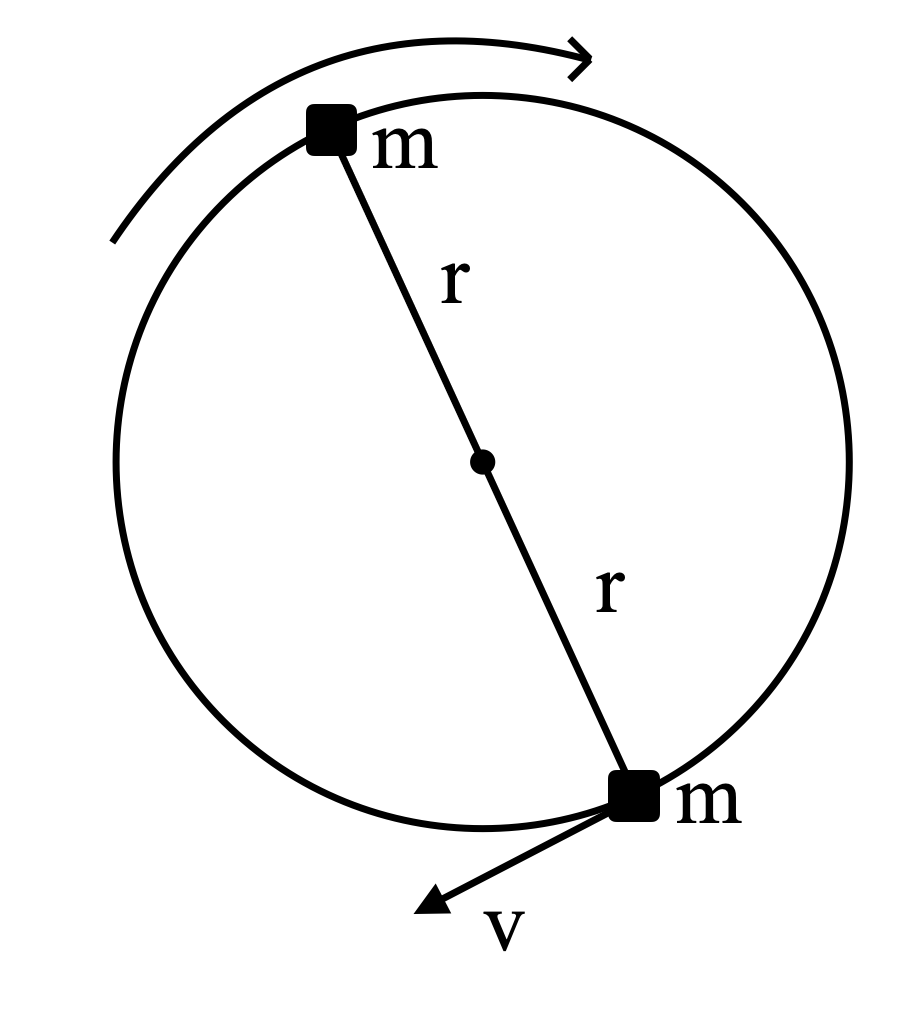
The two particles are moving in a circular motion in this way. As a result, the distance between the particles is,
$2r$
Hence the gravitational attraction between them is given by,
${{F}_{1}}=G\dfrac{m\times m}{{{(2R)}^{2}}}=\dfrac{G{{m}^{2}}}{4{{R}^{2}}}$
Now, let us consider the centrifugal force on the particle.
To continue the circular motion there must be a force which is equal to,
${{F}_{2}}=\dfrac{m{{v}^{2}}}{R}$
In this case, the gravitational force is contributing to the force.
We can consider a pseudo force working on the particle in the opposite direction, but it has the same magnitude.
Let’s look at the free-body diagram.
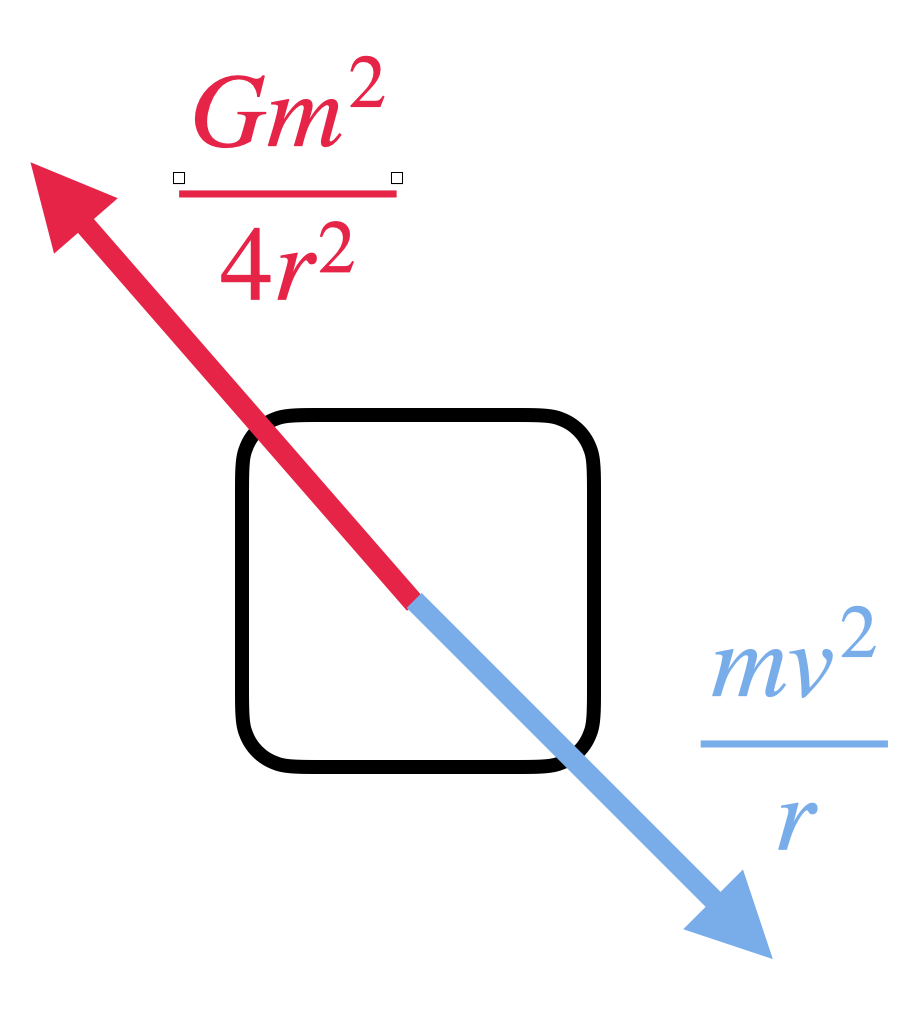
So, these two forces must be equal and opposite to maintain the circular motion of the particle.
Hence, we can write the equation,
${{F}_{1}}={{F}_{2}}$.
$\Rightarrow v=\dfrac{1}{2}\sqrt{\dfrac{Gm}{R}}$
$\Rightarrow {{v}^{2}}=\dfrac{Gm}{4R}$
$\Rightarrow v=\dfrac{1}{2}\sqrt{\dfrac{Gm}{R}}$
So, the correct option is (C).
Note: This problem was easy enough to complete without drawing the free body diagram (FBD). But it is a good practice to draw the FBD as we can incorporate all the forces in the same diagram.
If we don’t assume the effects of any other planets, the planetary motions are guided in a similar fashion. This problem is the basis of planetary motion.
Formula Used:
Newton’s law of gravitation gives us the following equation,
$F=G\dfrac{{{m}_{1}}{{m}_{2}}}{{{r}^{2}}}$,
Where,
$F$ is the gravitational force between the two particles,
$G$ is the universal gravitational constant
${{m}_{1}}$ is the mass of the first particle
${{m}_{2}}$is the mass of the second particle
$r$ is the distance between two particles.
The centrifugal force is given by,
$\dfrac{m{{v}^{2}}}{r}$
Where,
$m$ is the mass of the particle,
$v$ is the velocity of the particle,
$r$ is the radius of the circle.
Complete step by step answer:
Let’s understand the following figure first.
The two particles are moving in a circular motion in this way. As a result, the distance between the particles is,
$2r$
Hence the gravitational attraction between them is given by,
${{F}_{1}}=G\dfrac{m\times m}{{{(2R)}^{2}}}=\dfrac{G{{m}^{2}}}{4{{R}^{2}}}$
Now, let us consider the centrifugal force on the particle.
To continue the circular motion there must be a force which is equal to,
${{F}_{2}}=\dfrac{m{{v}^{2}}}{R}$
In this case, the gravitational force is contributing to the force.
We can consider a pseudo force working on the particle in the opposite direction, but it has the same magnitude.
Let’s look at the free-body diagram.
So, these two forces must be equal and opposite to maintain the circular motion of the particle.
Hence, we can write the equation,
${{F}_{1}}={{F}_{2}}$.
$\Rightarrow v=\dfrac{1}{2}\sqrt{\dfrac{Gm}{R}}$
$\Rightarrow {{v}^{2}}=\dfrac{Gm}{4R}$
$\Rightarrow v=\dfrac{1}{2}\sqrt{\dfrac{Gm}{R}}$
So, the correct option is (C).
Note: This problem was easy enough to complete without drawing the free body diagram (FBD). But it is a good practice to draw the FBD as we can incorporate all the forces in the same diagram.
If we don’t assume the effects of any other planets, the planetary motions are guided in a similar fashion. This problem is the basis of planetary motion.
Recently Updated Pages
If x a + bt + ct2 where x is in meters and t is in class 11 physics CBSE

A car covers the first half distance between two places class 11 physics CBSE
The resultant of two vectors overrightarrow P and overrightarrow class 11 physics CBSE
Find the value of cos 135 class 11 maths CBSE
A mass M is held in place by an applied force F and class 11 physics CBSE
A solution of glucose in water is labelled as 10 dfracwv class 11 chemistry CBSE
Trending doubts
One Metric ton is equal to kg A 10000 B 1000 C 100 class 11 physics CBSE
Find the value of the expression given below sin 30circ class 11 maths CBSE
What do you mean by retardation What is its SI uni class 11 physics CBSE
Draw a diagram of nephron and explain its structur class 11 biology CBSE
10 examples of friction in our daily life
Difference between physical and chemical change class 11 chemistry CBSE