




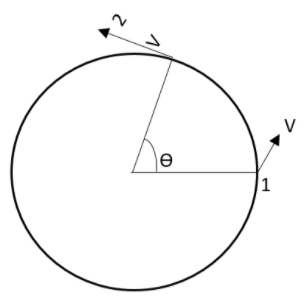
Two particles describe the same particles of circle $R$ in the same direction with the same speed $V$, then at given instant the relative angular velocity of $2$ with respect to $1$ will be given as,
$\begin{align}
& A.\dfrac{2V\sin \dfrac{\theta }{2}}{R} \\
& B.\dfrac{V}{2R\sin \dfrac{\theta }{2}} \\
& C.\dfrac{V}{R} \\
& D.\dfrac{V\cos \dfrac{\theta }{2}}{R} \\
\end{align}$
Answer
 Verified
573.9k+ views
Hint: First of all find out the velocity at each point and take the relative velocity of $2$ with respect to $1$. The angular velocity can be found by taking the ratio of the relative velocity of the particle to the radius of the circle. Using this find the angular velocity and arrive at its magnitude. Simplify the equation and find out the correct answer. This will help you in answering this question.
Complete step by step solution:
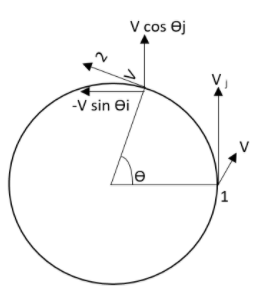
The velocity at $2$ is given as,
${{V}_{2}}=\left( v\cos \theta \right)\hat{j}-v\sin \theta \hat{i}$
The velocity at $1$ has been mentioned as,
${{V}_{1}}=v\hat{j}$
The relative velocity can be found by taking the difference of the velocity at $2$ and the velocity at $1$. This can be shown as,
${{V}_{21}}={{V}_{2}}-{{V}_{1}}$
Substituting the values in it will give,
${{V}_{21}}=\left( v\cos \theta \right)\hat{j}-v\sin \theta \hat{i}-v\hat{j}$
The angular velocity can be found by taking the ratio of the relative velocity to the radius of the circle,
$\omega =\dfrac{{{V}_{21}}}{R}=\dfrac{\left( v\cos \theta -v \right)\hat{j}-v\sin \theta \hat{i}}{R}$
The magnitude of the angular velocity can be found as,
$\omega =\dfrac{v\sqrt{{{\left( \cos \theta -1 \right)}^{2}}+{{\left( -\sin \theta \right)}^{2}}}}{R}$
Simplifying this value can be shown as,
$\omega =\dfrac{v\sqrt{{{\cos }^{2}}\theta +1-2\cos \theta +{{\sin }^{2}}\theta }}{R}$
That is we can write that,
$\begin{align}
& \omega =\dfrac{v}{R}\sqrt{2-2\cos \theta } \\
& \Rightarrow \omega =\dfrac{v}{R}\sqrt{2\left( 1-\cos \theta \right)} \\
& \Rightarrow \omega =\dfrac{v}{R}\sqrt{2\times 2{{\sin }^{2}}\dfrac{\theta }{2}} \\
\end{align}$
Therefore we can write that,
$\omega =\dfrac{2v\sin \dfrac{\theta }{2}}{R}$
Therefore the angular velocity has been calculated.
The correct answer has been mentioned as option A.
Note: Angular velocity is defined as the measure of the speed of an object revolves or rotates relative to another point. That is how fast the angular position or arrangement of an object varies with time. There are two kinds of angular velocity. They are the orbital angular velocity and spin angular velocity. Angular velocity is a vector quantity which is having a magnitude as well as direction.
Complete step by step solution:
The velocity at $2$ is given as,
${{V}_{2}}=\left( v\cos \theta \right)\hat{j}-v\sin \theta \hat{i}$
The velocity at $1$ has been mentioned as,
${{V}_{1}}=v\hat{j}$
The relative velocity can be found by taking the difference of the velocity at $2$ and the velocity at $1$. This can be shown as,
${{V}_{21}}={{V}_{2}}-{{V}_{1}}$
Substituting the values in it will give,
${{V}_{21}}=\left( v\cos \theta \right)\hat{j}-v\sin \theta \hat{i}-v\hat{j}$
The angular velocity can be found by taking the ratio of the relative velocity to the radius of the circle,
$\omega =\dfrac{{{V}_{21}}}{R}=\dfrac{\left( v\cos \theta -v \right)\hat{j}-v\sin \theta \hat{i}}{R}$
The magnitude of the angular velocity can be found as,
$\omega =\dfrac{v\sqrt{{{\left( \cos \theta -1 \right)}^{2}}+{{\left( -\sin \theta \right)}^{2}}}}{R}$
Simplifying this value can be shown as,
$\omega =\dfrac{v\sqrt{{{\cos }^{2}}\theta +1-2\cos \theta +{{\sin }^{2}}\theta }}{R}$
That is we can write that,
$\begin{align}
& \omega =\dfrac{v}{R}\sqrt{2-2\cos \theta } \\
& \Rightarrow \omega =\dfrac{v}{R}\sqrt{2\left( 1-\cos \theta \right)} \\
& \Rightarrow \omega =\dfrac{v}{R}\sqrt{2\times 2{{\sin }^{2}}\dfrac{\theta }{2}} \\
\end{align}$
Therefore we can write that,
$\omega =\dfrac{2v\sin \dfrac{\theta }{2}}{R}$
Therefore the angular velocity has been calculated.
The correct answer has been mentioned as option A.
Note: Angular velocity is defined as the measure of the speed of an object revolves or rotates relative to another point. That is how fast the angular position or arrangement of an object varies with time. There are two kinds of angular velocity. They are the orbital angular velocity and spin angular velocity. Angular velocity is a vector quantity which is having a magnitude as well as direction.
Recently Updated Pages
Master Class 11 Computer Science: Engaging Questions & Answers for Success

Master Class 11 Business Studies: Engaging Questions & Answers for Success
Master Class 11 Economics: Engaging Questions & Answers for Success
Master Class 11 English: Engaging Questions & Answers for Success
Master Class 11 Maths: Engaging Questions & Answers for Success
Master Class 11 Biology: Engaging Questions & Answers for Success
Trending doubts
One Metric ton is equal to kg A 10000 B 1000 C 100 class 11 physics CBSE
There are 720 permutations of the digits 1 2 3 4 5 class 11 maths CBSE
Discuss the various forms of bacteria class 11 biology CBSE
Draw a diagram of a plant cell and label at least eight class 11 biology CBSE
State the laws of reflection of light
Explain zero factorial class 11 maths CBSE