




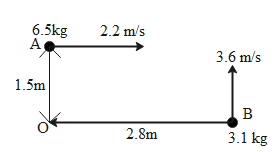
Two particles A and B are moving as shown in the figure. Their total angular momentum about the point O is:
\[
{\text{A}}{\text{. 9}}{\text{.8kg }}{{\text{m}}^2}/s \\
{\text{B}}{\text{. zero}} \\
{\text{C}}{\text{. 52}}{\text{.7kg }}{{\text{m}}^2}/s \\
{\text{D}}{\text{. 37}}{\text{.9kg }}{{\text{m}}^2}/s \\
\]
Answer
 Verified
600k+ views
Hint: The angular momentum of a particle is given as the product of mass of the particle, velocity with which the particle moves and the radius or the distance of that particle from a point about which the rotation takes place.
Formula used:
The angular momentum of a particle is given as
$L = m{\text{v}}r$
where L is the angular momentum of the particle whose mass is m and is moving with velocity v and r signifies the distance of the particle from origin about which the particle is rotating.
Detailed step by step answer:
We have two particles A and B moving with velocity \[{{\text{v}}_1}\] and \[{{\text{v}}_2}\] respectively as shown in the diagram. The values of velocities is given as
\[
{{\text{v}}_1} = 2.2m/s \\
{{\text{v}}_2} = 3.6m/s \\
\]
The masses of the particles are given as
$
{m_1} = 6.5kg \\
{m_2} = 3.1kg \\
$
If ${r_1}$ and ${r_2}$ are distances of A and B respectively from the origin O then they are given as
$
{r_1} = 1.5m \\
{r_2} = 2.8m \\
$
As we know that angular momentum of the particle is given by equation (i), we can write total angular momentum of the given system to be equal to the sum of individual angular momenta of A and B which is given as
$
L = {L_1} + {L_2} \\
= {m_1}{{\text{v}}_1}{r_1} + {m_2}{{\text{v}}_2}{r_2} \\
$
Now substituting all the known values in the equation for total angular momentum, we get
$
L = - 6.5 \times 2.2 \times 1.5 + 3.1 \times 3.6 \times 2.8 \\
= - 21.45 + 31.248 \\
= 9.8kg{m^2}/s \\
$
Hence, the correct answer is option A.
Note: We consider the clockwise direction to be positive and the anticlockwise direction to be negative. The particle A moves in anticlockwise direction so its angular momentum is taken as positive while the particle B moves in clockwise direction so its angular momentum is taken to be positive.
Formula used:
The angular momentum of a particle is given as
$L = m{\text{v}}r$
where L is the angular momentum of the particle whose mass is m and is moving with velocity v and r signifies the distance of the particle from origin about which the particle is rotating.
Detailed step by step answer:
We have two particles A and B moving with velocity \[{{\text{v}}_1}\] and \[{{\text{v}}_2}\] respectively as shown in the diagram. The values of velocities is given as
\[
{{\text{v}}_1} = 2.2m/s \\
{{\text{v}}_2} = 3.6m/s \\
\]
The masses of the particles are given as
$
{m_1} = 6.5kg \\
{m_2} = 3.1kg \\
$
If ${r_1}$ and ${r_2}$ are distances of A and B respectively from the origin O then they are given as
$
{r_1} = 1.5m \\
{r_2} = 2.8m \\
$
As we know that angular momentum of the particle is given by equation (i), we can write total angular momentum of the given system to be equal to the sum of individual angular momenta of A and B which is given as
$
L = {L_1} + {L_2} \\
= {m_1}{{\text{v}}_1}{r_1} + {m_2}{{\text{v}}_2}{r_2} \\
$
Now substituting all the known values in the equation for total angular momentum, we get
$
L = - 6.5 \times 2.2 \times 1.5 + 3.1 \times 3.6 \times 2.8 \\
= - 21.45 + 31.248 \\
= 9.8kg{m^2}/s \\
$
Hence, the correct answer is option A.
Note: We consider the clockwise direction to be positive and the anticlockwise direction to be negative. The particle A moves in anticlockwise direction so its angular momentum is taken as positive while the particle B moves in clockwise direction so its angular momentum is taken to be positive.
Recently Updated Pages
Master Class 11 Computer Science: Engaging Questions & Answers for Success

Master Class 11 Business Studies: Engaging Questions & Answers for Success
Master Class 11 Economics: Engaging Questions & Answers for Success
Master Class 11 English: Engaging Questions & Answers for Success
Master Class 11 Maths: Engaging Questions & Answers for Success
Master Class 11 Biology: Engaging Questions & Answers for Success
Trending doubts
One Metric ton is equal to kg A 10000 B 1000 C 100 class 11 physics CBSE
There are 720 permutations of the digits 1 2 3 4 5 class 11 maths CBSE
Discuss the various forms of bacteria class 11 biology CBSE
Draw a diagram of a plant cell and label at least eight class 11 biology CBSE
State the laws of reflection of light
Explain zero factorial class 11 maths CBSE