




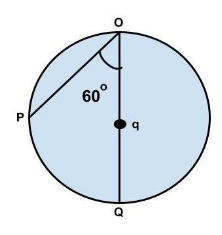
Two particles 1 and 2 are allowed to descend on two frictionless chords \[OP\] and \[OQ\] . The ratio of the speeds of the particles 1 and 2 respectively when they reach on the circumference is:
A. $\dfrac{1}{4}$
B. $\dfrac{1}{2}$
C. $1$
D. $\dfrac{1}{{2\sqrt 2 }}$
Answer
 Verified
513.9k+ views
Hint:Before going through the question let us first talk about work. In physics, work is energy transferred through the use of force throughout a displacement to or from an object. It is often depicted as a product of strength and displacement in its simplest form.
Complete step by step answer:
Let the radius of the given circle = $R$
$Oq = Pq = R$$\Delta OPq$
So, $\Delta OPq$ is an equilateral triangle.
So Particle on chord \[OP\] will travel vertical distance = $R\cos 60 = \dfrac{R}{2}$
Work is closely connected with energy. The principle of work-energy says that increasing the kinetic energy of a rigid body is caused by equal amounts of positive work done on the body by the consequent power acting on it.
On the other hand, an equal amount of negative work done by the resulting force is caused to reduce the kinetic energy. So, if the network is good, the kinetic energy of the particle increases by the quantity of work. When the network is negative, the film energy of the particle decreases by the quantity of the work. Therefore, from work-energy theorem :
$mg\left( {\dfrac{R}{2}} \right) = \dfrac{1}{2}mv_1^2 \\
\Rightarrow {v_1} = \sqrt {Rg} \\ $
Particle on the chord \[OQ\] will travel a vertical distance = \[2R\]
Similarly for particle on \[OQ\] :
${v_2} = \sqrt {4Rg} = 2\sqrt {Rg} $
Therefore ratio of their speed is : $\dfrac{{{v_1}}}{{{v_2}}} = \dfrac{1}{2}$
Hence, the ratio of the speeds of the particles 1 and 2 respectively when they reach the circumference is: $\dfrac{1}{2}$.
Note:If you are aware of the motion of an object but are not familiar with the values of one or more of the forces acting on it, you can use the work-energy theorem to gain some information about these forces.
Complete step by step answer:
Let the radius of the given circle = $R$
$Oq = Pq = R$$\Delta OPq$
So, $\Delta OPq$ is an equilateral triangle.
So Particle on chord \[OP\] will travel vertical distance = $R\cos 60 = \dfrac{R}{2}$
Work is closely connected with energy. The principle of work-energy says that increasing the kinetic energy of a rigid body is caused by equal amounts of positive work done on the body by the consequent power acting on it.
On the other hand, an equal amount of negative work done by the resulting force is caused to reduce the kinetic energy. So, if the network is good, the kinetic energy of the particle increases by the quantity of work. When the network is negative, the film energy of the particle decreases by the quantity of the work. Therefore, from work-energy theorem :
$mg\left( {\dfrac{R}{2}} \right) = \dfrac{1}{2}mv_1^2 \\
\Rightarrow {v_1} = \sqrt {Rg} \\ $
Particle on the chord \[OQ\] will travel a vertical distance = \[2R\]
Similarly for particle on \[OQ\] :
${v_2} = \sqrt {4Rg} = 2\sqrt {Rg} $
Therefore ratio of their speed is : $\dfrac{{{v_1}}}{{{v_2}}} = \dfrac{1}{2}$
Hence, the ratio of the speeds of the particles 1 and 2 respectively when they reach the circumference is: $\dfrac{1}{2}$.
Note:If you are aware of the motion of an object but are not familiar with the values of one or more of the forces acting on it, you can use the work-energy theorem to gain some information about these forces.
Recently Updated Pages
Master Class 11 Computer Science: Engaging Questions & Answers for Success

Master Class 11 Business Studies: Engaging Questions & Answers for Success
Master Class 11 Economics: Engaging Questions & Answers for Success
Master Class 11 English: Engaging Questions & Answers for Success
Master Class 11 Maths: Engaging Questions & Answers for Success
Master Class 11 Biology: Engaging Questions & Answers for Success
Trending doubts
One Metric ton is equal to kg A 10000 B 1000 C 100 class 11 physics CBSE
There are 720 permutations of the digits 1 2 3 4 5 class 11 maths CBSE
Discuss the various forms of bacteria class 11 biology CBSE
Draw a diagram of a plant cell and label at least eight class 11 biology CBSE
State the laws of reflection of light
Explain zero factorial class 11 maths CBSE