




Two parallel forces 20 N and 30N act at the ends A and B of a rod 1.5m long.
The resultant of the force will act at the point:
A.) 90cm from A
B.) 75cm from B
C.) 20cm from B
D.) 85cm from A
Answer
 Verified
598.5k+ views
Hint: If two forces are parallel in nature then resultant force must be the addition of two vector forces. Remember rod cannot be moved. Use the formula of torque. Force will be torque while the body is moving.
Complete step by step solution:
Diagram:
Before solving the question, understand what the question wants to convey.
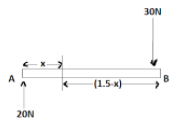
Question says that we have a rod of 1.5m long whose ends are A and B. Forces acting are 20N and 30N on each end of the rod respectively.
Aim: find out the distance or a point at which the resultant of force will act.
Consider any point on rod at which resultant of force will act, suppose y m from A.
So the remaining distance will be (1.5-y) m from point B.
So we need to apply resultant force in the opposite direction to prevent the rod from moving
.
Resultant of force is given by,
Resultant force=20+30=50N.
Use formula of torque which is given by,
Torque=distance*force acting
$\begin{align}
& 20y=30(1.5-y) \\
& 20y=4.5-30y \\
& 2y=4.5-3y \\
\end{align}$
Arrange terms containing variables on one side and constants on the other side.
4.5=5y
y = 0.9 m or 90 cm.
Note: before solving any type of question, first understand the question and analyse the data given in the question. Then make the picture in mind of what we want to calculate. This will give a clear idea about how to write a solution.
Complete step by step solution:
Diagram:
Before solving the question, understand what the question wants to convey.
Question says that we have a rod of 1.5m long whose ends are A and B. Forces acting are 20N and 30N on each end of the rod respectively.
Aim: find out the distance or a point at which the resultant of force will act.
Consider any point on rod at which resultant of force will act, suppose y m from A.
So the remaining distance will be (1.5-y) m from point B.
So we need to apply resultant force in the opposite direction to prevent the rod from moving
.
Resultant of force is given by,
Resultant force=20+30=50N.
Use formula of torque which is given by,
Torque=distance*force acting
$\begin{align}
& 20y=30(1.5-y) \\
& 20y=4.5-30y \\
& 2y=4.5-3y \\
\end{align}$
Arrange terms containing variables on one side and constants on the other side.
4.5=5y
y = 0.9 m or 90 cm.
Note: before solving any type of question, first understand the question and analyse the data given in the question. Then make the picture in mind of what we want to calculate. This will give a clear idea about how to write a solution.
Recently Updated Pages
Master Class 11 Computer Science: Engaging Questions & Answers for Success

Master Class 11 Business Studies: Engaging Questions & Answers for Success
Master Class 11 Economics: Engaging Questions & Answers for Success
Master Class 11 English: Engaging Questions & Answers for Success
Master Class 11 Maths: Engaging Questions & Answers for Success
Master Class 11 Biology: Engaging Questions & Answers for Success
Trending doubts
One Metric ton is equal to kg A 10000 B 1000 C 100 class 11 physics CBSE
There are 720 permutations of the digits 1 2 3 4 5 class 11 maths CBSE
Discuss the various forms of bacteria class 11 biology CBSE
Draw a diagram of a plant cell and label at least eight class 11 biology CBSE
State the laws of reflection of light
Explain zero factorial class 11 maths CBSE