




Two metals which will replace hydrogen and two metals which will not displace hydrogen from dilute acid, respectively are:
A. ${\text{Potassium ,calcium ,aluminium and zinc}}$
B. ${\text{Sodium, calcium, zinc and iron}}$
C. ${\text{Zinc, iron, copper and mercury}}$
D. ${\text{Copper, mercury, Silver and gold}}$
Answer
 Verified
573k+ views
Hint: Judge the reactivity on the basis of Reactivity Series table as in this case 2 metals are above hydrogen and 2 metals are below hydrogen in reactivity series.
Only those metals will replace hydrogen from dilute acid which are above hydrogen in reactivity series
And , hydrogen will not be replaced by those metals which are below hydrogen in reactivity series.
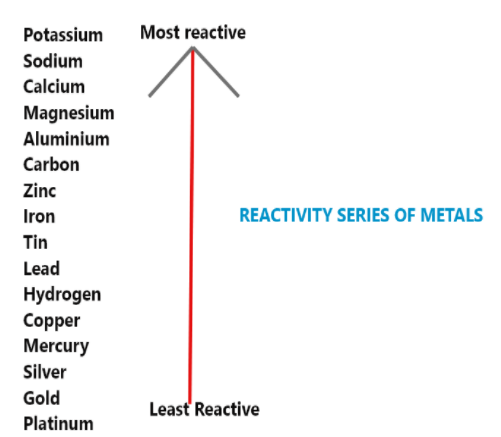
Hence,Option C is the correct answer.
Additional Information:
In the reactivity series, as we move from bottom to top, the reactivity of metals increases. Metals present at the top of the series can lose electrons more readily to form positive ions and corrode or tarnish more readily. They require more energy to be separated from their ores, and become stronger reducing agents, while metals present at the bottom of the series are good oxidizing agents.
Silver, gold, and platinum are metals with the least reactivity. They are found in nature. The metals with high reactive series in the above table also indicate that reverse reaction is a bit tough process.
Reactions are mostly Exothermic in case of highly reactive metals.
The reaction takes place fast in highly reactive metals.
Metals which are present above the carbon are extracted using an electrolysis method.
Carbon and hydrogen plays a vital role in terms of a method that involves metal extraction.
Note:
1) Students should ensure they keep themselves in check with the reactivity series.
2) Reactivity series is different for non-metals.
Only those metals will replace hydrogen from dilute acid which are above hydrogen in reactivity series
And , hydrogen will not be replaced by those metals which are below hydrogen in reactivity series.
Hence,Option C is the correct answer.
Additional Information:
In the reactivity series, as we move from bottom to top, the reactivity of metals increases. Metals present at the top of the series can lose electrons more readily to form positive ions and corrode or tarnish more readily. They require more energy to be separated from their ores, and become stronger reducing agents, while metals present at the bottom of the series are good oxidizing agents.
Silver, gold, and platinum are metals with the least reactivity. They are found in nature. The metals with high reactive series in the above table also indicate that reverse reaction is a bit tough process.
Reactions are mostly Exothermic in case of highly reactive metals.
The reaction takes place fast in highly reactive metals.
Metals which are present above the carbon are extracted using an electrolysis method.
Carbon and hydrogen plays a vital role in terms of a method that involves metal extraction.
Note:
1) Students should ensure they keep themselves in check with the reactivity series.
2) Reactivity series is different for non-metals.
Recently Updated Pages
Master Class 12 Economics: Engaging Questions & Answers for Success

Master Class 12 English: Engaging Questions & Answers for Success
Master Class 12 Social Science: Engaging Questions & Answers for Success
Master Class 12 Maths: Engaging Questions & Answers for Success
Master Class 12 Physics: Engaging Questions & Answers for Success
Master Class 11 Social Science: Engaging Questions & Answers for Success
Trending doubts
One Metric ton is equal to kg A 10000 B 1000 C 100 class 11 physics CBSE
Difference Between Prokaryotic Cells and Eukaryotic Cells
Find the value of the expression given below sin 30circ class 11 maths CBSE
Two of the body parts which do not appear in MRI are class 11 biology CBSE
Draw a diagram of nephron and explain its structur class 11 biology CBSE
10 examples of friction in our daily life