




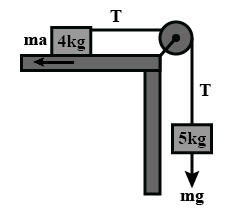
Two masses of \[4kg\] and \[5kg\] are connected by a string passing through a frictionless pulley and are kept on a frictionless table as shown in figure .The acceleration of \[5kg\] mass is.
Answer
 Verified
553.5k+ views
Hint: A pulley is a wheel on an axle or shaft that is designed to support movement and change of direction of a taut cable or belt, or transfer of power between the shaft and cable or belt. Pulleys are assembled to form a block and tackle in order to provide mechanical advantage to apply large forces.
Complete step by step solution:
What we mean by a frictionless pulley is that the friction in the bearings of the pulley is negligible, and the pulley is free to rotate without any resistance. We don't mean that the friction between the string and the pulley surface is negligible.
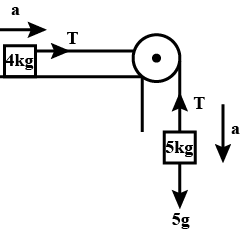
Here, the same tension force is present as there is only on \[5kg\] string used in this system. Also, the acceleration of the system is \[a\] which acts in the downward direction as the mass \[5kg\] is greater than the other mass of \[4kg\]. According to this the free body diagram will be:
We are given the following things,
\[{M_1} = 4kg\]
\[{M_2} = 5kg\]
The equation of force on ${M_1}$,
$T = 4a.......(1)$
The equation of force on ${M_2}$,
$5g - T = 5a........(2)$
On putting the value of tension $T$ from equation (1) in equation (2),
$5g - 4a = 5a$
$5g = 4a + 5a$
$9a = 5g$
On taking $9$ on the other side, we get,
$a = \dfrac{{5g}}{9}$
On putting $g = 9.8\dfrac{m}{{{s^2}}}$, we get,
$a = \dfrac{{5 \times 9.8}}{9}$
\[a = \dfrac{{49}}{9}\]
\[a = 5.44\dfrac{m}{{{s^2}}}\]
So, the final answer is \[a = 5.44\dfrac{m}{{{s^2}}}\]
Note: It is important to note that in this question, we are given a frictionless surface so that the problem does not get complicated and so that the question can easily be solved. But in real practical life, a proper frictionless surface does not exist. If there was no friction everything would slide to the lowest point.
Complete step by step solution:
What we mean by a frictionless pulley is that the friction in the bearings of the pulley is negligible, and the pulley is free to rotate without any resistance. We don't mean that the friction between the string and the pulley surface is negligible.
Here, the same tension force is present as there is only on \[5kg\] string used in this system. Also, the acceleration of the system is \[a\] which acts in the downward direction as the mass \[5kg\] is greater than the other mass of \[4kg\]. According to this the free body diagram will be:
We are given the following things,
\[{M_1} = 4kg\]
\[{M_2} = 5kg\]
The equation of force on ${M_1}$,
$T = 4a.......(1)$
The equation of force on ${M_2}$,
$5g - T = 5a........(2)$
On putting the value of tension $T$ from equation (1) in equation (2),
$5g - 4a = 5a$
$5g = 4a + 5a$
$9a = 5g$
On taking $9$ on the other side, we get,
$a = \dfrac{{5g}}{9}$
On putting $g = 9.8\dfrac{m}{{{s^2}}}$, we get,
$a = \dfrac{{5 \times 9.8}}{9}$
\[a = \dfrac{{49}}{9}\]
\[a = 5.44\dfrac{m}{{{s^2}}}\]
So, the final answer is \[a = 5.44\dfrac{m}{{{s^2}}}\]
Note: It is important to note that in this question, we are given a frictionless surface so that the problem does not get complicated and so that the question can easily be solved. But in real practical life, a proper frictionless surface does not exist. If there was no friction everything would slide to the lowest point.
Recently Updated Pages
Which will be the least stable resonating structure class 11 chemistry CBSE

How many 5 digit telephone numbers can be construc-class-11-maths-CBSE
How do you find the angle of the resultant vector class 11 physics CBSE
Draw labelled diagram of the following i Gram seed class 11 biology CBSE
1 Quintal is equal to a 110 kg b 10 kg c 100kg d 1000 class 11 physics CBSE
What is the need and importance of classification class 11 biology CBSE
Trending doubts
One Metric ton is equal to kg A 10000 B 1000 C 100 class 11 physics CBSE
Find the value of the expression given below sin 30circ class 11 maths CBSE
Draw a diagram of nephron and explain its structur class 11 biology CBSE
10 examples of friction in our daily life
Proton was discovered by A Thomson B Rutherford C Chadwick class 11 chemistry CBSE
The teeth used for biting and cutting food are called class 11 biology CBSE