




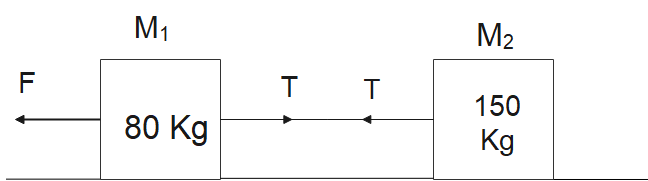
Two masses ${{m}_{1}}$ and ${{m}_{2}}$ are connected by a massless string. Find the value of tension in the string if a force of 200 N is applied
Answer
 Verified
564.6k+ views
Hint: Tension is defined in physics as the pulling force transmitted axially by a string, cable, chain, or other one-dimensional continuous component, or by each end of a rod, truss member, or other three-dimensional object; tension may also be defined as the action-reaction pair of forces acting at each end of said elements. Tension can be thought of as the polar opposite of compression.
Complete step by step solution:
In this question we need to find the value of Tension (T), and we have been given that
Mass of Block ${{m}_{1}}$= 80 Kg
Mass of Block ${{m}_{2}}$ = 150 Kg
Force Applied (F) = 200 N
Now, we know that force is given by the formula
F = m.a
But in this question, we have two masses, therefore, force will be written as
F = (${{m}_{1}}$+ ${{m}_{2}}$) a
Where “a” is the acceleration
Now, putting the values of both the masses and the force applied we can find the acceleration
200 N = (80+150) a
On solving this, we get
$a=1.15\text{ m}{{\text{s}}^{-2}}$
Now, as we can see in the figure that the string is attached in between mass ${{m}_{1}}$ and ${{m}_{2}}$. Also the applied force is in the left direction, therefore the tension will be only due to the mass ${{m}_{2}}$
So, we can write
Tension (T) = ${{m}_{2}}$(a)
Putting the values, we get
Tension (T) = (150) (1.15)
Therefore, Tension (T) = 173 N
Hence, this is the required solution for this question.
Note: The force exerted by the ends of a three-dimensional, continuous object, such as a rod or truss member, is also known as tension. Under strain, such a rod elongates. The force per cross-sectional area, rather than the force alone, determines the amount of elongation and the load that will cause failure.
Complete step by step solution:
In this question we need to find the value of Tension (T), and we have been given that
Mass of Block ${{m}_{1}}$= 80 Kg
Mass of Block ${{m}_{2}}$ = 150 Kg
Force Applied (F) = 200 N
Now, we know that force is given by the formula
F = m.a
But in this question, we have two masses, therefore, force will be written as
F = (${{m}_{1}}$+ ${{m}_{2}}$) a
Where “a” is the acceleration
Now, putting the values of both the masses and the force applied we can find the acceleration
200 N = (80+150) a
On solving this, we get
$a=1.15\text{ m}{{\text{s}}^{-2}}$
Now, as we can see in the figure that the string is attached in between mass ${{m}_{1}}$ and ${{m}_{2}}$. Also the applied force is in the left direction, therefore the tension will be only due to the mass ${{m}_{2}}$
So, we can write
Tension (T) = ${{m}_{2}}$(a)
Putting the values, we get
Tension (T) = (150) (1.15)
Therefore, Tension (T) = 173 N
Hence, this is the required solution for this question.
Note: The force exerted by the ends of a three-dimensional, continuous object, such as a rod or truss member, is also known as tension. Under strain, such a rod elongates. The force per cross-sectional area, rather than the force alone, determines the amount of elongation and the load that will cause failure.
Recently Updated Pages
Master Class 11 English: Engaging Questions & Answers for Success

Master Class 11 Social Science: Engaging Questions & Answers for Success
Master Class 11 Maths: Engaging Questions & Answers for Success
Master Class 11 Biology: Engaging Questions & Answers for Success
Master Class 11 Physics: Engaging Questions & Answers for Success
Master Class 11 Chemistry: Engaging Questions & Answers for Success
Trending doubts
One Metric ton is equal to kg A 10000 B 1000 C 100 class 11 physics CBSE
What is cell theory Who formulated it class 11 biology CBSE
Phyllotaxy is the arrangement of ALeaflets BLeaves class 11 biology CBSE
Difference Between Prokaryotic Cells and Eukaryotic Cells
The symbiotic association of fungi and algae is called class 11 biology CBSE
Cell theory was formulated by A Schleiden and Schwann class 11 biology CBSE