




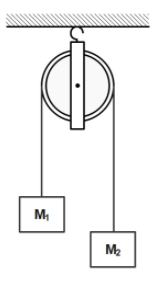
Two masses ${M_1} = 5kg$ and ${M_2} = 10kg$ are connected at the ends of an inextensible string passing over a frictionless pulley as shown. When the masses are released, then the acceleration of the masses will be:
A. $g$
B. $\dfrac{g}{2}$
C. $\dfrac{g}{3}$
D. $\dfrac{g}{4}$
Answer
 Verified
604.2k+ views
Hint: In the question, they’ve given a mass-pulley system, with masses, ${M_1}$ = 5kg and ${M_2}$ = 10kg. As ${M_2}$ > ${M_1}$ the acceleration of the second mass, ${M_2}$ will be downward while the acceleration of the ${M_1}$ will be upward. One can write the acceleration of the masses, with the help of Newton’s 2nd law. Solving these equations, we can find the acceleration of the masses.
Formula used:
$a = g\dfrac{{\left( {{M_2} - {M_1}} \right)}}{{{M_1} + {M_2}}}$
Complete answer:
The forces acting on the masses are the tension of the string and the weight of the blocks in a downward direction. The free-body diagrams of each of the blocks will be
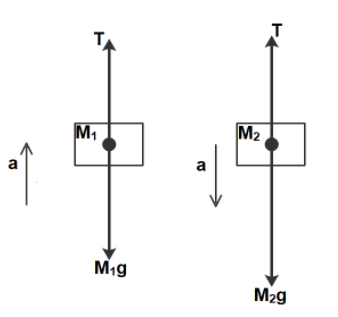
For the block of mass ${M_1}$, the forces acting are weight ${M_1}$g in the downward direction and the tension T in the upward direction. One can see that, ${M_1}$ < ${M_2}$ from the data given in the question. Let us say that ‘$a$’ is the acceleration of the block in an upward direction. According to Newton’s 2nd law, it will be given by
${M_1}a = T - {M_1}g - - > eq.1$
Similarly, for the second mass ‘$a$’ will be the acceleration in the downward direction. Applying the newton’s second law, we’ll have
${M_2}a = {M_2}g - T - - > eq.2$
Adding equation 1 and 2, we get
$\eqalign{
& {M_1}a + {M_2}a = {M_2}g - {M_1}g \cr
& \Rightarrow a = g\dfrac{{\left( {{M_2} - {M_1}} \right)}}{{{M_1} + {M_2}}} \cr} $
Substituting the values of ${M_1}$ = 5kg and ${M_2}$ = 10kg,
$\eqalign{
& a = g\dfrac{{\left( {{M_2} - {M_1}} \right)}}{{{M_1} + {M_2}}} \cr
& \Rightarrow a = g \times \dfrac{{\left( {10 - 5} \right)}}{{10 + 5}} \cr
& \Rightarrow a = g \times \dfrac{5}{{15}} \cr
& \Rightarrow a = \dfrac{g}{3} \cr} $
Therefore, the correct option is C.
Note:
Please note that a single string will only have the same tension all over the string. That is, it will be constant across the string, on either side. The acceleration of the system will be the same for both the masses, as we’re assuming the string to be rigid. Always try to incorporate a free body diagram into problems involving mechanics, as it helps you in understanding the direction of net force and the direction of acceleration.
Formula used:
$a = g\dfrac{{\left( {{M_2} - {M_1}} \right)}}{{{M_1} + {M_2}}}$
Complete answer:
The forces acting on the masses are the tension of the string and the weight of the blocks in a downward direction. The free-body diagrams of each of the blocks will be
For the block of mass ${M_1}$, the forces acting are weight ${M_1}$g in the downward direction and the tension T in the upward direction. One can see that, ${M_1}$ < ${M_2}$ from the data given in the question. Let us say that ‘$a$’ is the acceleration of the block in an upward direction. According to Newton’s 2nd law, it will be given by
${M_1}a = T - {M_1}g - - > eq.1$
Similarly, for the second mass ‘$a$’ will be the acceleration in the downward direction. Applying the newton’s second law, we’ll have
${M_2}a = {M_2}g - T - - > eq.2$
Adding equation 1 and 2, we get
$\eqalign{
& {M_1}a + {M_2}a = {M_2}g - {M_1}g \cr
& \Rightarrow a = g\dfrac{{\left( {{M_2} - {M_1}} \right)}}{{{M_1} + {M_2}}} \cr} $
Substituting the values of ${M_1}$ = 5kg and ${M_2}$ = 10kg,
$\eqalign{
& a = g\dfrac{{\left( {{M_2} - {M_1}} \right)}}{{{M_1} + {M_2}}} \cr
& \Rightarrow a = g \times \dfrac{{\left( {10 - 5} \right)}}{{10 + 5}} \cr
& \Rightarrow a = g \times \dfrac{5}{{15}} \cr
& \Rightarrow a = \dfrac{g}{3} \cr} $
Therefore, the correct option is C.
Note:
Please note that a single string will only have the same tension all over the string. That is, it will be constant across the string, on either side. The acceleration of the system will be the same for both the masses, as we’re assuming the string to be rigid. Always try to incorporate a free body diagram into problems involving mechanics, as it helps you in understanding the direction of net force and the direction of acceleration.
Recently Updated Pages
Master Class 11 Social Science: Engaging Questions & Answers for Success

Master Class 11 English: Engaging Questions & Answers for Success
Master Class 11 Maths: Engaging Questions & Answers for Success
Master Class 11 Chemistry: Engaging Questions & Answers for Success
Master Class 11 Biology: Engaging Questions & Answers for Success
Master Class 11 Physics: Engaging Questions & Answers for Success
Trending doubts
Differentiate between an exothermic and an endothermic class 11 chemistry CBSE
One Metric ton is equal to kg A 10000 B 1000 C 100 class 11 physics CBSE
Difference Between Prokaryotic Cells and Eukaryotic Cells
There are 720 permutations of the digits 1 2 3 4 5 class 11 maths CBSE
Draw a diagram of a plant cell and label at least eight class 11 biology CBSE
Which chemical is known as king of chemicals A H 2 class 11 chemistry CBSE