




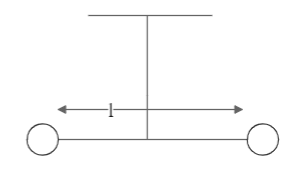
Two masses m and $\dfrac{m}{2}$ are connected at the two ends of a massless rigid rod of length l. The rod is suspended by a thin wire of torsional constant k at the centre of mass of the rod-mass system (see figure). Because of torsional constant k, the restoring torque is $\tau = k\theta $ for angular displacement $\theta $. If the rod is rotated by ${\theta _0}$ and released, the tension in it when it passes through its mean position will be:
(A) $\dfrac{{3k\theta _0^2}}{l}$
(B) $\dfrac{{k\theta _0^2}}{{2l}}$
(C) $\dfrac{{2k\theta _0^2}}{l}$
(D) $\dfrac{{k\theta _0^2}}{l}$
Answer
 Verified
595.5k+ views
Hint
For a two mass system such as this one, the total force would act on the centre of mass of the system. So when a torsion is applied, the tension generated can be found on the centre of the mass.
Formula used: $T = \dfrac{{m{v^2}}}{r}$, where T is the tension generated and is equal to the centrifugal force generated by mass m moving with velocity v, and at a distance of r from the axis.
Complete step by step answer
In this question, we have two unequal masses connected by a rod. The road is then rotated by some angle which causes a restoring torque to appear. This torque will be responsible for generating a tension in the road, and this is what we are required to find out. The information provided to us includes:
Two masses m and $\dfrac{m}{2}$
Torsional constant: k
Restoring torque $\tau = k\theta $
Angular displacement of the rod: ${\theta _0}$
Let us assume the centre of mass of the system is at x distance from the LHS mass. Since the distance between the two masses is l, the distance x from mass $\dfrac{m}{2}$, will be given as:
$x = \dfrac{{\dfrac{m}{2} \times 0 + m \times l}}{{\dfrac{m}{2} + m}} = \dfrac{{2ml}}{{3m}} = \dfrac{{2l}}{3}$
Hence, from the RHS mass m, the distance of the centre of mass will be:
$r = l - \dfrac{{2l}}{3} = \dfrac{l}{3}$
We know that the tension generated in the rod will be equal to the outward centrifugal force, hence:
$T = \dfrac{{m{v^2}}}{r}$
Here, the velocity of rotation is unknown to us. We know the angular displacement, hence along the arc made by r, the velocity will be:
$v = (r{\theta _0})\omega = \dfrac{{l{\theta _0}}}{3}\omega $ where $\omega $ is the frequency of the torsional pendulum created.
We know that this frequency can be given us:
$\omega = \sqrt {\dfrac{k}{I}} $
Where k is the torsional constant and I is the moment of inertia. We calculate this moment of inertia as:
$I = M{l^2}$ where M is the reduced mass of the system and l is the distance between the two.
This reduced mass for our case will be given as:
$M = \dfrac{{\dfrac{m}{2} \times m}}{{\dfrac{m}{2} + m}} = \dfrac{{\dfrac{{{m^2}}}{2}}}{{\dfrac{{3m}}{2}}} = \dfrac{m}{3}$
This gives us the moment of inertia of the rotating system as:
$I = \dfrac{{m{l^2}}}{3}$
Now, putting these values to calculate the tension, we get:
$T = \dfrac{{m{v^2}}}{r} = \dfrac{{m{{\left( {\dfrac{{l{\theta _0}}}{3}\omega } \right)}^2}}}{{\dfrac{l}{3}}}$
On solving further:
$T = m\dfrac{{l{\theta _0}^2}}{3}{\omega ^2}$
Substituting the value of $\omega $ gives us:
$T = m\dfrac{{l{\theta _0}^2k}}{{3I}} = m\dfrac{{l{\theta _0}^2k3}}{{3m{l^2}}} = \dfrac{{{\theta _0}^2k}}{l}$
Hence, the correct answer is option (D).
Note
In this question, the centrifugal force acts on the rod because of its moment of inertia. This inertia along with the force is generated due to the circular motion of the rod, and is directed away from the centre around which the body is rotating which is the centre of the mass.
For a two mass system such as this one, the total force would act on the centre of mass of the system. So when a torsion is applied, the tension generated can be found on the centre of the mass.
Formula used: $T = \dfrac{{m{v^2}}}{r}$, where T is the tension generated and is equal to the centrifugal force generated by mass m moving with velocity v, and at a distance of r from the axis.
Complete step by step answer
In this question, we have two unequal masses connected by a rod. The road is then rotated by some angle which causes a restoring torque to appear. This torque will be responsible for generating a tension in the road, and this is what we are required to find out. The information provided to us includes:
Two masses m and $\dfrac{m}{2}$
Torsional constant: k
Restoring torque $\tau = k\theta $
Angular displacement of the rod: ${\theta _0}$
Let us assume the centre of mass of the system is at x distance from the LHS mass. Since the distance between the two masses is l, the distance x from mass $\dfrac{m}{2}$, will be given as:
$x = \dfrac{{\dfrac{m}{2} \times 0 + m \times l}}{{\dfrac{m}{2} + m}} = \dfrac{{2ml}}{{3m}} = \dfrac{{2l}}{3}$
Hence, from the RHS mass m, the distance of the centre of mass will be:
$r = l - \dfrac{{2l}}{3} = \dfrac{l}{3}$
We know that the tension generated in the rod will be equal to the outward centrifugal force, hence:
$T = \dfrac{{m{v^2}}}{r}$
Here, the velocity of rotation is unknown to us. We know the angular displacement, hence along the arc made by r, the velocity will be:
$v = (r{\theta _0})\omega = \dfrac{{l{\theta _0}}}{3}\omega $ where $\omega $ is the frequency of the torsional pendulum created.
We know that this frequency can be given us:
$\omega = \sqrt {\dfrac{k}{I}} $
Where k is the torsional constant and I is the moment of inertia. We calculate this moment of inertia as:
$I = M{l^2}$ where M is the reduced mass of the system and l is the distance between the two.
This reduced mass for our case will be given as:
$M = \dfrac{{\dfrac{m}{2} \times m}}{{\dfrac{m}{2} + m}} = \dfrac{{\dfrac{{{m^2}}}{2}}}{{\dfrac{{3m}}{2}}} = \dfrac{m}{3}$
This gives us the moment of inertia of the rotating system as:
$I = \dfrac{{m{l^2}}}{3}$
Now, putting these values to calculate the tension, we get:
$T = \dfrac{{m{v^2}}}{r} = \dfrac{{m{{\left( {\dfrac{{l{\theta _0}}}{3}\omega } \right)}^2}}}{{\dfrac{l}{3}}}$
On solving further:
$T = m\dfrac{{l{\theta _0}^2}}{3}{\omega ^2}$
Substituting the value of $\omega $ gives us:
$T = m\dfrac{{l{\theta _0}^2k}}{{3I}} = m\dfrac{{l{\theta _0}^2k3}}{{3m{l^2}}} = \dfrac{{{\theta _0}^2k}}{l}$
Hence, the correct answer is option (D).
Note
In this question, the centrifugal force acts on the rod because of its moment of inertia. This inertia along with the force is generated due to the circular motion of the rod, and is directed away from the centre around which the body is rotating which is the centre of the mass.
Recently Updated Pages
Master Class 11 Social Science: Engaging Questions & Answers for Success

Master Class 11 Physics: Engaging Questions & Answers for Success
Master Class 11 Maths: Engaging Questions & Answers for Success
Master Class 11 Economics: Engaging Questions & Answers for Success
Master Class 11 Computer Science: Engaging Questions & Answers for Success
Master Class 11 Chemistry: Engaging Questions & Answers for Success
Trending doubts
One Metric ton is equal to kg A 10000 B 1000 C 100 class 11 physics CBSE
There are 720 permutations of the digits 1 2 3 4 5 class 11 maths CBSE
1 Quintal is equal to a 110 kg b 10 kg c 100kg d 1000 class 11 physics CBSE
State and prove Bernoullis theorem class 11 physics CBSE
Difference Between Prokaryotic Cells and Eukaryotic Cells
Which among the following are examples of coming together class 11 social science CBSE