




Two loudspeakers $ M $ and $ N $ are located $ 20m $ apart and emit sound at frequencies $ 118\;Hz $ and $ 121\;Hz $ respectively. A car is initially at a point $ P,\;1800\;m $ away from the midpoint $ Q $ of the line $ MN $ and moves towards Q constantly at $ 60km{h^{ - 1}} $ along perpendicular bisector of $ MN $ . It crosses $ Q $ and eventually reaches a point $ R,1800 $ away from $ Q $ . Let $ \nu \left( t \right)\; $ represent the beat frequency measured by a person sitting in the car at time $ t $ . Let $ {v_P} $ , $ {v_Q} $ and $ {v_R} $ be the beat frequencies measured at locations $ P,Q,R\; $ respectively. The speed of sound in air is $ 300m{s^{ - 1}} $ . Which of the following statement (s) is (are) true regarding the sound heard by the person?
(A) A plot below represents schematically the variation of beat frequency with time
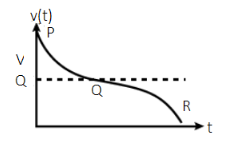
(B) The rate of change in beat frequency is maximum when the car reaches point $ Q $ .
(C) $ {v_P} + {v_R} = 2{v_Q} $
(D) The plot below shows the variation for beat frequency with time.
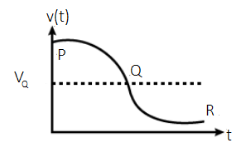
Answer
 Verified
561.6k+ views
Hint :In order to solve this question, we are first going to consider all the information given, then after finding the apparent frequencies of the loudspeakers at the distance $ P $ and $ Q $ , we get the idea of the relation of the frequencies at different points and also the point where the frequency is maximum.
Complete Step By Step Answer:
Here, we are given with the two loudspeakers, $ M $ and $ N $
Distance between them is, $ d = 20m $
Frequency by loudspeaker $ M $ , $ {\nu _M} = 118Hz $
Frequency for loudspeaker $ N $ , $ {\nu _N} = 121Hz $
Now the point $ P,\;1800\;m $ away from the midpoint $ Q $ of the line $ MN $ ,
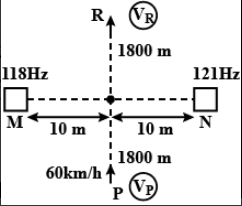
Thus, apparent frequency of $ M $ and $ N $ at $ P $ is:
$ {\nu _M}' = \dfrac{{v + {v_0}}}{v}{\nu _M} $ ,putting the values of the velocities in this equation, we get
$ {\nu _M}' = \dfrac{{330 + \dfrac{{50}}{3}}}{{330}} \times 118 \\
\Rightarrow {\nu _M}' = \dfrac{{1040}}{{990}}118 \\ $
Also, $ {\nu _N}' = \dfrac{{v + {v_0}}}{v}{\nu _N} $
Putting the values in this equation,
$ {\nu _N}' = \dfrac{{330 + \dfrac{{50}}{3}}}{{330}} \times 121 \\
\Rightarrow {\nu _N}' = \dfrac{{1040}}{{990}}121 \\ $
Thus, frequency at $ P $ is
$ {\nu _P} = {\nu _M}' - {\nu _N}' = \dfrac{{1040}}{{330}}Hz $
Thus, apparent frequency of $ M $ and $ N $ at $ R $ is:
$ {\nu _M}' = \dfrac{{v - {v_0}}}{v}{\nu _M} $
Putting the values, we get
$ {\nu _M}' = \dfrac{{330 - \dfrac{{50}}{3}}}{{330}} \times 118 \\
\Rightarrow {\nu _M}' = \dfrac{{940}}{{990}}118 \\ $
Also, $ {\nu _N}' = \dfrac{{v - {v_0}}}{v}{\nu _N} $ ,
Putting values, we get
$ {\nu _N}' = \dfrac{{330 - \dfrac{{50}}{3}}}{{330}} \times 121 \\
\Rightarrow {\nu _N}' = \dfrac{{940}}{{990}}121 \\ $
Thus, apparent frequency is
$ {\nu _R} = {\nu _N}' - {\nu _M}' = \dfrac{{940}}{{330}}Hz $
Now, beat frequency at $ Q $ is calculated as
$ {v_Q} = 121 - 118 = 3Hz $
Now, if we check option (C),
$ {v_P} + {v_R} = 2{\nu _Q} \\
6 = 2 \times 3 \\ $
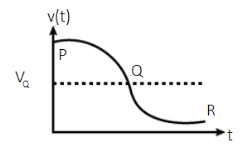
Also, $ \dfrac{{d\nu }}{{dt}} $ is maximum at $ Q $ ,
Hence, the correct options are (B),(C),(D), i.e.,
The rate of change in beat frequency is maximum when the car reaches point $ Q $ .
$ {v_P} + {v_R} = 2{v_Q} $
The plot below shows the variation for beat frequency with time.
Note :
It is important to note that at the point of maximum rate of change of frequency, the double derivative is zero thus, indicating that the point is a maxima point. Also the apparent frequencies at the points at larger distances is less as compared to those points which are nearer.
Complete Step By Step Answer:
Here, we are given with the two loudspeakers, $ M $ and $ N $
Distance between them is, $ d = 20m $
Frequency by loudspeaker $ M $ , $ {\nu _M} = 118Hz $
Frequency for loudspeaker $ N $ , $ {\nu _N} = 121Hz $
Now the point $ P,\;1800\;m $ away from the midpoint $ Q $ of the line $ MN $ ,
Thus, apparent frequency of $ M $ and $ N $ at $ P $ is:
$ {\nu _M}' = \dfrac{{v + {v_0}}}{v}{\nu _M} $ ,putting the values of the velocities in this equation, we get
$ {\nu _M}' = \dfrac{{330 + \dfrac{{50}}{3}}}{{330}} \times 118 \\
\Rightarrow {\nu _M}' = \dfrac{{1040}}{{990}}118 \\ $
Also, $ {\nu _N}' = \dfrac{{v + {v_0}}}{v}{\nu _N} $
Putting the values in this equation,
$ {\nu _N}' = \dfrac{{330 + \dfrac{{50}}{3}}}{{330}} \times 121 \\
\Rightarrow {\nu _N}' = \dfrac{{1040}}{{990}}121 \\ $
Thus, frequency at $ P $ is
$ {\nu _P} = {\nu _M}' - {\nu _N}' = \dfrac{{1040}}{{330}}Hz $
Thus, apparent frequency of $ M $ and $ N $ at $ R $ is:
$ {\nu _M}' = \dfrac{{v - {v_0}}}{v}{\nu _M} $
Putting the values, we get
$ {\nu _M}' = \dfrac{{330 - \dfrac{{50}}{3}}}{{330}} \times 118 \\
\Rightarrow {\nu _M}' = \dfrac{{940}}{{990}}118 \\ $
Also, $ {\nu _N}' = \dfrac{{v - {v_0}}}{v}{\nu _N} $ ,
Putting values, we get
$ {\nu _N}' = \dfrac{{330 - \dfrac{{50}}{3}}}{{330}} \times 121 \\
\Rightarrow {\nu _N}' = \dfrac{{940}}{{990}}121 \\ $
Thus, apparent frequency is
$ {\nu _R} = {\nu _N}' - {\nu _M}' = \dfrac{{940}}{{330}}Hz $
Now, beat frequency at $ Q $ is calculated as
$ {v_Q} = 121 - 118 = 3Hz $
Now, if we check option (C),
$ {v_P} + {v_R} = 2{\nu _Q} \\
6 = 2 \times 3 \\ $
Also, $ \dfrac{{d\nu }}{{dt}} $ is maximum at $ Q $ ,
Hence, the correct options are (B),(C),(D), i.e.,
The rate of change in beat frequency is maximum when the car reaches point $ Q $ .
$ {v_P} + {v_R} = 2{v_Q} $
The plot below shows the variation for beat frequency with time.
Note :
It is important to note that at the point of maximum rate of change of frequency, the double derivative is zero thus, indicating that the point is a maxima point. Also the apparent frequencies at the points at larger distances is less as compared to those points which are nearer.
Recently Updated Pages
Master Class 11 Social Science: Engaging Questions & Answers for Success

Master Class 11 Chemistry: Engaging Questions & Answers for Success
Master Class 12 Business Studies: Engaging Questions & Answers for Success
Master Class 12 Chemistry: Engaging Questions & Answers for Success
Master Class 12 Biology: Engaging Questions & Answers for Success
Class 12 Question and Answer - Your Ultimate Solutions Guide
Trending doubts
One Metric ton is equal to kg A 10000 B 1000 C 100 class 11 physics CBSE
Difference Between Prokaryotic Cells and Eukaryotic Cells
Two of the body parts which do not appear in MRI are class 11 biology CBSE
Explain zero factorial class 11 maths CBSE
10 examples of friction in our daily life
Name the Largest and the Smallest Cell in the Human Body ?