




Two large parallel plates are located in vacuum. One of them serves as a cathode, a source of electrons whose initial velocity is negligible. An electron flow directed toward the opposite plates produce a space charge causing the potential in the gap between the plates to vary as \[V = a{x^{\dfrac{4}{3}}}.\] where, a is a positive constant and $x$ is the distance from the cathode.
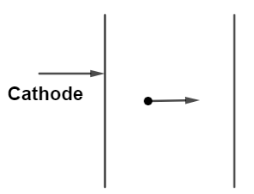
The electric field between the plates as a function of $x$ is:
A. $E = a{x^{\dfrac{1}{3}}}$
B. $E = - a{x^{\dfrac{2}{3}}}$
C. $E = \dfrac{{ - 4a}}{3}{x^{\dfrac{1}{3}}}$
D. None
Answer
 Verified
515.1k+ views
Hint: In order to solve this question, we should know about electric potential and electric field. Electric potential is the amount of work done while moving a unit test charge from one point to another and electric field is the field around a charge where any other electric charge can experience electric force. Here, we will use the general relation between electric potential and electric field to calculate the electric field as a function of x between the plates.
Formula used:
If $V$ is the electric potential as a function of variable $x$ written as $V(x)$ in the region of space, then electric field in that region is calculated as,
$E(x) = - \dfrac{{dV(x)}}{{dx}}$
Which is the derivative of potential function with respect to variable $x$.
Complete step by step answer:
According to the question, we have simply given that, the potential between the plates as a function of variable $x$.
\[V = a{x^{\dfrac{4}{3}}}\]
Now, in order to find electric field in this region we use the formula as,
$E(x) = - \dfrac{{dV(x)}}{{dx}}$
Where, \[V(x) = a{x^{\dfrac{4}{3}}}\].
Finding the derivative as
$E(x) = - \dfrac{{d(a{x^{\dfrac{4}{3}}})}}{{dx}}$
As we know, a is a constant so it will not be differentiated and $\dfrac{d}{{dx}}({x^n}) = n{x^{n - 1}}$ so,
$E(x) = - a\dfrac{{d({x^{\dfrac{4}{3}}})}}{{dx}}$
$\Rightarrow E(x) = - a\dfrac{4}{3}{x^{\dfrac{1}{3}}}$
$\therefore E(x) = \dfrac{{ - 4a}}{3}{x^{\dfrac{1}{3}}}$
Hence, the correct option is C.
Note: It should be remembered that, in the electric potential and electric field relation $E(x) = - \dfrac{{dV(x)}}{{dx}}$ the negative sign indicates that in the direction of away from the source of electric field in the region the electric potential keeps on decreasing so always keep in mind this negative sign while solving such questions.
Formula used:
If $V$ is the electric potential as a function of variable $x$ written as $V(x)$ in the region of space, then electric field in that region is calculated as,
$E(x) = - \dfrac{{dV(x)}}{{dx}}$
Which is the derivative of potential function with respect to variable $x$.
Complete step by step answer:
According to the question, we have simply given that, the potential between the plates as a function of variable $x$.
\[V = a{x^{\dfrac{4}{3}}}\]
Now, in order to find electric field in this region we use the formula as,
$E(x) = - \dfrac{{dV(x)}}{{dx}}$
Where, \[V(x) = a{x^{\dfrac{4}{3}}}\].
Finding the derivative as
$E(x) = - \dfrac{{d(a{x^{\dfrac{4}{3}}})}}{{dx}}$
As we know, a is a constant so it will not be differentiated and $\dfrac{d}{{dx}}({x^n}) = n{x^{n - 1}}$ so,
$E(x) = - a\dfrac{{d({x^{\dfrac{4}{3}}})}}{{dx}}$
$\Rightarrow E(x) = - a\dfrac{4}{3}{x^{\dfrac{1}{3}}}$
$\therefore E(x) = \dfrac{{ - 4a}}{3}{x^{\dfrac{1}{3}}}$
Hence, the correct option is C.
Note: It should be remembered that, in the electric potential and electric field relation $E(x) = - \dfrac{{dV(x)}}{{dx}}$ the negative sign indicates that in the direction of away from the source of electric field in the region the electric potential keeps on decreasing so always keep in mind this negative sign while solving such questions.
Recently Updated Pages
Basicity of sulphurous acid and sulphuric acid are

Master Class 12 English: Engaging Questions & Answers for Success
Master Class 12 Social Science: Engaging Questions & Answers for Success
Master Class 12 Maths: Engaging Questions & Answers for Success
Master Class 12 Economics: Engaging Questions & Answers for Success
Master Class 12 Physics: Engaging Questions & Answers for Success
Trending doubts
Draw ray diagrams each showing i myopic eye and ii class 12 physics CBSE
Giving reasons state the signs positive or negative class 12 physics CBSE
Explain esterification reaction with the help of a class 12 chemistry CBSE
What is defined as a solenoid Depict a diagram with class 12 physics CBSE
Explain sex determination in humans with line diag class 12 biology CBSE
Organisms of a higher trophic level which feed on several class 12 biology CBSE