




Two lamp posts are 60 meters apart, and the height of the one is double that of the other. From the middle of the line joining their feet, an observer finds the angular elevation of their top to be complimentary. Find the height of each lamp.
$
(a){\text{ 52}}{\text{.63 m; 85}}{\text{.22 m}} \\
(b){\text{ 46}}{\text{.53 m; 71}}{\text{.39 m}} \\
(c){\text{ 20}}{\text{.63 m; 22}}{\text{.32 m}} \\
(d){\text{ 21}}{\text{.21 m; 42}}{\text{.42 m}} \\
$
Answer
 Verified
626.1k+ views
Hint: In this height and distance problem the distance between two lamps is given and the relation between the heights of two lamps is also given. Now it is given that an observer finds the angular elevation of their top to be complimentary. Thus using the definition of complementary angles if one angle is $\theta$ then the other must be $90-\theta$ as the sum of complementary angles Is 90. Use this concept to get the answer.
Complete step-by-step answer:
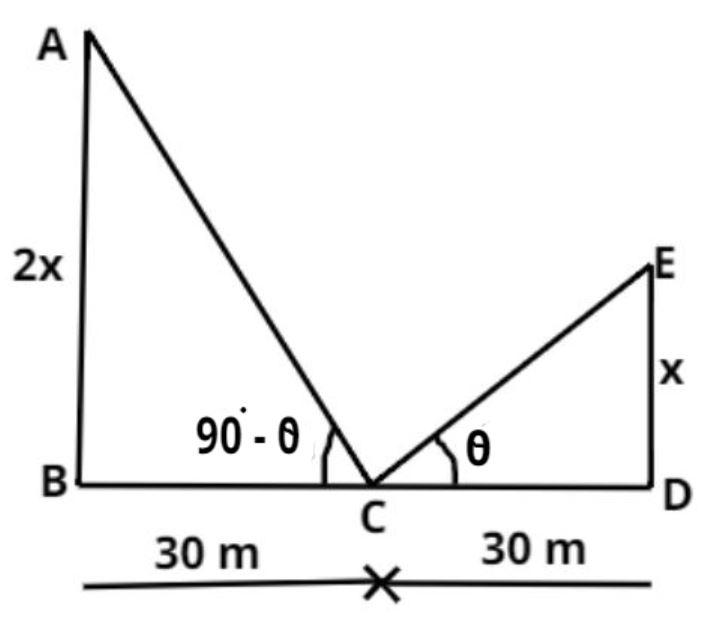
It is given that the length of one lamp post is double to another.
So, let the length of one lamp post be 2x m (see figure).
And the length of the other lamp post is x m (see figure), which satisfies the condition.
Now it is given that the observer is at the middle of the line joining the feet (say at C).
And it is given that two lamp posts are 60 meters apart.
$ \Rightarrow BC = CD = \dfrac{{BD}}{2} = \dfrac{{60}}{2} = 30{\text{ m}}$ (See figure).
Now it is also given the angular elevation of their top to be complementary.
I.e. $\angle BCA + \angle DCE = {90^ \circ }$.
Let angle $\angle DCE = \theta $
Therefore $\angle BCA = {90^ \circ } - \theta $
Now in triangle ABC
$\tan \left( {{{90}^ \circ } - \theta } \right) = \dfrac{{{\text{Perpendicular}}}}{{{\text{base}}}} = \dfrac{{2x}}{{30}}$
As we know $\tan \left( {{{90}^ \circ } - \theta } \right) = \cot \theta $ so, apply this property then we have,
$ \Rightarrow \cot \theta = \dfrac{{2x}}{{30}}$
Now as we know $\cot \theta = \dfrac{1}{{\tan \theta }}$ so, apply this property then we have,
$ \Rightarrow \tan \theta = \dfrac{{30}}{{2x}}$ …………….. (1)
Now in triangle DCE
$\tan \theta = \dfrac{{{\text{Perpendicular}}}}{{{\text{base}}}} = \dfrac{x}{{30}}$
$ \Rightarrow \tan \theta = \dfrac{x}{{30}}$ ………………………….. (2)
Now in equation (1) and (2) L.H.S is the same, therefore R.H.S also should be the same.
So, equate R.H.S then we have,
$ \Rightarrow \dfrac{x}{{30}} = \dfrac{{30}}{{2x}}$
Now simplify this equation then we have,
$ \Rightarrow 2{x^2} = 900$
Now divide by 2 and take square root then we have,
$
\Rightarrow {x^2} = \dfrac{{900}}{2} = 450 \\
\Rightarrow x = \sqrt {450} = 21.21{\text{ m}} \\
$
So the height of second lamp post is $2x = 2 \times 21.21 = 42.42{\text{ m}}$
Hence option (d) is correct.
Note: Whenever we face such types of problems the key concept here is to use the basic trigonometric ratios in the specific triangles. The diagrammatic representation of the data provided in the question helps in better understanding of geometry and thus helping you through to get the right answer.
Complete step-by-step answer:
It is given that the length of one lamp post is double to another.
So, let the length of one lamp post be 2x m (see figure).
And the length of the other lamp post is x m (see figure), which satisfies the condition.
Now it is given that the observer is at the middle of the line joining the feet (say at C).
And it is given that two lamp posts are 60 meters apart.
$ \Rightarrow BC = CD = \dfrac{{BD}}{2} = \dfrac{{60}}{2} = 30{\text{ m}}$ (See figure).
Now it is also given the angular elevation of their top to be complementary.
I.e. $\angle BCA + \angle DCE = {90^ \circ }$.
Let angle $\angle DCE = \theta $
Therefore $\angle BCA = {90^ \circ } - \theta $
Now in triangle ABC
$\tan \left( {{{90}^ \circ } - \theta } \right) = \dfrac{{{\text{Perpendicular}}}}{{{\text{base}}}} = \dfrac{{2x}}{{30}}$
As we know $\tan \left( {{{90}^ \circ } - \theta } \right) = \cot \theta $ so, apply this property then we have,
$ \Rightarrow \cot \theta = \dfrac{{2x}}{{30}}$
Now as we know $\cot \theta = \dfrac{1}{{\tan \theta }}$ so, apply this property then we have,
$ \Rightarrow \tan \theta = \dfrac{{30}}{{2x}}$ …………….. (1)
Now in triangle DCE
$\tan \theta = \dfrac{{{\text{Perpendicular}}}}{{{\text{base}}}} = \dfrac{x}{{30}}$
$ \Rightarrow \tan \theta = \dfrac{x}{{30}}$ ………………………….. (2)
Now in equation (1) and (2) L.H.S is the same, therefore R.H.S also should be the same.
So, equate R.H.S then we have,
$ \Rightarrow \dfrac{x}{{30}} = \dfrac{{30}}{{2x}}$
Now simplify this equation then we have,
$ \Rightarrow 2{x^2} = 900$
Now divide by 2 and take square root then we have,
$
\Rightarrow {x^2} = \dfrac{{900}}{2} = 450 \\
\Rightarrow x = \sqrt {450} = 21.21{\text{ m}} \\
$
So the height of second lamp post is $2x = 2 \times 21.21 = 42.42{\text{ m}}$
Hence option (d) is correct.
Note: Whenever we face such types of problems the key concept here is to use the basic trigonometric ratios in the specific triangles. The diagrammatic representation of the data provided in the question helps in better understanding of geometry and thus helping you through to get the right answer.
Recently Updated Pages
Master Class 10 English: Engaging Questions & Answers for Success

Master Class 10 Social Science: Engaging Questions & Answers for Success
Master Class 10 Computer Science: Engaging Questions & Answers for Success
Class 10 Question and Answer - Your Ultimate Solutions Guide
Master Class 10 General Knowledge: Engaging Questions & Answers for Success
Master Class 10 Maths: Engaging Questions & Answers for Success
Trending doubts
A boat goes 24 km upstream and 28 km downstream in class 10 maths CBSE
State and explain Ohms law class 10 physics CBSE
Distinguish between soap and detergent class 10 chemistry CBSE
a Why did Mendel choose pea plants for his experiments class 10 biology CBSE
What is a "free hit" awarded for in limited-overs cricket?
Draw the diagram of the sectional view of the human class 10 biology CBSE